

RADAR TULUNGAGUNG – The story of the G30S PKI remains one of the most controversial chapters in Indonesia’s history. More than five decades later, key questions still remain. Who planned the events of September 30, 1965? What were their true goals?
In the early hours of October 1, 1965, a group of soldiers led by Untung Samsuri launched a coordinated operation. They targeted top Indonesian Army generals. The group kidnapped and killed several high-ranking officers. This event caused national chaos and marked the beginning of a major political shift in Indonesia.
Many people link the incident to the Partai Komunis Indonesia (PKI). At the time, it was one of the largest communist parties in the world. However, historians still debate how deeply the PKI was involved.
Understanding the Ideological Conflict
To understand the G30S PKI, we must examine the ideological clash in Indonesia at the time. The conflict centered on Pancasila and communism.
Pancasila promotes belief in God, national unity, democracy through deliberation, and social justice. In contrast, communist ideology, inspired by Karl Marx, emphasizes class equality and rejects private ownership. It often separates religion from government.
This ideological divide created strong tensions in Indonesia. The PKI grew rapidly in the 1950s under the leadership of Dipa Nusantara Aidit. In the 1955 election, the party became a major political force and gained significant public support.
Rising Political Tensions
During President Soekarno’s rule, the concept of NASAKOM emerged. It aimed to unite nationalism, religion, and communism. Soekarno used this idea to balance competing forces.
However, many leaders in the Indonesian Army opposed this approach. The Army feared the growing influence of communism.
Tensions increased when the PKI proposed the formation of an “Angkatan Kelima” or Fifth Force. This force would consist of armed workers and peasants. The Army strongly rejected the idea. They believed it could strengthen communist power.
At the same time, rumors spread about a “Council of Generals.” Some claimed this group planned a coup against Soekarno. These claims later became a key reason for the actions on September 30.
The Night of Violence
The operation targeted several top generals, including Ahmad Yani, R. Suprapto, and M.T. Haryono. The attackers killed some generals in their homes. They abducted others and later executed them.
The perpetrators dumped the bodies in a well in an area now known as Lubang Buaya. The brutality shocked the nation and triggered a rapid response from the Army.
Only Abdul Haris Nasution escaped, although his daughter died after being shot during the attack.
Who Was Behind G30S PKI
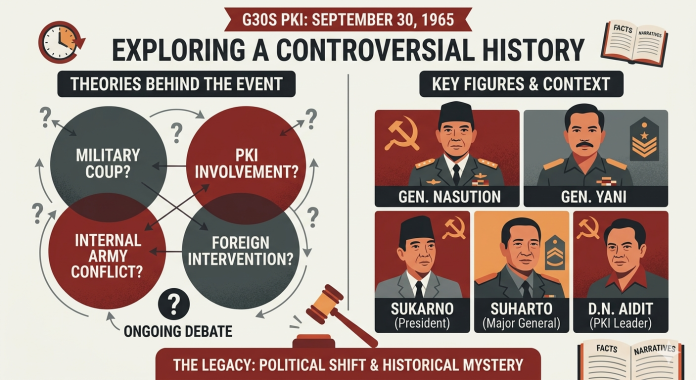
The biggest mystery remains the identity of the mastermind. Several theories have emerged over time.
First, the New Order government under Soeharto blamed the PKI. Officials claimed the party attempted to seize power through violence. This version dominated public narratives for decades.
Second, some historians argue that internal conflict within the Army caused the event. Rival factions may have used the situation to remove opponents and gain power.
Third, some scholars suggest foreign involvement. Historian Peter Dale Scott argued that the United States, through the CIA, may have supported anti-communist forces during the Cold War.
Another theory points to Soekarno. Some believe he anticipated or allowed the situation to weaken military opposition. However, strong evidence for this claim remains limited.
Finally, some researchers argue that multiple factors caused the event. They highlight internal tensions, ideological conflict, and possible foreign influence.
A Lasting Historical Debate
The truth behind the G30S PKI remains unresolved. However, the event clearly changed Indonesia’s history. It led to mass anti-communist purges and the rise of Soeharto to power.
Today, interpretations continue to evolve. Since the Reformasi era, scholars have re-examined earlier narratives. Many now see the tragedy as complex and multi-layered.
The G30S PKI is no longer viewed as a simple conflict between good and evil. Instead, it reflects political ambition, ideological struggle, and global tensions.