

RADAR TULUNGAGUNG – Nusakambangan Prison Island, long known as Indonesia’s most heavily guarded prison complex, holds a history that stretches far beyond crime and punishment. For more than a century, the island off the southern coast of Java has witnessed colonial rule, war, political upheaval, and the evolution of Indonesia’s modern correctional system, making it one of the country’s most significant historical sites.
Often called “Indonesia’s Alcatraz,” Nusakambangan has served as a place of confinement since the Dutch colonial era. Its natural isolation, dense forests, and rough Indian Ocean coastline made it an ideal location for a penal colony, a role it continues to play today.
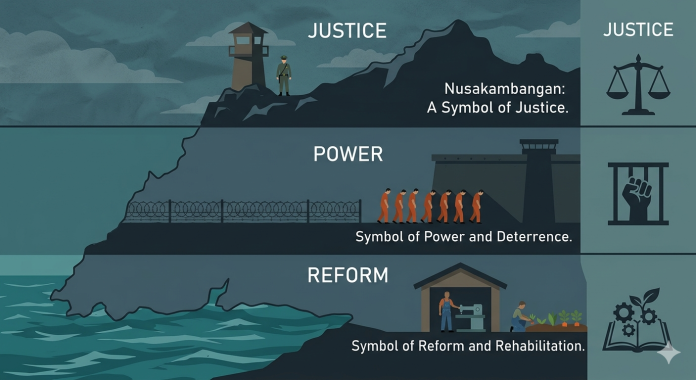
The island’s story reflects Indonesia’s broader struggle with justice, state power, and rehabilitation. While it remains synonymous with maximum-security prisons and death-row inmates, Nusakambangan also preserves a complex legacy involving political prisoners, independence fighters, and efforts at prisoner rehabilitation.
Colonial Origins of Nusakambangan Prison Island
Located near Cilacap in Central Java, Nusakambangan stretches roughly 36 kilometers from west to east and is separated from Java by the Segara Anakan lagoon. Before colonial intervention, the island was sparsely inhabited by local communities who depended on fishing, farming, and forest resources.
Dutch colonial authorities began utilizing the island in the late 19th century. Historical records indicate that convict labor was used during the construction of defensive fortifications around 1861, marking the beginning of Nusakambangan’s association with punishment and exile.
The Dutch formally developed Nusakambangan as a penal colony in the early 20th century. The first major prison facility, Permisan Prison, opened in 1908. Colonial officials considered the island’s geography a natural barrier against escape, with dense forests, coastal cliffs, and surrounding waters creating formidable obstacles.
Over subsequent decades, additional prisons were constructed, including Batu Prison in 1925 and Besi Prison in 1929. During the colonial era, prisoners often performed forced labor in forestry, agriculture, and infrastructure projects. Thousands of inmates, including political detainees and prisoners of war, passed through the island’s prison camps.
From Independence to Political Detention
Following Indonesia’s independence in 1945, the newly formed republic retained Nusakambangan as a national correctional center. Dutch-built prison facilities remained in operation, although they came under Indonesian administration.
The island became intertwined with several major chapters of Indonesian history. During the turbulent years after independence, authorities used Nusakambangan to detain various groups considered threats to state security.
Its role expanded dramatically after the political upheaval of 1965. Following the events surrounding the September 30 Movement (G30S), large numbers of alleged communist sympathizers and political detainees were imprisoned across Indonesia, including at Nusakambangan. Human rights organizations and historians have since documented the widespread detention of individuals without formal trials during this period.
For many survivors, the island became a symbol of political repression during the New Order era. Yet it also became a place where prisoners forged solidarity and sought to preserve dignity under difficult conditions.
Modern Correctional System and Continuing Legacy
Today, Nusakambangan remains the centerpiece of Indonesia’s high-security correctional network. The island hosts multiple correctional facilities with different security classifications, including medium-security, maximum-security, and super-maximum-security institutions.
Facilities such as Permisan, Kembang Kuning, Batu, and Besi prisons continue to operate, while newer institutions have expanded the island’s role as a national correctional hub. Prisoners include convicted terrorists, drug traffickers, murderers, corruption offenders, and other high-risk inmates.
Modern correctional policies emphasize rehabilitation alongside security. Inmates participate in vocational training programs that include agriculture, carpentry, handicrafts, batik production, and other skills designed to support reintegration into society. Indonesian correctional reforms increasingly focus on rehabilitation rather than punishment alone.
Despite these changes, Nusakambangan continues to evoke strong public emotions. Its association with death-row facilities and high-profile executions has kept the island in international headlines for decades.
More than a prison complex, however, Nusakambangan remains a living historical landscape. From colonial penal policies and wartime occupation to political imprisonment and modern rehabilitation efforts, the island reflects Indonesia’s long and often difficult journey in defining justice, freedom, and human dignity.