
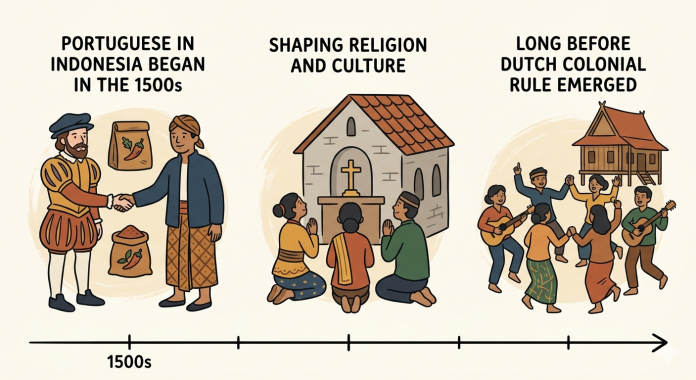

RADAR TULUNGAGUNG – The history of Portuguese in Indonesia began nearly a century before Dutch traders established a foothold in the archipelago. Driven by the lucrative spice trade, Portuguese explorers reached Southeast Asia in the early 16th century and forged political, commercial, and religious connections that continue to influence parts of modern Indonesia.
Many people associate European colonialism in Indonesia with Dutch rule. However, Portugal became the first European power to establish a lasting presence in several parts of the archipelago. Although Portuguese influence never matched the territorial reach later achieved by the Dutch, Portugal played a crucial role in shaping the early history of European involvement in the region.
The Portuguese presence peaked in the spice-producing islands of eastern Indonesia, where local kingdoms competed for influence and control of valuable trade routes.
Portugal’s Seizure of Malacca Opened the Door to the Spice Islands
Portugal’s expansion into Southeast Asia accelerated after Portuguese navigator Diogo Lopes de Sequeira arrived in Malacca in 1509. At the time, Malacca stood as one of Asia’s busiest trading centers, attracting merchants from across the Middle East, India, China, and the Indonesian archipelago.
Two years later, Admiral Afonso de Albuquerque led Portuguese forces in the conquest of Malacca. The victory gave Portugal control of a strategic commercial gateway and strengthened its access to the highly profitable spice trade.
After securing Malacca, Portuguese expeditions sailed east through Sumatra, Java, Bali, Lombok, Sumbawa, Flores, and eventually the Maluku Islands. In 1512, Portuguese traders reached Ternate, where local rulers initially welcomed them as trading partners and military allies.
Portuguese merchants sought direct access to cloves, nutmeg, and mace, commodities that commanded extremely high prices in European markets. Their arrival transformed regional trade networks and intensified competition among local kingdoms.
Rivalry Between Portugal and Spain Reshaped Maluku’s Political Landscape
European competition soon extended beyond trade. In 1521, Spanish expeditions reached Maluku and established relations with Tidore, a rival of Ternate. Portugal supported Ternate, while Spain backed Tidore, creating a broader international dimension to existing regional rivalries.
To settle competing territorial claims, Portugal and Spain signed the Treaty of Zaragoza in 1529. Under the agreement, Spain withdrew from the Maluku Islands and focused its activities on the Philippines, while Portugal maintained its influence in the spice-producing region.
Portugal strengthened its position by constructing forts and trading posts across Maluku. The Portuguese built Fort São João Baptista in Ternate in 1522, creating one of their most important strongholds in Southeast Asia.
However, Portuguese authorities often imposed restrictive trade policies that angered local rulers and merchants. Many communities opposed efforts to monopolize the spice trade, particularly when Portuguese officials fixed prices below market value.
Portugal also attempted to expand its influence in western Java. In 1522, representatives of Portugal and the Sunda Kingdom signed an agreement that aimed to strengthen political and military cooperation. The arrangement alarmed the Demak Sultanate, which sought greater influence along Java’s northern coast.
Demak forces captured Sunda Kelapa in 1527 and drove out Portuguese interests from the area. The city later became known as Jayakarta, the predecessor of modern Jakarta.
Portuguese Influence Still Survives in Religion, Language, and Culture
The arrival of Dutch forces in the early 17th century gradually reduced Portuguese power across the archipelago. In 1605, Dutch troops captured the Portuguese fortress in Ambon, marking a major shift in control of the regional spice trade.
Although Portugal lost most of its political influence, many aspects of Portuguese culture survived. Catholic missionaries introduced Christianity to several parts of eastern Indonesia, particularly Flores, Timor, and parts of Maluku. Today, large Catholic communities remain in those regions.
Portuguese influence also appears in architecture, family names, language, and music. Surnames such as Da Costa, Dias, De Fretes, and Gonzalves still exist among communities with Portuguese ancestry.
In North Jakarta, Kampung Tugu preserves part of that heritage through descendants of Portuguese-speaking communities who settled during the colonial era. Historians also link Portuguese cultural influence to the development of keroncong music, one of Indonesia’s best-known traditional musical styles.
Several Indonesian words entered local languages through Portuguese contact, reflecting centuries of cultural exchange between European traders and indigenous communities.
Although Portugal controlled fewer territories and ruled for a shorter period than the Dutch, its legacy remains visible throughout Indonesia. From Catholic traditions in eastern Indonesia to linguistic and cultural influences that endure today, the story of Portuguese in Indonesia continues to occupy an important place in the nation’s history.