
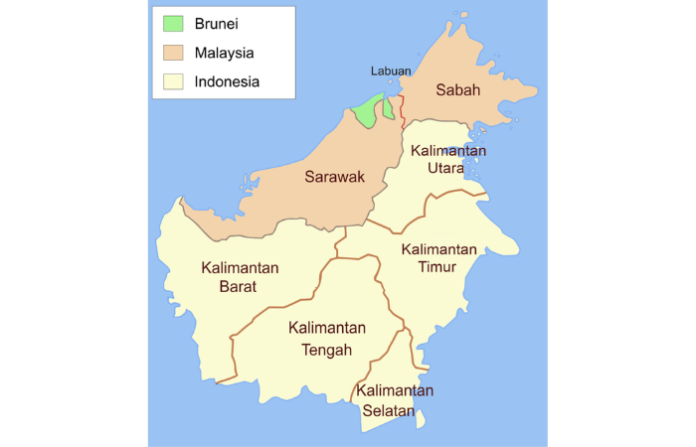

RADAR TULUNGAGUNG – Borneo, the world’s only island governed by three sovereign nations, remains one of the most unique geopolitical regions on Earth. Shared by Indonesia, Malaysia, and Brunei, the island’s modern borders are the result of centuries of indigenous kingdoms, colonial rivalry, and post-war independence movements that reshaped Southeast Asia.
Known as Kalimantan in Indonesia, Borneo is the third-largest island in the world, covering approximately 748,168 square kilometers. Today, around 73% of the island belongs to Indonesia, while Malaysia controls the states of Sabah and Sarawak in the north, and Brunei occupies a small portion of the northern coast. No other major island in the world shares sovereignty among three independent countries
The story behind Borneo’s political division stretches back thousands of years and reflects the region’s rich history of trade, empire-building, and colonial competition.
The Historical Roots of Borneo’s Three-Nation Division
Archaeological evidence suggests humans have inhabited Borneo for tens of thousands of years. The island later became a crossroads for maritime trade linking China, India, and the wider Southeast Asian region.
Among the earliest known states on the island was the Hindu kingdom of Kutai, established in eastern Borneo around the fourth century CE. Over subsequent centuries, various kingdoms and sultanates emerged across the island, including the powerful Brunei Sultanate, which reached its peak between the 15th and 17th centuries.
During this period, Brunei exerted influence over large parts of northern Borneo and controlled important regional trade routes. European powers eventually arrived in Southeast Asia, with the Portuguese visiting the region in the 16th century, followed by Spanish expeditions. However, neither power succeeded in establishing lasting control over the island.
By the 17th and 18th centuries, British and Dutch interests increasingly expanded into Borneo, setting the stage for the island’s eventual political fragmentation.
Colonial Rivalry Shaped Modern Borders
A major turning point came in 1841 when British adventurer and administrator James Brooke was granted control of Sarawak by the Sultan of Brunei after helping suppress a local rebellion. Brooke established the White Rajah dynasty, which ruled Sarawak for more than a century.
As British influence expanded in northern Borneo, Brunei’s territorial control steadily diminished. In 1888, Brunei became a British protectorate, retaining internal autonomy while Britain assumed responsibility for its external defense and foreign affairs.
Meanwhile, the Dutch consolidated their influence across southern and central Borneo through the Dutch East Indies. To avoid conflict, Britain and the Netherlands negotiated agreements that effectively divided the island into northern and southern spheres of influence.
The resulting colonial boundaries would later become the foundation of the modern borders separating Indonesia, Malaysia, and Brunei. Historians widely regard these agreements as crucial in shaping Borneo’s contemporary political geography.
Independence Movements Created Three Separate States
The end of World War II transformed Southeast Asia and accelerated decolonization across the region. Following Japan’s defeat, nationalist movements gained momentum throughout Borneo.
In the south, sovereignty was transferred from the Netherlands to Indonesia in 1949, and the territory became part of the newly independent Republic of Indonesia. The Indonesian portion of the island is now collectively known as Kalimantan.
In northern Borneo, Sarawak and North Borneo, later renamed Sabah, became British Crown Colonies before joining the newly formed Federation of Malaysia in 1963. The federation also initially included Singapore, which separated and became an independent nation in 1965.
Brunei chose a different path. Although invited to join Malaysia, the sultanate remained under British protection and eventually achieved full independence on January 1, 1984.
Today, Borneo is home to more than 23 million people and some of the planet’s oldest tropical rainforests, estimated to be around 140 million years old. The island’s remarkable biodiversity and multicultural population continue to make it one of Southeast Asia’s most significant regions.
The division of Borneo among Indonesia, Malaysia, and Brunei was not the result of a single event but centuries of political change, colonial expansion, and national independence movements. That complex history explains why Borneo remains the only major island in the world shared by three sovereign nations.