
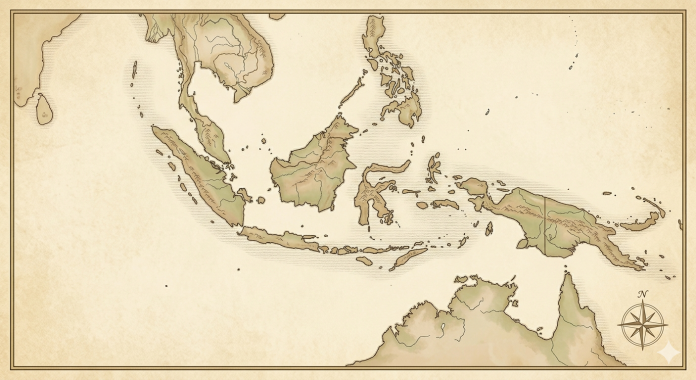

RADAR TULUNGAGUNG – The story of the origin of Indonesia has long intrigued historians and the public alike. From the naming of the archipelago to the formation of its islands and the roots of its people, the narrative reveals a complex and fascinating past. The keyword origin of Indonesia not only reflects national identity but also opens a window into centuries of cultural and geological evolution.
The term “Indonesia” itself was not originally coined by locals. Before independence, the archipelago was known by various names. Chinese sources referred to it as southern sea islands, while Indian texts called it Dwipantara. Arab traders used the term Jazair al-Jawi, and European colonizers labeled it the East Indies. These diverse names reflect the region’s strategic importance in global trade routes.
The Birth of the Name “Indonesia”
The modern term “Indonesia” emerged in the 19th century through academic discourse. British ethnologist George Samuel Windsor Earl initially proposed names like “Indunesia” and “Malayunesia.” However, Scottish scholar James Richardson Logan later popularized the term “Indonesia” in an ilmiah journal around 1850, arguing it was more precise and less confusing than “Hindia,” which often overlapped with India.
The name gained wider recognition after German ethnologist Adolf Bastian used it in his book published in 1884. Eventually, Indonesian nationalists adopted the term as a political identity. Figures like Ki Hajar Dewantara and Dr. Cipto Mangunkusumo used “Indonesia” to unite people across ethnic and cultural lines. By the 1920s, the name had become a symbol of independence, culminating in the proclamation of the Republic of Indonesia on August 17, 1945.
How the Indonesian Archipelago Was Formed
Beyond its name, the origin of Indonesia is also tied to geological processes. Scientists believe the archipelago was once part of two major landmasses: the Sunda Shelf and the Sahul Shelf. The Sunda Shelf connected mainland Southeast Asia with islands like Sumatra, Java, and Borneo, while the Sahul Shelf linked Australia with Papua.
Over millions of years, tectonic movements and rising sea levels separated these landmasses into the islands we know today. Some theories suggest that this transformation began around 65 million years ago due to shifts in Earth’s crust and climate changes. As sea levels rose, lower land areas submerged, leaving behind thousands of islands that form modern Indonesia.
Each major island also has its own historical naming story. Sumatra was once called Swarnadwipa or “Island of Gold,” reflecting its natural resources. Java was known as Jawadwipa, meaning a fertile land rich in agriculture. Borneo derived its name from the Sultanate of Brunei, while Sulawesi was referred to as “Celebes” by Portuguese explorers. Papua, meanwhile, has roots in Malay and local languages, often describing physical characteristics or geographic features.
Theories of Indonesian Ancestry
The origin of Indonesia would not be complete without understanding its people. Historians have proposed several theories regarding the ancestry of Indonesians. One of the most widely accepted is the “Out of Africa” theory, which states that modern humans migrated from Africa tens of thousands of years ago and eventually reached Southeast Asia.
Another theory, known as the “Out of Taiwan” hypothesis, suggests that Austronesian-speaking people migrated from Taiwan around 5,000 years ago, bringing advanced maritime and agricultural skills. This theory is supported by linguistic and archaeological evidence.
The Yunnan theory proposes that early Indonesians came from southern China, migrating in waves known as Proto-Malay and Deutero-Malay. These groups brought different levels of technological advancement, from stone tools to metalworking.
Meanwhile, the Nusantara theory argues that Indonesians originated from within the archipelago itself, supported by local fossil discoveries and cultural continuity. Despite differing perspectives, most scholars agree that Indonesia’s population is the result of multiple migration waves over thousands of years.
A Nation Built on Diversity
Ultimately, the origin of Indonesia reflects a blend of cultures, migrations, and natural transformations. The archipelago was shaped not only by geological forces but also by human movement and cultural exchange. From ancient Homo erectus to modern Homo sapiens, generations of people have contributed to the rich diversity seen today.
Rather than a single origin, Indonesia stands as a testament to unity in diversity. Its identity was forged through centuries of interaction, adaptation, and integration. Understanding this history helps explain why Indonesia is one of the most culturally diverse nations in the world.