
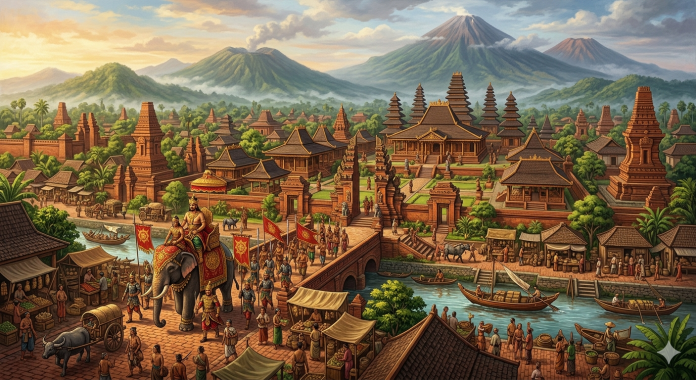

RADAR TULUNGAGUNG – The Majapahit Empire history continues to captivate historians and readers alike, telling the story of a once-mighty kingdom that dominated Southeast Asia before fading into legend. From its strategic founding to its golden age and eventual collapse, the Majapahit Empire history reflects both the brilliance and fragility of power.
In the 13th century, the rise of Raden Wijaya marked the beginning of a new political force in Java. After the fall of the Singasari Kingdom in 1292, he skillfully navigated political chaos and shifting alliances.
By exploiting the arrival of Mongol forces sent by Kublai Khan, Wijaya defeated his rival Jayakatwang before turning against the Mongols themselves. In 1293, he established Majapahit, laying the foundation of what would become a regional powerhouse.
The Early Foundation of Majapahit
In its early years, Majapahit was far from dominant. Its territory was limited to parts of East Java, and internal consolidation became the primary focus. Raden Wijaya strengthened governance, built alliances, and developed a structured bureaucracy. The capital at Trowulan was strategically located inland, protected from naval attacks yet connected to trade routes via the Brantas River.
Despite these efforts, instability persisted. After Wijaya’s death in 1309, his successor Jayanegara faced multiple rebellions, including those led by Nambi and Rangga Lawe. These internal conflicts tested the resilience of the young kingdom, forcing it to strengthen both military and administrative systems.
Gajah Mada and the Expansion Era
The turning point in Majapahit Empire history came during the reign of Tribhuwana Tunggadewi, when a powerful figure emerged: Gajah Mada. Rising from a military commander to Mahapatih (prime minister), Gajah Mada famously declared the Sumpah Palapa, vowing not to enjoy worldly pleasures until he unified the Nusantara.
Under his leadership, Majapahit expanded aggressively. Military campaigns and diplomatic strategies extended influence to Bali, Sumatra, Kalimantan, and beyond. Control over maritime trade routes became a cornerstone of Majapahit’s dominance, making it one of the largest empires in Southeast Asia.
However, not all campaigns were successful. The Bubat tragedy in 1357, involving a conflict with the Sunda Kingdom, stained Gajah Mada’s legacy. Still, his achievements cemented Majapahit’s position as a regional superpower.
The Golden Age Under Hayam Wuruk
Majapahit reached its peak during the reign of Hayam Wuruk. Supported by Gajah Mada, his rule marked a period of political stability, economic prosperity, and cultural advancement.
Trade flourished as Majapahit became a hub connecting China, India, and the Middle East. Ports along Java’s northern coast bustled with activity, exporting spices, rice, and handicrafts. The kingdom also saw significant infrastructure development, including temples and irrigation systems.
Culturally, this era produced important literary works such as the Nagarakretagama, documenting the empire’s vast territory. The concept of “Bhinneka Tunggal Ika” (Unity in Diversity) also emerged, reflecting the kingdom’s pluralistic society.
Decline and Collapse
Despite its achievements, the decline of Majapahit was inevitable. After Hayam Wuruk’s death in 1389, internal conflicts resurfaced. The Paregreg War (1404–1406), a civil war between Wikramawardhana and Bhre Wirabhumi, severely weakened the kingdom.
At the same time, global trade dynamics shifted. Emerging Islamic port cities like Demak and Gresik began to dominate maritime trade routes, reducing Majapahit’s economic influence. Political instability and weakening control over vassal regions further accelerated the decline.
By 1478, Majapahit’s central power collapsed following attacks linked to rising Islamic forces, including those associated with Raden Patah. Although remnants of the kingdom survived in eastern Java, its dominance had effectively ended.
A Lasting Legacy
The Majapahit Empire history is not merely a tale of rise and fall. Its legacy lives on in Indonesia’s cultural and political identity. Concepts of unity, governance, and cultural tolerance rooted in Majapahit continue to influence the nation today.
From a small kingdom born out of chaos to a vast empire shaping Southeast Asia, Majapahit remains a powerful reminder that even the greatest civilizations are vulnerable to internal division and external change.