
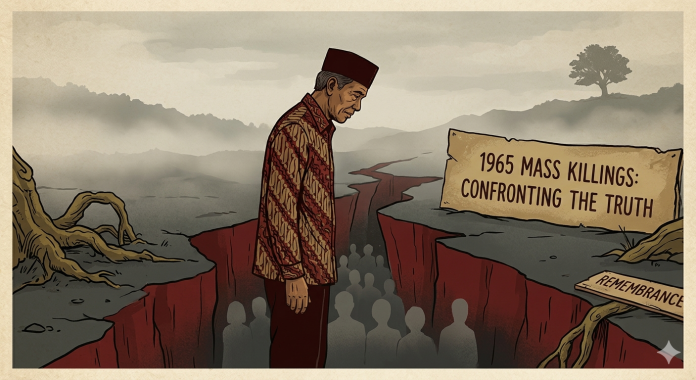

RADAR TULUNGAGUNG – Indonesia’s 1965 mass killings remain one of the most controversial and painful episodes in the nation’s history. Following the political turmoil surrounding the September 30 Movement, security forces and civilian groups launched a nationwide anti-communist campaign that killed hundreds of thousands of people accused of supporting the PKI.
More than six decades later, many families still do not know where authorities buried their relatives. Researchers continue to investigate reports of mass graves across Indonesia, while survivors and human rights advocates push for greater historical transparency.
The issue regained national attention in 2023 when President Joko Widodo acknowledged the grave human rights violations that occurred during the 1965-1966 period. Although the government stopped short of pursuing legal action, the recognition marked a significant step in addressing a long-contested chapter of Indonesian history.
How the Crisis Began
The crisis began after the events of September 30, 1965, when a group of conspirators abducted and killed six Indonesian Army generals and one officer in Jakarta. Authorities later recovered their bodies from a well at Lubang Buaya, a site that became central to the official narrative of the tragedy.
Military leaders quickly accused the PKI of organizing a coup attempt. Historians generally agree that elements connected to the party participated in the operation, but researchers continue to debate many details, including the extent of PKI involvement and whether other actors also influenced events behind the scenes.
The killings created widespread fear and political turmoil. Demonstrations erupted across the country, Sukarno’s political authority weakened, and Major General Soeharto emerged as the dominant figure within the armed forces.
One pivotal document from the period is the Supersemar letter, which Sukarno signed on March 11, 1966. The document gave Soeharto authority to restore order, although historians still debate the circumstances surrounding its signing and whether military officers pressured Sukarno.
A Nationwide Campaign of Violence
After consolidating military control, Soeharto banned the PKI and launched a nationwide crackdown. Security forces arrested, detained, tortured, and killed people they accused of communist sympathies. Authorities also targeted the families of suspected members, subjecting them to surveillance, discrimination, and social exclusion.
Scholars estimate that the violence killed between 500,000 and one million people, although exact figures remain uncertain because authorities never officially recorded many of the deaths. Government agencies and military authorities also imprisoned hundreds of thousands of people, including detainees held for years on remote sites such as Buru Island.
The military did not act alone. Local militias, religious organizations, and civilian groups participated in many regions. Anti-communist propaganda encouraged many communities to view alleged communists as enemies of religion and the nation. In some areas, people joined anti-communist actions because they feared becoming targets themselves.
Researchers believe numerous mass graves remain scattered across Indonesia, but investigators have examined only a limited number of sites. Survivors and relatives of victims have spent decades seeking information about family members who disappeared during the violence.
International and Historical Debate
The events of 1965–1966 unfolded during the Cold War, when the United States and its allies sought to contain the spread of communism across Asia. At the time, policymakers in Washington viewed Indonesia as strategically important because the PKI had become one of the world’s largest communist parties outside China and the Soviet Union.
Declassified documents show that American officials provided political support and assistance to the Indonesian military during the anti-communist campaign. Historians continue to debate the extent of foreign involvement. While evidence points to American support for the military, Indonesian actors carried out the killings during Indonesia’s internal political crisis.
Another major debate centers on the PKI itself. During the New Order era, government institutions portrayed the party exclusively as a treasonous movement manipulated by foreign powers. More recent scholarship presents a more complex picture. The PKI maintained international communist connections, but it also operated as a major political movement that organized labor groups, promoted land reform, expanded educational programs, and supported anti-colonial activism.
That complexity continues to make discussions about the PKI politically sensitive in Indonesia, where many people still regard the subject as taboo.
Why the Issue Remains Unresolved
Although President Widodo acknowledged the abuses, the government has not launched a comprehensive judicial process. Many victims’ families still lack official information about missing relatives, and authorities have held very few perpetrators accountable.
The legacy of the killings continues to shape Indonesian society across generations. Former detainees and their descendants often faced obstacles in employment, politics, and social acceptance. Human rights organizations, historians, and researchers continue to document survivor testimonies and investigate suspected mass grave locations.
Indonesia’s 1965 mass killings remind the country of the devastating consequences that political fear, propaganda, and unchecked state power can create. More than half a century later, Indonesians continue to debate how to remember the victims, establish historical truth, and reconcile with one of the deadliest episodes in the nation’s history.