
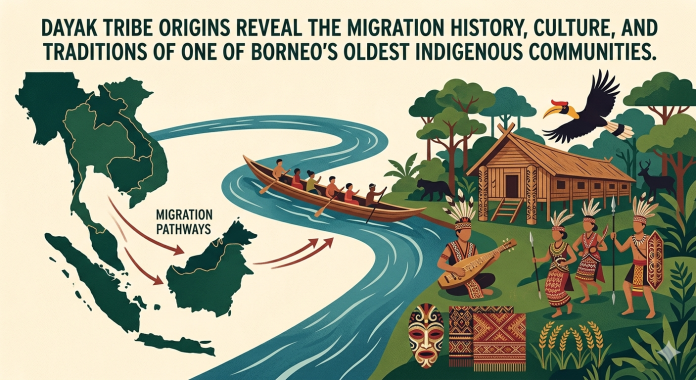

RADAR TULUNGAGUNG – The term “Dayak” commonly refers to indigenous communities that live throughout the interior regions of Kalimantan, the Indonesian portion of Borneo. Historians trace the word to local expressions that describe people living in upstream or inland areas.
Many scholars link the ancestors of the Dayak people to Austronesian migration waves that spread across Southeast Asia thousands of years ago. Several historical studies suggest that these early communities traveled from regions now located in southern China, particularly around Yunnan, before moving through mainland Southeast Asia and eventually reaching Borneo.
Over time, different Dayak communities developed their own languages, customs, and cultural identities. Today, the Dayak population consists of hundreds of indigenous groups spread across Kalimantan rather than a single ethnic community.
Researchers identify more than 400 Dayak subgroups, including the Iban, Kenyah, Kayan, Ngaju, Punan, and Murut peoples. Although each group maintains distinct traditions, they share cultural characteristics that connect them to the broader Dayak identity.
How the Dayak People Established One of Borneo’s Oldest Indigenous Cultures
The term “Dayak” commonly refers to indigenous communities that live throughout the interior regions of Kalimantan, the Indonesian portion of Borneo. Historians trace the word to local expressions that describe people living in upstream or inland areas.
Many scholars link the ancestors of the Dayak people to Austronesian migration waves that spread across Southeast Asia thousands of years ago. Several historical studies suggest that these early communities traveled from regions now located in southern China, particularly around Yunnan, before moving through mainland Southeast Asia and eventually reaching Borneo.
Over time, different Dayak communities developed their own languages, customs, and cultural identities. Today, the Dayak population consists of hundreds of indigenous groups spread across Kalimantan rather than a single ethnic community.
Researchers identify more than 400 Dayak subgroups, including the Iban, Kenyah, Kayan, Ngaju, Punan, and Murut peoples. Although each group maintains distinct traditions, they share cultural characteristics that connect them to the broader Dayak identity.
Migration, Settlement Patterns, and the Growth of Dayak Identity
The Dayak people built a rich cultural heritage that continues to shape life across Kalimantan. One of their most recognizable cultural symbols is the rumah panjang or longhouse, a communal residence that traditionally housed several families under one roof. Many communities still preserve longhouses as important cultural landmarks.
Dayak artisans have also produced distinctive cultural objects for centuries. Their work includes pottery, wood carving, weaving, and the crafting of the Mandau, a traditional sword that symbolizes honor, identity, and cultural heritage. While earlier generations sometimes used the Mandau in warfare and ritual activities, modern communities primarily preserve it as a cultural artifact and ceremonial object.
Trade networks and population movements gradually transformed Kalimantan’s demographic landscape. Malay and Banjar communities established settlements along rivers and coastal regions, while many Dayak groups continued to inhabit inland territories.
Islamic influence later reached parts of Kalimantan and reshaped local identities. Some indigenous communities embraced Islam and gradually integrated into Malay or Banjar society, while others maintained traditional beliefs before later adopting Christianity or other faiths.
Dayak Traditions Continue to Shape Cultural Life in Modern Kalimantan
Today, the Dayak people continue to preserve many ancestral traditions. Communities in Central Kalimantan, for example, still conduct the Tiwah ceremony, a secondary funeral ritual that honors deceased relatives and guides their remains to a specially constructed sandung.
Scholars have long studied Dayak spirituality, oral traditions, and customary laws. They also reject outdated stereotypes that portray Dayak communities as violent or cannibalistic. Anthropological research consistently highlights strong communal values, sophisticated customary institutions, and deep respect for nature within Dayak society.
Across Indonesia, Dayak cultural organizations now promote indigenous languages, traditional arts, and ancestral knowledge through festivals, exhibitions, and educational programs. These efforts help younger generations preserve their cultural heritage while strengthening public appreciation for one of Borneo’s oldest indigenous cultures.