
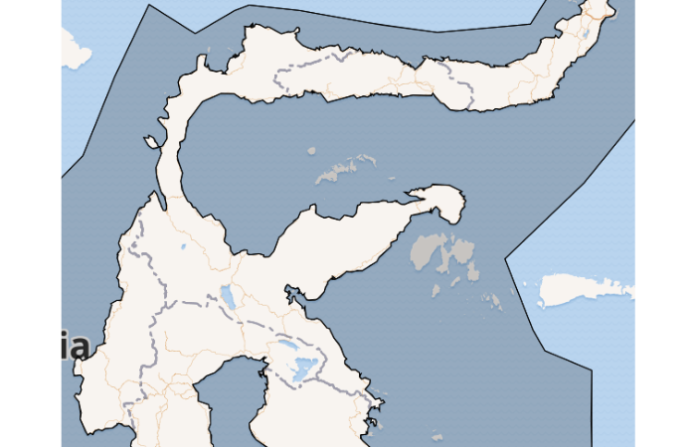

RADAR TULUNGAGUNG – The story of Sulawesi History stretches back more than 200 million years, beginning with dramatic tectonic collisions and continuing through some of humanity’s earliest maritime journeys. Scientific evidence shows that the Indonesian island emerged through complex geological processes before becoming a crucial crossroads for human migration, cultural development, and biodiversity.
Today, Sulawesi stands as one of the world’s most distinctive islands, known for its unusual shape, rich cultural diversity, and archaeological discoveries that have reshaped understanding of early human history.
Its past reveals a remarkable connection between Earth’s geological evolution and the development of human civilization across Southeast Asia.
Sulawesi’s Geological Origins and Unique Position in the World
According to geological research, Sulawesi was not formed from a single landmass. Instead, scientists, including geologist Robert Hall, have described the island as a product of multiple continental fragments that gradually collided over millions of years.
The island’s formation accelerated between roughly 50 million and 5 million years ago when the Indo-Australian, Eurasian, and Pacific tectonic plates interacted. Unlike sudden natural disasters, these collisions occurred slowly, creating the mountains, fault systems, and four distinctive peninsulas that define Sulawesi today.
Researchers have long regarded Sulawesi as one of the most geologically complex regions on Earth because its crust originated from several different sources.
Its location within Wallacea, a transitional biogeographical zone between Asia and Australia, further enhances its significance. British naturalist Alfred Russel Wallace observed during his 19th-century expeditions that Sulawesi’s wildlife differed markedly from both Asian and Australian species.
This observation contributed to the concept of the Wallace Line, an imaginary boundary separating the fauna of the two continents. Sulawesi became home to endemic species such as the anoa and babirusa, animals found nowhere else on Earth.
Human Arrival, Cave Art, and Ancient Migration Routes
One of the most important chapters in Sulawesi History involves the arrival of early humans.
Archaeological evidence suggests that humans may have reached Sulawesi more than 100,000 years ago, although the strongest evidence dates to approximately 40,000–50,000 years ago. Because the island was surrounded by deep seas, reaching it required some degree of seafaring capability, highlighting the maritime skills of prehistoric populations.
Among the most significant discoveries are the prehistoric cave paintings found in the Maros-Pangkep karst region of South Sulawesi. Scientific studies published in 2014 revealed hand stencils and animal depictions dating back at least 40,000 years, placing them among the oldest known examples of figurative and symbolic art anywhere in the world.
These artworks challenged earlier assumptions that sophisticated cave art first emerged exclusively in Europe.
Sulawesi is also believed to have served as an important migration corridor for early humans traveling from mainland Asia toward Australia approximately 50,000 years ago. Archaeologists and anthropologists consider the island a key link in understanding how modern humans spread across the wider Indo-Pacific region.
Later, between roughly 2000 and 1500 BCE, Austronesian-speaking peoples arrived from Taiwan and East Asia, bringing agriculture, advanced boat-building technologies, and linguistic traditions that would profoundly influence Sulawesi’s future societies.
From Diverse Indigenous Cultures to Regional Kingdoms
Sulawesi’s mountainous terrain and fragmented landscape encouraged communities to develop independently, creating remarkable cultural diversity. Ethnic groups such as the Bugis, Makassar, Toraja, Minahasa, Mandar, and Gorontalo developed distinct languages, traditions, and social systems over centuries.
Before the spread of major religions, many communities practiced indigenous beliefs centered on ancestral spirits and nature. The Toraja preserved elaborate funeral traditions that still attract international attention today.
Archaeologists have uncovered numerous megalithic stone monuments in Central Sulawesi, highlighting the island’s long-standing cultural traditions. Researchers continue to study these structures to better understand their social and religious functions.
By the 14th century, kingdoms such as Gowa and Bone had emerged as major political and commercial powers. Gowa, centered in present-day Makassar, connected eastern Indonesia to wider Asian trade networks through its maritime influence.
Islam spread rapidly across Sulawesi during the early 17th century, particularly after Dato Ri Bandang helped convert the Kingdom of Gowa around 1605. Islamic teachings blended with local customs and reshaped social and cultural life throughout the island.
Portuguese, Spanish, and Dutch traders entered Sulawesi from the 16th century onward. The 1667 Treaty of Bongaya expanded Dutch influence and reduced Gowa’s political dominance.
After Indonesia proclaimed independence in 1945, Sulawesi assumed an important role within the new republic. Today, scholars, tourists, and conservationists recognize the island for its cultural heritage, biodiversity, and historical significance.
Sulawesi’s enduring importance reflects its role as a living record of the interaction between nature, human migration, and cultural development across thousands of years.