
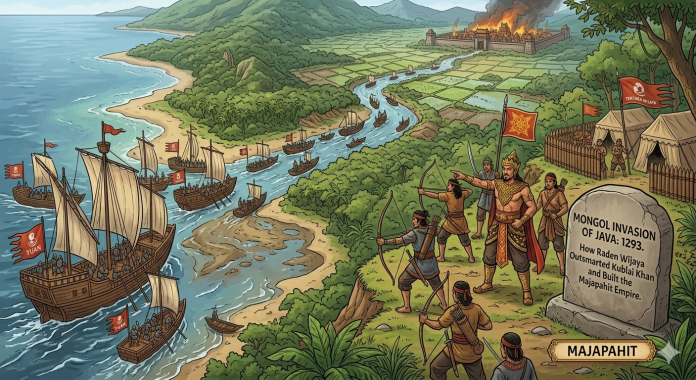

RADAR TULUNGAGUNG – Mongol Invasion of Java 1293 remains one of the most dramatic turning points in Southeast Asian history. What began as a mission of revenge by the powerful Yuan Dynasty under Kublai Khan ended in a humiliating defeat, paving the way for the rise of the Majapahit Empire. This historic episode highlights not only military confrontation but also the brilliance of political strategy led by Raden Wijaya.
The story of the Mongol Invasion of Java 1293 can be traced back to 1289, when Kublai Khan sent an envoy to the Singasari Kingdom demanding tribute. Instead of submitting, King Kertanegara responded with defiance by humiliating the envoy. This act triggered the wrath of the Mongol emperor, who then prepared a massive expedition to punish Java.
By the early months of 1293, thousands of Mongol troops and warships arrived on the northern coast of Java. However, the Mongol Invasion of Java 1293 did not unfold as planned. Unknown to the invaders, the political situation in Java had drastically changed following the internal collapse of Singasari.
The Fall of Singasari and Rise of Raden Wijaya
Before the Mongols arrived, Singasari had already fallen due to a rebellion led by Jayakatwang of Kediri. King Kertanegara was killed, leaving the kingdom in chaos. Amid this turmoil, Raden Wijaya, Kertanegara’s son-in-law, managed to escape and regroup.
Rather than confronting enemies head-on, Raden Wijaya adopted a calculated political approach. He pretended to submit to Jayakatwang and was granted permission to open land in the Tarik forest. This area would later become the foundation of Majapahit.
At the same time, Wijaya was aware that the Mongol forces were approaching. Instead of resisting them, he saw an opportunity to turn them into temporary allies.
A Brilliant Political Trap
When the Mongol army landed, they were confused to learn that Kertanegara was already dead. Raden Wijaya stepped in with a clever narrative, presenting himself as the rightful heir who had been wronged by Jayakatwang.
Through persuasive diplomacy, he convinced the Mongol generals to help him defeat Kediri. The Mongols, eager for quick victory and tribute, agreed without realizing they were being manipulated.
This marked a critical phase of the Mongol Invasion of Java 1293, where the invading army unknowingly became a tool in a local power struggle.
The Fall of Kediri
The combined forces of the Mongols and Raden Wijaya launched a coordinated attack on Kediri. With superior weaponry and military strength, the Mongols played a decisive role in defeating Jayakatwang’s forces.
Kediri eventually fell, and Jayakatwang was captured. For the Mongols, the mission seemed complete. They expected tribute and submission from Java as promised.
However, this victory was only the beginning of their downfall.
The Majapahit Betrayal
After the fall of Kediri, Raden Wijaya invited the Mongol troops to Majapahit under the pretense of preparing tribute. The Mongol forces, exhausted and overconfident, accepted the invitation.
In a carefully orchestrated move, Wijaya launched a sudden attack on the Mongol troops while they were unprepared. Many soldiers were resting, disarmed, and unfamiliar with the terrain.
The ambush turned into chaos. Thousands of Mongol troops were killed within hours. The tropical environment, unfamiliar geography, and disrupted command structure made it impossible for them to regroup.
Mongol Retreat and Lasting Impact
Following the ambush, the remaining Mongol forces attempted to retreat to their ships. However, they faced continuous attacks from local forces using guerrilla tactics. Supply lines were cut, and the changing monsoon winds added urgency to their escape.
The Mongol Invasion of Java 1293 ultimately ended in failure. The once-invincible Mongol army was forced to withdraw, suffering heavy losses and humiliation.
Back in China, Kublai Khan reportedly punished his commanders for the disastrous campaign. The defeat marked one of the few instances where Mongol expansion was successfully resisted.
Birth of the Majapahit Empire
In November 1293, Raden Wijaya was crowned as the first king of Majapahit, taking the title Kertarajasa Jayawardhana. His rise marked the beginning of one of the greatest empires in Indonesian history.
Majapahit emerged not from sheer military strength, but from strategic intelligence, diplomacy, and the ability to exploit geopolitical dynamics.
The Mongol Invasion of Java 1293 stands as a powerful lesson in history. It proves that even the mightiest empire can be defeated not by force alone, but by superior strategy and deep understanding of both allies and enemies.