
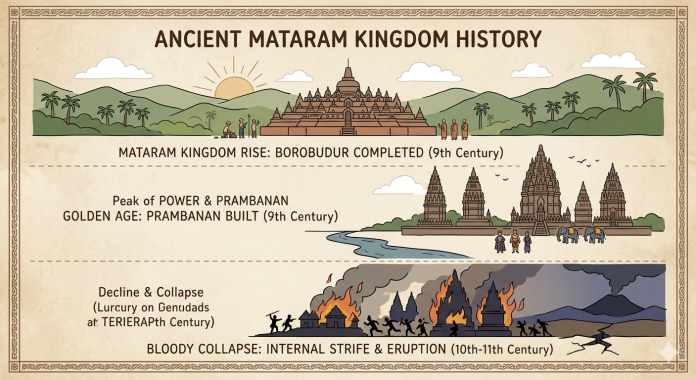

RADAR TULUNGAGUNG – The Ancient Mataram Kingdom stands as one of the greatest civilizations in Indonesian history. Its legacy still shines through Borobudur Temple, the world’s largest Buddhist monument in Central Java. Behind the temple’s breathtaking architecture lies the story of a powerful Hindu-Buddhist kingdom that once controlled large parts of Java between the 8th and 10th centuries.
Historians consider the Ancient Mataram Kingdom a major force that shaped the cultural, religious, and political history of ancient Java. The kingdom created extraordinary landmarks such as Borobudur Temple and Prambanan Temple, two iconic structures that continue to attract millions of visitors every year. These temples also showcase the advanced engineering and artistic skills of ancient Javanese society.
However, the story of the Ancient Mataram Kingdom was not only about glory and prosperity. The kingdom also faced fierce political rivalries, dynastic conflicts, and a tragic collapse that shocked the region. From the rise of King Sanjaya to the bloody downfall during Dharmawangsa Teguh’s reign, the history of Ancient Mataram remains one of the most fascinating chapters in Indonesian history.
The Origins of the Ancient Mataram Kingdom
The Ancient Mataram Kingdom was founded by King Sanjaya around the 8th century. Historical sources differ on the exact founding year, with some records pointing to 732 AD while others suggest 716 AD based on the Sanjaya calendar system. Sanjaya was not an ordinary ruler. He was the son of Dewi Sannaha and Prabu Bratasenawa of the Galuh Kingdom and a descendant of the legendary Queen Shima of the Kalingga Kingdom.
Queen Shima was famous for her strict leadership and strong sense of justice. According to popular stories, she even punished her own son for violating royal law. This reputation helped strengthen the image of Sanjaya as a ruler born from a respected royal bloodline.
Before establishing Medang, Sanjaya reportedly ruled the Sunda and Galuh kingdoms. He later expanded his influence across Java and founded the Medang Palace in the Mataram region, an area now associated with Central Java and Yogyakarta.
Hindu and Buddhist Dynasties in Ancient Java
One of the most unique aspects of the Ancient Mataram Kingdom was the coexistence of Hindu and Buddhist influences. Historians often associate the kingdom with two major dynasties: the Sanjaya Dynasty, which followed Hindu Shiva traditions, and the Sailendra Dynasty, known for Mahayana Buddhism.
After King Sanjaya’s reign, Rakai Panangkaran became ruler of Medang. During his leadership, Buddhist influence grew significantly. Many Buddhist temples were built during this period, signaling the rise of the Sailendra Dynasty.
The rivalry between Hindu and Buddhist dynasties eventually produced two of Indonesia’s greatest historical landmarks. Borobudur Temple was believed to have been constructed around 775 AD and completed in 825 AD during the reign of King Samaratungga from the Sailendra Dynasty. The temple later became an important pilgrimage center for Mahayana Buddhists.
Not long after Borobudur’s completion, the Sanjaya Dynasty responded by building Prambanan Temple around 850 AD. Dedicated to the Hindu Trimurti gods Brahma, Vishnu, and Shiva, Prambanan stood as a symbol of Hindu power and artistic achievement.
Despite the competition between dynasties, historical records suggest that religious tolerance remained strong within the kingdom. Hindu and Buddhist communities reportedly coexisted peacefully, and some historians even believe the construction of Prambanan involved cooperation between both dynasties.
Daily Life Inside the Ancient Mataram Kingdom
The life of people in the Ancient Mataram Kingdom can still be observed through the relief carvings of Borobudur Temple. The carvings depict hunting, fishing, farming, trading, and religious activities.
Ancient Javanese society had already developed an economic system using gold and silver currency. Trade flourished alongside agriculture, while taxes collected from the people likely helped finance the construction of massive temples.
Society was also divided into several social classes, including Brahmins, Kshatriyas, Vaishyas, and Sudras. Religious leaders, nobles, merchants, and commoners each played distinct roles within the kingdom.
Another remarkable feature of the kingdom was the frequent relocation of its capital city. Over time, rulers moved the center of power several times across Central Java before eventually shifting it to East Java under the leadership of Mpu Sindok in the 10th century.
The Bloody Collapse of the Medang Kingdom
The downfall of the Ancient Mataram Kingdom began during the reign of Dharmawangsa Teguh, the kingdom’s final ruler in East Java. Seeking to dominate maritime trade routes, Dharmawangsa launched an ambitious attack against the powerful Srivijaya Kingdom in Sumatra.
The decision proved disastrous. After successfully repelling Medang forces, Srivijaya allied with King Wurawari, a vassal ruler who allegedly held a personal grudge against Dharmawangsa. In 1016 AD, during the wedding celebration of Dharmawangsa’s daughter and Prince Airlangga, enemy forces launched a sudden attack on the royal palace.
The massacre destroyed the Medang Kingdom. Dharmawangsa and many royal family members were killed in what later became known as the “Mahapralaya” tragedy. However, Airlangga managed to escape and would later rise to rebuild power in Java.
The collapse of the Ancient Mataram Kingdom marked the end of one of the greatest Hindu-Buddhist empires in Indonesian history, but its cultural legacy continues to survive through Borobudur, Prambanan, and the enduring influence of Javanese civilization.