
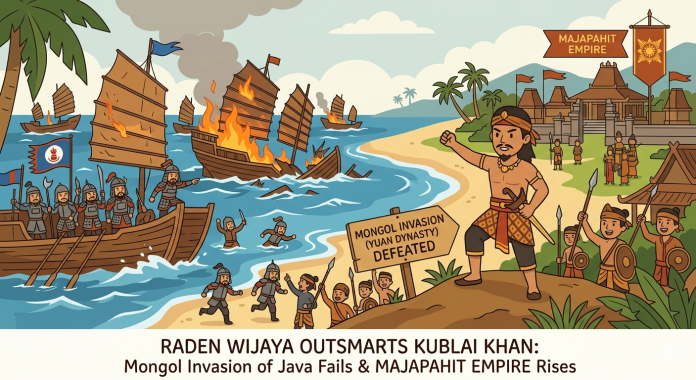

RADAR TULUNGAGUNG – The story of the Mongol Invasion of Java remains one of the most fascinating turning points in Southeast Asian history. It raises a compelling question: how could the world’s most powerful empire, led by Kublai Khan, lose to a relatively small kingdom in Java? The answer lies not in brute force, but in strategy, timing, and political intelligence.
At the height of its power in the 13th century, the Mongol Empire under Kublai Khan controlled vast territories across Asia. From China to Central Asia, Mongol armies inspired fear through discipline, mobility, and devastating tactics. Under the Yuan Dynasty, the empire expanded aggressively and sought to control trade routes while demanding tribute from surrounding regions.
The Mongol Invasion of Java began after a diplomatic insult. When Kublai Khan sent envoys demanding submission from the Singasari Kingdom, its ruler, Kertanegara, rejected the demand and humiliated the emissaries. This act triggered a massive retaliation. By 1292, Kubl
The Rise of a New Player in Java
However, when Mongol forces arrived in early 1293, the political landscape in Java had drastically changed. Kertanegara was already dead, killed in a rebellion led by Jayakatwang of Kediri. The Singasari Kingdom had collapsed, leaving a power vacuum.
Amid this chaos emerged a young nobleman, Raden Wijaya. Rather than confronting the Mongols directly, he devised a strategic alliance. Presenting himself as a victim of Jayakatwang’s rebellion, Raden Wijaya convinced the Mongol commanders to help him defeat Kediri.
This temporary alliance proved effective. Combined Mongol and Javanese forces quickly overpowered Jayakatwang’s army. Kediri fell, and Jayakatwang was executed. For the Mongols, it seemed their mission was accomplished.
A Brilliant Strategic Reversal
But Raden Wijaya had no intention of submitting to foreign rule. Once the Mongols had fulfilled their role, he turned against them. Using his deep knowledge of Java’s terrain and climate, he launched a sudden counterattack.
The Mongol troops, accustomed to open battlefields, struggled in Java’s tropical environment. Dense forests, unfamiliar terrain, and guerrilla tactics disrupted their formations. The heat and humidity further weakened their forces.
Caught off guard, Mongol commanders were unable to reorganize effectively. Within a short time, they were forced to retreat back to their ships. The once-invincible army suffered a humiliating defeat.
The Birth of the Majapahit Empire
The failure of the Mongol Invasion of Java marked more than just a military setback. It became the foundation for the rise of a new power. In 1293, Raden Wijaya established the Majapahit Kingdom, one of the greatest empires in Indonesian history.
Majapahit would later expand its influence across much of the Nusantara, becoming a symbol of unity and political sophistication. Its rise demonstrated that intelligence and adaptability could outweigh sheer military strength.
Why the Mongols Failed in Java
Several key factors explain why the Mongol Invasion of Java ended in failure. First, the Mongols underestimated the complexity of local politics. They arrived to punish a king who was no longer alive, making their mission strategically flawed from the start.
Second, environmental challenges played a major role. The tropical climate and unfamiliar geography severely limited Mongol effectiveness. Their traditional warfare strategies were not suited for jungle conditions.
Third, and most importantly, was the brilliance of Raden Wijaya. His ability to manipulate alliances, exploit timing, and execute a surprise attack turned the situation completely in his favor.
A Turning Point in History
The defeat of Mongol forces in Java stands as a rare example of resistance against one of history’s most dominant empires. Unlike Japan, which was saved by natural disasters, or Vietnam, which relied on prolonged resistance, Java’s victory was driven by calculated strategy.
The Mongol Invasion of Java ultimately reshaped the political landscape of the region. It marked the decline of Mongol expansion in Southeast Asia and the rise of a powerful indigenous empire.
More importantly, it left a lasting lesson: history does not always favor the strongest. Sometimes, it belongs to those who think differently and act decisively.