
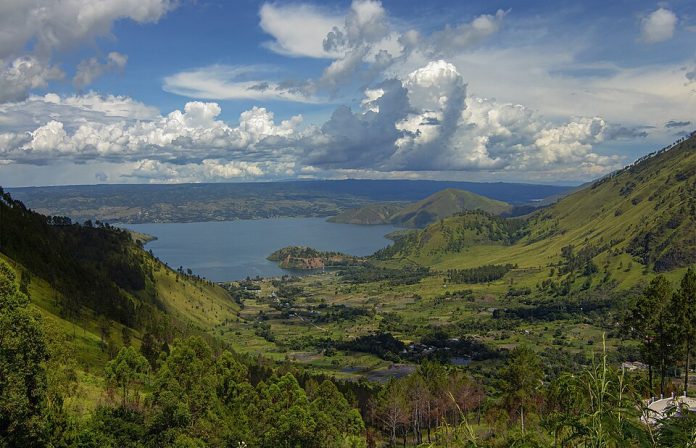

RADAR TULUNGAGUNG – The Toba supervolcano eruption in present-day Indonesia around 74,000 years ago remains one of the most powerful volcanic events ever recorded on Earth, with scientists believing the massive blast may have altered global climate systems and dramatically reduced the early human population.
The ancient eruption, linked to what is now Lake Toba in North Sumatra, has continued to attract global scientific attention because of its possible connection to volcanic winter, ecological collapse, and even human evolution. Researchers estimate the eruption released thousands of cubic kilometers of volcanic material into the atmosphere, making it far larger than modern eruptions such as Mount Tambora in 1815.
Indonesia’s location on the Pacific Ring of Fire, a seismically active zone surrounding the Pacific Ocean, places the country among the world’s most disaster-prone regions. The archipelago contains the highest number of active volcanoes globally, contributing to frequent earthquakes, eruptions, and tsunamis.
The Ancient Eruption That Formed Lake Toba
Lake Toba, located about 900 meters above sea level in North Sumatra, occupies the caldera of a giant supervolcano. Stretching roughly 100 kilometers long and 30 kilometers wide, it is currently recognized as the largest volcanic lake in the world.
The site gained international recognition in July 2020 when UNESCO designated the Toba Caldera as a Global Geopark. Scientists believe the caldera formed after a sequence of massive eruptions during the Quaternary period, with the largest eruption occurring approximately 74,000 years ago.
Dutch geologist Reinout Willem van Bemmelen first proposed in 1939 that Lake Toba originated from a giant volcanic eruption after discovering extensive pumice deposits surrounding the lake. Later studies strengthened the theory when researchers found volcanic ash deposits matching Toba material as far away as Malaysia and central India, nearly 3,000 kilometers from the eruption site.
Marine researchers also identified traces of Toba volcanic material in the Indian Ocean and the Bay of Bengal, suggesting the eruption’s reach extended across much of Asia.
Scientists Estimate the Eruption Was the Largest in 25 Million Years
Recent geological studies estimate the Toba supervolcano eruption reached level 8 on the Volcanic Explosivity Index, the highest possible category for volcanic eruptions. Researchers believe the eruption expelled approximately 2,800 cubic kilometers of magma and volcanic material.
Scientists estimate that around 800 cubic kilometers of ash spread across vast regions of South Asia, leaving volcanic deposits up to 15 centimeters thick in some areas. Ash particles also settled in the South China Sea, Arabian Sea, and Indian Ocean.
The scale of the eruption has led many researchers to compare it with the 1815 eruption of Mount Tambora in Indonesia, which triggered the “Year Without a Summer” in 1816 due to global cooling effects. Some scientific estimates suggest the Toba eruption may have been nearly 100 times larger than Tambora.
Geologists believe the Toba volcanic complex sits near the collision zone of the Eurasian and Australian tectonic plates along the Bukit Barisan mountain range in Sumatra. The tectonic interaction in the region continues to fuel volcanic activity across Indonesia today.
Toba Catastrophe Theory Still Sparks Scientific Debate
One of the most controversial scientific discussions surrounding the Toba supervolcano eruption is the so-called Toba catastrophe theory. The theory argues that the eruption caused a severe volcanic winter lasting between six and ten years, followed by a prolonged cooling period that may have lasted up to 1,000 years.
Some researchers believe the eruption lowered global temperatures by 3 to 5 degrees Celsius, disrupting ecosystems and accelerating glacial conditions already developing at the time. The dramatic environmental changes may have destroyed vegetation, disrupted food chains, and caused widespread drought across tropical regions.
The theory also suggests the eruption created a genetic bottleneck in early human populations. According to several genetic studies, the global human population may have dropped to between 3,000 and 10,000 surviving individuals during that period.
Scientists supporting the hypothesis argue that modern humans descended from a relatively small breeding population that survived the environmental collapse triggered by the eruption. Other researchers, however, remain cautious and say more evidence is needed to directly connect the eruption to mass extinction events or population decline.
Despite ongoing debate, the Toba supervolcano eruption continues to serve as one of the most important case studies in understanding Earth’s climate history, volcanic disasters, and the survival of early human civilization.