
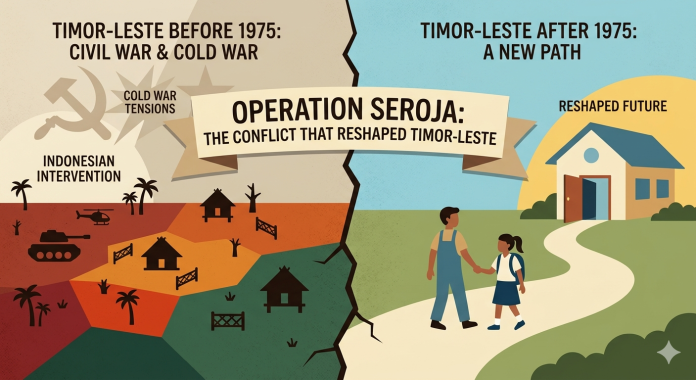

RADAR TULUNGAGUNG – Operation Seroja, Indonesia’s military intervention in Timor-Leste on December 7, 1975, followed months of political turmoil and civil war in the former Portuguese territory. The operation transformed the future of Timor-Leste, triggering a prolonged conflict that remains one of the most debated chapters in Southeast Asian history.
Following Portugal’s Carnation Revolution in 1974, Lisbon began withdrawing from its colonial possessions, including Timor-Leste. As Portuguese authority weakened, competing political movements emerged with different visions for the territory’s future, ranging from full independence to integration with Indonesia.
The rivalry among these factions escalated into a brief but violent civil war in 1975. The conflict ultimately paved the way for Operation Seroja, a military campaign that would reshape the political landscape of Timor-Leste for decades.
Political Rivalries Pushed Timor-Leste Into Civil War
As Portuguese colonial rule weakened following the Carnation Revolution of 1974, three major political movements emerged in Timor-Leste. Fretilin advocated full independence, UDT initially favored a gradual transition toward self-government and eventual independence, while APODETI supported integration with Indonesia.
In early 1975, UDT and Fretilin formed a political alliance aimed at managing the decolonization process. However, the partnership collapsed within months as ideological differences and growing political tensions deepened divisions among Timorese factions.
The situation deteriorated dramatically in August 1975 when UDT launched an armed uprising against Fretilin, accusing the movement of pursuing a radical political agenda. The confrontation quickly escalated into a brief but violent civil war that caused civilian casualties and forced thousands of residents to flee their homes.
As fighting spread across the territory, Portuguese authorities effectively lost control of Timor-Leste. Governor Mário Lemos Pires withdrew to Atauro Island while rival factions competed for dominance on the mainland.
By September 1975, Fretilin had gained the military advantage and established control over most of the territory. The victory allowed the movement to emerge as the dominant political force, although anti-Fretilin groups continued operating from areas near the Indonesian border.
Indonesia’s Intervention and the Launch of Operation Seroja
On November 28, 1975, Fretilin unilaterally declared the independence of the Democratic Republic of Timor-Leste, ending more than four centuries of Portuguese colonial rule.
Two days later, a coalition of anti-Fretilin parties issued the Balibo Declaration, calling for integration with Indonesia. The declaration became one of the key political developments preceding Indonesia’s military intervention.
Amid Cold War tensions and fears of regional instability, the government of President Suharto viewed developments in Timor-Leste as a strategic concern. Indonesian officials argued that political uncertainty in the territory could create security challenges along Indonesia’s eastern frontier.
Historical records show that senior Indonesian officials held discussions with representatives of the United States before the intervention. Meetings involving President Gerald Ford and Secretary of State Henry Kissinger in December 1975 have since become a significant focus of historical debate regarding international awareness of Indonesia’s plans.
On December 7, 1975, Indonesia launched Operation Seroja, deploying naval, air, and ground forces into Timor-Leste. Indonesian troops entered Dili while airborne units secured key strategic locations. Following intense fighting, Indonesian forces gained control of the capital and gradually expanded operations across the territory.
Long-Term Consequences and Historical Legacy
Indonesia formally integrated the territory as Timor Timur, its 27th province, on July 17, 1976. However, the conflict did not end with the incorporation.
Fretilin fighters retreated into mountainous regions and continued a guerrilla campaign against Indonesian forces for years. The Indonesian military responded with extensive counterinsurgency operations throughout the late 1970s and 1980s.
The human cost of the conflict remains one of the most debated aspects of Timor-Leste’s history. Scholars, governments, and international organizations have produced varying estimates of deaths linked to the conflict. Many studies conclude that tens of thousands of people died as a result of combat, displacement, famine, and disease during the years of occupation.
International criticism of Indonesia’s presence in Timor-Leste increased over time, particularly amid allegations of human rights violations. The issue remained unresolved until the late 1990s, when political reforms in Indonesia opened the door to a new settlement process.
In 1999, the people of Timor-Leste voted overwhelmingly for independence in a United Nations-sponsored referendum. Following a transitional period under UN administration, the country achieved full sovereignty on May 20, 2002.
Operation Seroja remains a defining chapter in the histories of both Indonesia and Timor-Leste, illustrating how decolonization, Cold War geopolitics, and domestic political rivalries combined to produce a conflict whose consequences shaped the region for decades.