
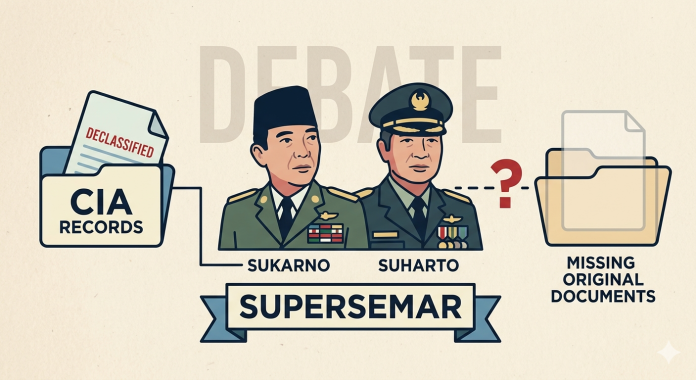

RADAR TULUNGAGUNG – The Supersemar controversy has resurfaced as historians continue to examine declassified CIA documents, disputed historical records, and unanswered questions surrounding the transfer of power from President Sukarno to General Suharto between 1966 and 1967. Decades later, the episode remains one of the most contested chapters in Indonesia’s modern political history.
The debate centers on the March 11, 1966 order known as Supersemar (Surat Perintah Sebelas Maret), a document that enabled then-Army commander General Suharto to take decisive political action following months of turmoil after the failed September 30 Movement in 1965.
While the document became the legal basis for a series of measures that ultimately weakened Sukarno’s authority, historians continue to dispute the circumstances under which it was issued and the extent of foreign influence surrounding the political transition.
How Supersemar Shifted Power From Sukarno to Suharto
The events leading to Supersemar unfolded amid a tense political environment marked by anti-government demonstrations, military maneuvering, and growing conflict between President Sukarno and senior Army officers led by Major General Suharto.
On March 11, 1966, Sukarno left a cabinet meeting in Jakarta and traveled to Bogor after security concerns emerged during student-led demonstrations near the presidential palace. Later that day, Sukarno signed the Supersemar order, giving Suharto authority to take measures aimed at restoring security and stability.
Using the powers granted by the document, Suharto quickly consolidated his position. On March 12, 1966, he banned the Indonesian Communist Party (PKI). In the following days, military authorities detained several ministers who remained loyal to Sukarno, while the Army expanded its influence across key state institutions.
Historians generally agree that these actions shifted the balance of power away from Sukarno and strengthened the Army’s position, paving the way for the emergence of the New Order government.
Declassified CIA Records Reveal Cold War Concerns Over Indonesia
Recently examined CIA records have renewed debate over the Supersemar controversy. Declassified intelligence reports from April 1966 show that U.S. officials closely monitored political developments in Indonesia and viewed the Army’s growing influence as a major turning point.
Several scholars argue that the United States held significant strategic interests in Indonesia during the Cold War. Washington worried about the spread of communism in Southeast Asia and closely watched Sukarno’s foreign policy, which maintained ties with both the Soviet Union and the People’s Republic of China.
Historical evidence shows that the United States supported anti-communist groups in Indonesia during the mid-1960s. However, historians have not produced conclusive evidence proving that the CIA directly orchestrated the transfer of power from Sukarno to Suharto.
Political change accelerated throughout 1966. During a session of the Provisional People’s Consultative Assembly (MPRS) between June and July, members rejected Sukarno’s accountability speech, known as Nawaksara. The assembly also strengthened Supersemar’s legal standing, further weakening Sukarno’s political position.
On March 12, 1967, exactly one year after Suharto used Supersemar to begin consolidating power, the MPRS removed Sukarno from effective executive authority and appointed Suharto as Acting President.
Why the Missing Original Supersemar Document Still Matters
The transfer of power fundamentally reshaped Indonesia’s political and economic direction. Under Suharto’s New Order administration, Indonesia moved closer to Western countries, opened its economy to foreign investment, and abandoned many of the policies associated with Sukarno’s era.
Scholars continue to debate the long-term consequences of that transition. Critics argue that the New Order government restricted political freedoms and limited public dissent, while supporters credit the administration with promoting stability and economic growth.
Questions about the authenticity of the Supersemar document have added another layer to the controversy. Indonesia’s National Archives (ANRI) has repeatedly stated that researchers have never located the original version.
Forensic investigators and archival experts have examined several known versions of Supersemar and concluded that they are copies rather than original records. Differences in signatures, document formatting, and production methods have fueled further debate among historians about the document’s authenticity.
As a result, the Supersemar controversy continues to generate discussion among scholars, researchers, and the public decades after the political transition took place.
The missing original document, along with ongoing analysis of declassified foreign records, keeps the debate alive. Many historians believe that a clearer understanding of Supersemar remains crucial to explaining one of the most significant political transitions in modern Indonesian history.