
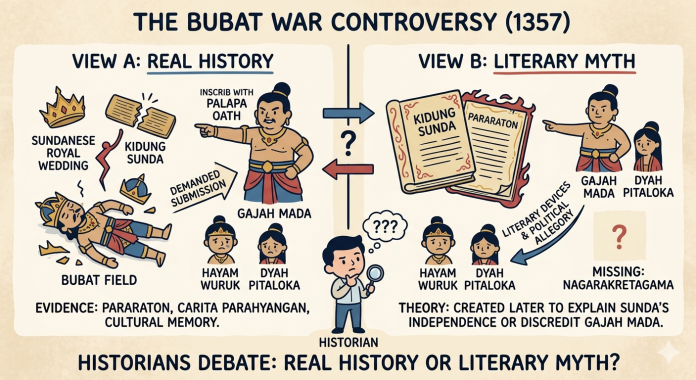

RADAR TULUNGAGUNG – The Bubat War remains one of the most controversial episodes in Indonesian history, as historians, archaeologists, and philologists continue to debate whether the conflict between the Majapahit Kingdom and the Sunda Kingdom in 1357 was a real historical event or a story that later literary traditions created and expanded.
For decades, Indonesian history textbooks have presented the Bubat War as a tragic clash that ended a planned royal marriage between Majapahit ruler Hayam Wuruk and Sunda princess Dyah Pitaloka. Despite its prominence in popular historical narratives, scholars still disagree over the reliability of the sources that describe the event.
The controversy highlights broader challenges in reconstructing Indonesia’s past. Historians often rely on manuscripts produced centuries after the events they describe, making it difficult to separate historical fact from literary interpretation. As a result, the debate continues to attract attention from researchers and the public alike.
The Origins of the Bubat War and the Failed Royal Marriage
Traditional accounts place the Bubat War in 1357 during the height of the Majapahit Kingdom under King Hayam Wuruk and his influential prime minister, Gajah Mada.
According to these accounts, Hayam Wuruk sought to marry Dyah Pitaloka, the daughter of Sunda ruler Sri Baduga Maharaja Linggabuana. The Sunda king accepted the proposal and personally traveled to Majapahit with his daughter and members of the royal court.
When the delegation arrived at Bubat Square near the Majapahit capital, tensions reportedly emerged. Traditional narratives state that Gajah Mada demanded that Dyah Pitaloka enter Majapahit as a symbol of Sunda’s submission rather than as a future queen.
The demand angered the Sunda delegation and sparked a violent confrontation. Historical narratives claim that King Linggabuana, Princess Dyah Pitaloka, and many members of the Sunda entourage lost their lives during the battle. The marriage proposal collapsed, ending what could have united two major kingdoms.
Many historians connect the alleged conflict to Gajah Mada’s famous Sumpah Palapa, which reflected his ambition to expand Majapahit’s influence across the archipelago.
Historical Sources Behind the Bubat War Narrative
The modern understanding of the Bubat War is largely based on four literary sources: Pararaton, Kidung Sunda, Carita Parahyangan, and Kidung Sundayana.
A key issue is that all of these texts were written long after the supposed event. Scholars note that the manuscripts emerged more than two centuries after 1357, raising questions about their historical reliability.
Among these sources, Pararaton briefly mentions the event known as “Pasunda Bubat,” while Kidung Sunda provides a much more detailed narrative that generally portrays the Sunda side sympathetically.
Critics argue that the absence of contemporary evidence weakens the case for the war’s historicity. Researchers point out that around 50 known Majapahit inscriptions discovered to date do not mention the conflict. They also note that the famous 1365 manuscript Nagarakretagama, written by court poet Mpu Prapanca only eight years after the alleged event and roughly one year after Gajah Mada’s death, contains no reference to the Bubat War.
Many historians regard contemporary inscriptions and documents as the most reliable historical sources, making the silence of Nagarakretagama a significant point in the debate.
Why Historians Still Debate the Bubat War Today
Despite the lack of direct contemporary evidence, some scholars argue that the absence of references does not necessarily prove the event never occurred.
Archaeologist Agus Aris Munandar of the University of Indonesia has suggested that Mpu Prapanca may have intentionally omitted the incident because Nagarakretagama was designed to celebrate Majapahit’s greatness rather than record embarrassing episodes.
Supporters of the Bubat War narrative also point to the existence of similar traditions in both Javanese and Sundanese literary sources. They argue that the appearance of comparable stories in different cultural traditions may reflect a shared collective memory rooted in a real event.
Other researchers remain skeptical, describing the narrative as a blend of history, legend, literary creativity, and political interpretation. Some even argue that colonial-era scholars helped popularize the story during the Dutch colonial period, potentially contributing to divisions between ethnic communities.
Today, the Bubat War remains less a settled historical fact than a subject of ongoing scholarly investigation. The debate continues to encourage historians to reexamine sources, question assumptions, and seek stronger evidence about one of the most discussed episodes associated with the Majapahit era.
The enduring controversy demonstrates that history is not only about preserving stories from the past but also about critically evaluating how those stories were created, transmitted, and understood across generations.