
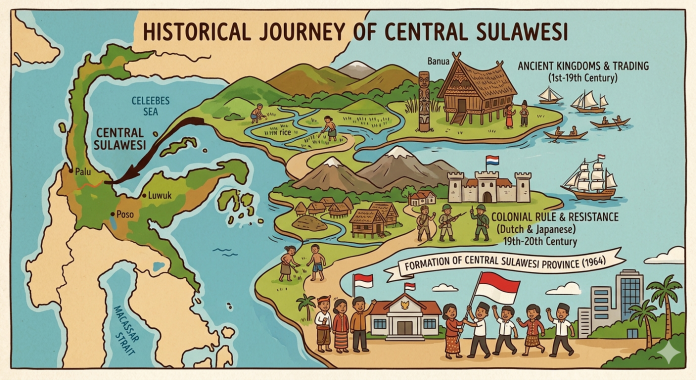

RADAR TULUNGAGUNG – Central Sulawesi history reflects centuries of political change, from the rise of local kingdoms and foreign influence to colonial domination and Indonesia’s struggle for independence. Officially established as a separate province on September 23, 1964, Central Sulawesi today stands as one of Indonesia’s most diverse regions, shaped by a rich historical legacy and strategic position in the heart of Sulawesi.
Long before the formation of modern Indonesia, the area now known as Central Sulawesi was home to numerous indigenous kingdoms and chiefdoms. Among the most influential were the Kingdom of Banawa and the Banggai Kingdom, which played important roles in regional politics, trade, and cultural development.
The Banggai Kingdom emerged as a significant power in eastern Sulawesi and maintained close relations with the Sultanate of Ternate during the 16th century. These connections linked Central Sulawesi to wider maritime trade networks that stretched across eastern Indonesia and the Maluku Islands.
Ancient Kingdoms Laid the Foundations of Central Sulawesi
For centuries, local rulers governed various parts of Central Sulawesi through traditional political systems. Coastal kingdoms benefited from trade routes connecting Sulawesi with Maluku, while inland communities developed distinct cultural identities that remain visible today.
The region’s strategic location attracted outside powers seeking influence over trade and maritime security. As commercial activity expanded across eastern Indonesia, local kingdoms increasingly interacted with larger regional powers, including Ternate.
These early political structures helped shape the cultural diversity that characterizes Central Sulawesi today, where numerous ethnic groups and languages continue to coexist.
Dutch Colonial Expansion Changed the Region’s Political Landscape
Dutch influence began expanding into Central Sulawesi during the 17th century as colonial authorities sought to secure shipping routes and strengthen control over eastern Indonesia. Over time, the Dutch established agreements with local rulers and increased their political presence across the region.
By the 18th and 19th centuries, colonial authorities exerted greater pressure on local kingdoms, gradually reducing their autonomy. Dutch officials often intervened in succession matters and administrative affairs, ensuring that regional leaders remained aligned with colonial interests.
The early 20th century witnessed the growth of nationalist sentiment across the Indonesian archipelago, including Central Sulawesi. Organizations inspired by independence movements emerging from Java began attracting support from local communities. These developments encouraged political awareness and strengthened resistance to colonial rule.
World War II and Indonesia’s Independence Struggle
A major turning point came during World War II when Japanese forces occupied Central Sulawesi in 1942 after defeating Dutch colonial authorities. Although Japanese rule ended European control temporarily, residents faced severe economic hardship, forced labor policies, and strict military administration.
Following Japan’s surrender in August 1945, Indonesia proclaimed its independence. Central Sulawesi became part of the larger Province of Sulawesi during the early years of the republic.
The Netherlands later attempted to regain influence through federal-state policies designed to weaken the newly independent nation. However, Indonesian nationalists resisted these efforts, and the country formally consolidated itself as a unitary state on August 17, 1950.
Formation of Central Sulawesi Province and Modern Legacy
Administrative reforms continued throughout the 1950s and early 1960s as Indonesia reorganized regional governance. A historic milestone arrived on September 23, 1964, when the government officially established Central Sulawesi as a separate province with Palu as its capital.
The creation of the province enabled local authorities to focus on regional development, infrastructure expansion, education, and economic growth tailored to the area’s unique geography and population.
Today, Central Sulawesi is known not only for its historical significance but also for its tourism potential. The Togean Islands attract visitors from around the world with their marine biodiversity, while historical sites and cultural traditions continue to preserve the province’s rich heritage.
Central Sulawesi history offers a window into Indonesia’s broader journey, from indigenous kingdoms and colonial domination to independence and nation-building. More than six decades after gaining provincial status, the region remains an important part of Indonesia’s cultural, economic, and historical landscape.