
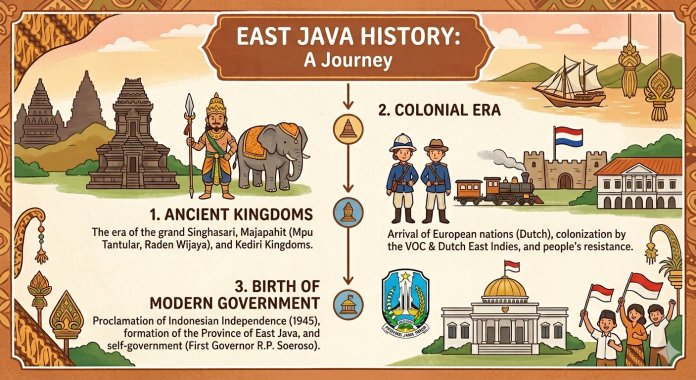

RADAR TULUNGAGUNG – The history of East Java has once again become a hot topic after a historical review explained how the province evolved from ancient kingdoms into one of Indonesia’s most influential regions. The story of East Java history is closely linked to powerful kingdoms, colonial administration, and the early formation of Indonesia’s modern government system.
Based on historical records and ancient inscriptions, East Java history can be traced back to the 8th century. One of the most important findings is the Dinoyo Inscription, which revealed that the region was once under the rule of the Kanjuruhan Kingdom in Malang around the year 760.
The development of East Java history continued rapidly during the 10th century when the region transformed from a peripheral territory into the center of political power in Java. Several major kingdoms emerged and played crucial roles in shaping the political and cultural identity of the archipelago.
Ancient Kingdoms Became the Foundation of East Java
Historical sources mention that East Java became the home of several influential kingdoms such as Medang, Daha, Singasari, and Majapahit. These kingdoms were not only powerful in military and economic sectors, but also established governance systems that influenced later administrations.
One of the most important figures in East Java history was Mpu Sindok. He was considered the architect of the early government system in East Java after moving the center of power from Central Java to the eastern region. Historians believe his policies laid the foundation for a hierarchical administration that survived for centuries.
During the Singasari era, the government structure was already organized into several layers. The system included the royal palace as the central government, regional authorities known as watak, and villages called wanua. This arrangement showed that governance in ancient Java had already become highly structured long before the colonial era.
The Emergence of Provincial Administration
Another major turning point in East Java history occurred in the 13th century. At that time, the concept of territorial administration began to evolve into something similar to modern provinces.
During the era of the Islamic Mataram Kingdom, East Java was known by the term Bang Wetan. The territory covered the eastern coastal regions and the inland areas of Java. The area became strategically important due to trade routes and political influence.
The political situation changed dramatically after the Chinese rebellion in Kartasura in 1743. Following the conflict, the northern coastal regions of Java and Madura fell into Dutch control. Meanwhile, the Mataram Kingdom retained only the inland territories.
The end of the Diponegoro War in 1830 marked another important chapter in East Java history. After the war, the entire East Java region officially came under the administration of the Dutch East Indies government.
Dutch Colonial Government Changed East Java
From 1830 to 1929, the Dutch colonial government implemented a centralized administrative system. The Dutch authorities established direct relations between the colonial government in Batavia and local regents across East Java.
The colonial administration intensified its governance system by officially forming the East Java Province in 1929. Interestingly, the bureaucratic structure created during that period was not significantly different from the provincial system used today.
The Japanese occupation between 1942 and 1945 also left a strong impact on East Java. Like many other regions in Indonesia, East Java was placed under Japanese military rule during World War II.
However, the most historic moment came after Indonesia declared independence in 1945. The newly formed Republic of Indonesia immediately reorganized its administrative system to strengthen national governance.
RMT Suryo Became East Java’s First Governor
On August 19, 1945, the Preparatory Committee for Indonesian Independence (PPKI) officially established provinces and appointed governors across the country. RMT Suryo, who was serving as the Resident of Bojonegoro at the time, was selected as the first Governor of East Java.
Although he was inaugurated on September 5, 1945, RMT Suryo still had to complete his responsibilities in Bojonegoro before fully assuming his role. He eventually moved to Surabaya on October 12, 1945, marking the official start of the provincial government’s operations in East Java.
Because of the historical importance of that event, the East Java Provincial Government later issued Regional Regulation Number 6 of 2007. The regulation officially established October 12 as the anniversary date of East Java Province.
Today, East Java history remains an important reflection of Indonesia’s long political journey. From ancient kingdoms to colonial rule and independence, the province continues to hold a central role in the nation’s historical identity.