
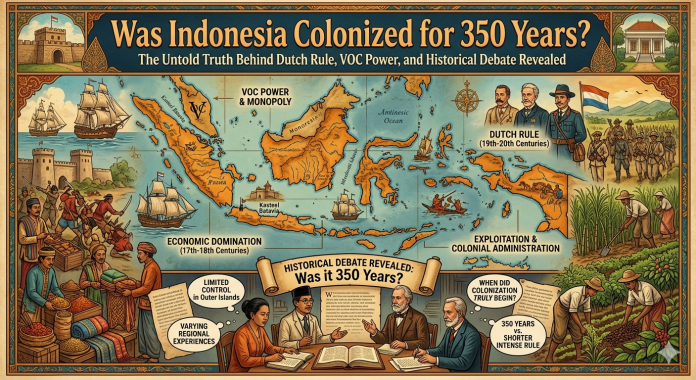

RADAR TULUNGAGUNG – The long-standing claim that Indonesia was colonized for 350 years continues to spark debate among historians. The statement, famously delivered by Indonesia’s first president in 1950, has shaped public understanding for decades. But is it historically accurate? A closer look at the timeline of colonial rule in the archipelago reveals a far more complex story.
The discussion about whether Indonesia was colonized for 350 years is not just academic, it reflects how history is interpreted and remembered. From early European expeditions to the rise of colonial administrations, the narrative involves multiple powers, shifting control, and evolving definitions of colonization.
The Arrival of Europeans and the Spice Trade
The story begins in the early 16th century, when Portuguese explorers first arrived in the Maluku Islands in 1512. At the time, spices such as cloves and nutmeg were as valuable as gold in European markets. The region quickly became a focal point of global trade.
Soon after, Spain entered the competition, leading to conflict with Portugal. This rivalry ended with the Treaty of Zaragoza in 1529, which divided influence between the two powers. Portugal retained control over Maluku, while Spain shifted its focus to the Philippines.
By the late 16th century, other European nations began to take interest. England arrived in the archipelago in the 1570s, followed by the Dutch in 1596. What began as trade expeditions soon escalated into a fierce struggle for dominance over the lucrative spice trade.
VOC: From Trade Company to Colonial Power
In 1602, the Dutch established the Verenigde Oostindische Compagnie (VOC), a trading company that would become one of the most powerful entities in colonial history. Initially formed to prevent competition among Dutch merchants, the VOC was granted extraordinary rights by the Dutch government.
These rights included the authority to wage war, build forts, mint currency, and govern territories. With such powers, the VOC transformed from a trading organization into a de facto colonial ruler.
The company quickly expanded its influence, seizing control of key regions like Batavia and parts of Java. It also enforced strict monopolies on spice production, often using violence to maintain control. Local populations were subjected to forced labor and harsh economic policies, leading to widespread suffering.
Collapse of VOC and Rise of Colonial Government
Despite its dominance, the VOC eventually collapsed in the late 18th century due to corruption, mismanagement, and excessive expansion. In 1800, the Dutch government took over its assets, marking the beginning of formal colonial rule.
This transition is crucial in understanding the timeline of colonization. Some historians argue that true colonization began only after the Dutch state established direct control over the archipelago.
During the early 19th century, Indonesia briefly came under British rule from 1811 to 1816. Under British administration, certain reforms were introduced, including the abolition of forced labor and monopolies. However, these changes were short-lived, as the Dutch regained control shortly after.
Forced Cultivation and Economic Exploitation
In the 1830s, the Dutch implemented the Cultivation System, requiring farmers to dedicate a portion of their land to export crops such as coffee, sugar, and tobacco. While this policy generated enormous profits for the Netherlands, it caused widespread hardship among local populations.
Famine, poverty, and exploitation became common, prompting criticism from both local and European observers. One notable critique came through the novel Max Havelaar, which exposed the injustice of colonial policies.
By the late 19th century, the system was gradually replaced by a more liberal economic approach, allowing private enterprises to operate in the colony. Although this created job opportunities, inequality remained a persistent issue.
Ethical Policy and Rising Awareness
In 1901, the Dutch introduced the Ethical Policy, aimed at improving the welfare of the indigenous population through education, irrigation, and migration programs. While the policy had limited success, it played a significant role in raising political awareness among educated Indonesians.
This newfound awareness contributed to the emergence of nationalist movements, which eventually led to the struggle for independence.
The Debate Over “350 Years”
The claim that Indonesia was colonized for 350 years is widely debated. Some experts argue that colonization should be counted from the establishment of a centralized colonial government, which would place the timeline closer to 1800-1945.
Others suggest that the presence of foreign powers since the 16th century justifies the longer timeframe. There is also the argument that Indonesia, as a unified nation, did not exist until the 19th century, making earlier colonization less relevant to the modern concept of colonization.
Ultimately, the answer depends on how colonization is defined, whether as initial contact, economic control, or formal governance.
A Legacy That Still Resonates
Regardless of the exact duration, there is no doubt that colonial rule left a deep impact on Indonesia. From economic structures to social inequalities, many effects of that era continue to shape the nation today.”of that era continue to shape the nation today.
The debate over “350 years” serves as a reminder that history is not always straightforward. It is shaped by perspective, interpretation, and evolving definitions. What remains clear, however, is the importance of understanding the past to better navigate the future.