
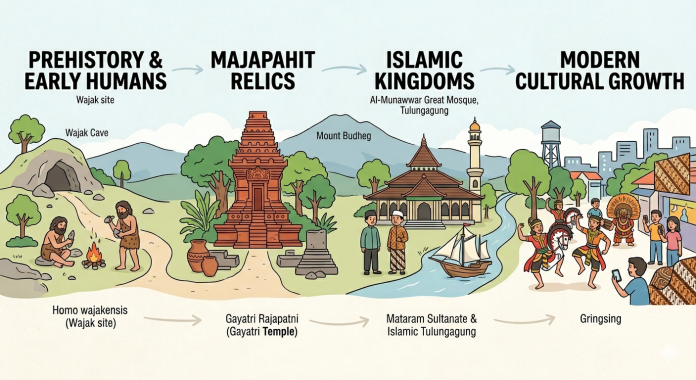

RADAR TULUNGAGUNG – The history of Tulungagung stretches back thousands of years and makes the region one of the oldest centers of civilization in East Java. Archaeologists discovered evidence of prehistoric human life in caves such as Song Gentong, Song Terus, and Song Banyu Urip, showing that ancient communities once lived, hunted, and survived in the southern mountain area long before major kingdoms rose in Java.
Over the centuries, powerful kingdoms such as Kanjuruhan, Medang, Kediri, Singhasari, and Majapahit shaped Tulungagung into an important political, spiritual, and economic region. The Lawadan Inscription in Boyolangu and the famous Gayatri Statue strengthen historical evidence that Tulungagung played a major role in the development of ancient Javanese civilization.
Prehistoric Evidence in Tulungagung
Researchers found some of the oldest traces of human civilization in Tulungagung inside caves located in the southern mountain region. Archaeologists uncovered stone tools, animal bones, and hunting equipment that indicate prehistoric humans actively lived in the area.
Communities during that era relied heavily on rivers, forests, and caves for survival. They practiced hunting and gathering while moving between strategic locations near water sources. In Campurdarat and Kalidawir, researchers also discovered megalithic relics such as menhirs, dolmens, and stone sarcophagi that reveal early spiritual beliefs and burial traditions.
These discoveries prove that Tulungagung already supported organized human activity long before the rise of Hindu-Buddhist kingdoms in Java.
Hindu Kingdom Influence and the Lawadan Inscription
By the 8th century, Tulungagung became part of the influence zone of the Kanjuruhan Kingdom, one of the earliest Hindu kingdoms in East Java. Ancient irrigation systems and agricultural patterns found in the Brantas River valley indicate the region had become an important agrarian area.
The strongest historical evidence appeared during the Medang Kingdom era under Mpu Sindok in the 10th century. The famous Lawadan Inscription discovered in Boyolangu is believed to date back to 921 AD and records the establishment of tax-free “sima” land for religious purposes.
The inscription proves that Tulungagung already had an organized administrative system more than 1,100 years ago. Historians believe Boyolangu functioned as an important spiritual and agricultural center during the early East Javanese kingdom period.
Tulungagung During Kediri, Singhasari, and Majapahit
The history of Tulungagung became increasingly significant during the Kediri Kingdom era between the 11th and 13th centuries. Fertile land in southern Brantas Valley turned the region into one of the kingdom’s main rice-producing areas.
Hindu-Siwa culture flourished during this period, marked by the spread of Shiva statues, Lingga-Yoni artifacts, and spiritual hermitages. Tulungagung gradually evolved not only as an agricultural hub but also as a center of spirituality and culture.
During the Singhasari Kingdom, the region was integrated into a more centralized political and military system. Infrastructure, transportation routes, and agricultural supervision were strengthened to support the kingdom’s expansion across East Java.
However, the golden era of Tulungagung history emerged under the Majapahit Kingdom. The region became an important buffer zone supporting the kingdom’s economy and logistics. Agricultural products, forest resources, and spices from Tulungagung were distributed to the Majapahit capital in Trowulan.
One of the most famous relics from this era is the Gayatri Statue in Boyolangu. The statue is believed to represent Sri Rajapatni Gayatri, the grandmother of King Hayam Wuruk and wife of Raden Wijaya, the founder of Majapahit.
The meditative Buddhist statue symbolizes the strong spiritual status of Tulungagung during the Majapahit period. Until today, Boyolangu remains an important cultural and historical site visited by historians and spiritual communities.
Islamization and Colonial Transformation
The spread of Islam in Tulungagung began gradually during the 15th and 16th centuries as the influence of Majapahit weakened. Islamic teachings entered through trade, marriage, cultural preaching, and Sufi approaches promoted by ulama connected to the Wali Songo network.
Traditional Islamic institutions such as pesantren and mosques started growing in Kauman, Ngunut, and Rejotangan. Old mosques like Masjid Tegalsari became symbols of the deep Islamic roots that still shape Tulungagung society today.
During the Dutch colonial period, Tulungagung was previously known as Ngrowo. The colonial government developed irrigation canals, roads, and transportation systems to support plantations and agricultural production.
In 1901, the official name changed from Ngrowo to Tulungagung. The name comes from the words “tulung” meaning water source and “agung” meaning great, referring to the region’s abundant springs.
Modern Tulungagung and Cultural Identity
Today, Tulungagung has transformed into one of the most developed regencies in East Java. The region is widely known for its marble industry centered in Campurdarat, as well as its unique batik motifs and cultural festivals.
The local government continues promoting tourism, MSMEs, and cultural preservation programs to strengthen Tulungagung’s identity in the modern era. Traditional arts such as reog, gamelan, and wayang kulit remain actively preserved alongside rapid economic growth.
With a combination of rich history, strong cultural identity, and economic progress, Tulungagung continues to stand out as one of East Java’s most historically significant regions.