
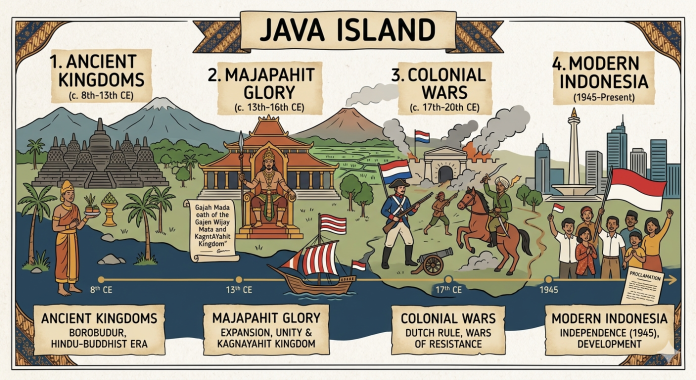

RADAR TULUNGAGUNG – For more than 10,000 years, Java Island has stood as the heart of Indonesian civilization, witnessing the rise and fall of kingdoms, religions, colonial powers, and modern political movements that shaped the nation known today as Indonesia.
A historical timeline circulating through a long-form YouTube documentary recently drew attention for summarizing the complete history of Java Island, starting from prehistoric cultures and ending with the establishment of Indonesia’s future capital city, Nusantara.
The documentary highlighted how Java Island evolved from ancient megalithic settlements into the political and cultural center of Southeast Asia through centuries of conflict, migration, diplomacy, and technological development.
Early Civilizations on Java Island
The earliest chapter of Java Island history began around 10,000 BC with the emergence of the Gunung Padang civilization in Cianjur, West Java. The site is widely recognized as one of the largest prehistoric megalithic complexes in the world.
Other prehistoric cultures later appeared across the island, including Gowa Pawon in Bandung, Paguyangan in Sukabumi, Cipari in Kuningan, and Pasir Angin in Bogor. These civilizations demonstrated how early humans adapted to changing environments while developing social and cultural systems.
Over centuries, ancient settlements gradually evolved into organized societies with political structures and trade networks.
Rise of Ancient Kingdoms
The documentary described the establishment of Salakanagara around 130 AD as one of the earliest kingdoms on Java Island. Historical references from China and even Greek geographer Ptolemy were said to mention the kingdom, showing Java’s early international connections.
Tarumanegara later emerged as a dominant power under King Purnawarman in the fourth century. Historical inscriptions recorded major engineering projects, including river excavations designed to prevent floods and droughts.
Following the decline of Tarumanegara, new kingdoms such as Sunda, Galuh, Kalingga, and Mataram rose to prominence. These kingdoms expanded political influence while encouraging the spread of Hindu-Buddhist culture throughout Java.
The construction of monumental temples such as Borobudur and Prambanan during the Sailendra and Sanjaya dynasties marked one of the greatest architectural achievements in Indonesian history.
Majapahit and the Golden Era of Java
One of the most important periods in Java Island history was the rise of Majapahit in the late 13th century.
Founded by Raden Wijaya after defeating Mongol forces in 1293, Majapahit eventually became a regional superpower under the leadership of Hayam Wuruk and Mahapatih Gajah Mada.
The famous Sumpah Palapa oath symbolized Gajah Mada’s ambition to unite the archipelago under Majapahit influence. During its golden age, Majapahit controlled large territories across Southeast Asia and maintained diplomatic relations with foreign kingdoms.
The Nagarakretagama manuscript, written in 1365, documented the vast influence of the empire and became one of the most valuable historical sources about ancient Java.
However, internal conflict, civil war, and regional rebellions weakened the kingdom over time.
Spread of Islam and Fall of Hindu Kingdoms
The documentary also traced the spread of Islam across Java through the role of Walisongo, including Sunan Gresik, Sunan Kalijaga, Sunan Giri, and Sunan Gunung Jati.
Islamic kingdoms such as Demak, Cirebon, and Banten gradually replaced older Hindu-Buddhist powers. The fall of Majapahit and Pajajaran marked a major turning point in Java’s political and cultural transformation.
Demak expanded aggressively during the 16th century, while Islamic boarding schools and trading ports became important centers of religious and economic activity.
At the same time, European powers began entering the region. Portuguese forces seized Malacca in 1511 before later establishing diplomatic relations with several kingdoms on Java Island.
Dutch Colonization and Resistance
Dutch influence grew significantly after the VOC established trading posts in Java during the early 17th century. Batavia, formerly Jayakarta, became the center of Dutch colonial administration.
The rise of Mataram under Sultan Agung created one of the strongest challenges against Dutch expansion. Although Mataram launched major attacks against Batavia in 1628 and 1629, the campaigns ultimately failed.
Over time, internal political conflicts weakened local kingdoms, allowing the Dutch to dominate Java through treaties, military intervention, and economic control.
Several major resistance movements later emerged, including the Diponegoro War between 1825 and 1830. The conflict caused massive casualties and became one of the largest anti-colonial uprisings in Indonesian history.
From Independence to Modern Indonesia
The documentary concluded with modern Indonesian history, including Japanese occupation during World War II and the proclamation of Indonesian independence by Soekarno and Mohammad Hatta on August 17, 1945.
Indonesia then experienced political turmoil, military conflict, the rise of the New Order era under Soeharto, the Reformasi movement in 1998, and democratic transitions in the decades that followed.
The historical journey ended with President Joko Widodo’s 2023 announcement regarding the relocation of Indonesia’s capital city to Nusantara in East Kalimantan.
The decision symbolically reconnects modern Indonesia with the ancient concept of “Nusantara,” a term once associated with unity across the archipelago during the Majapahit era.