
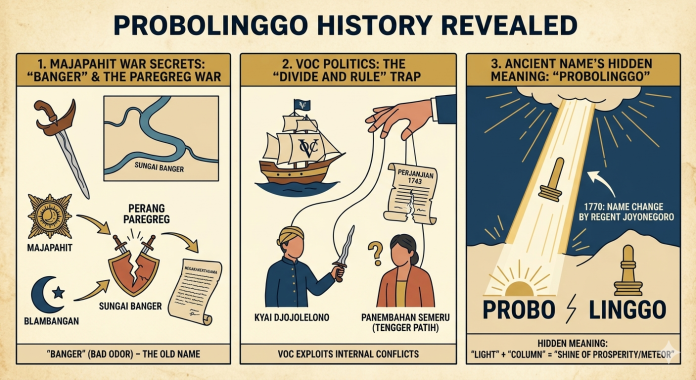

RADAR TULUNGAGUNG – The history of Probolinggo holds a dramatic story tied to the glory of the Majapahit Empire, civil war, and colonial political manipulation. Long before becoming one of East Java’s important coastal regions, Probolinggo carried the name Banger, a strategic area that turned into a battleground during one of the bloodiest conflicts in Javanese history.
The origins of Probolinggo trace back to the reign of Hayam Wuruk, the fourth king of the Majapahit Kingdom who ruled between 1350 and 1389. Historical records from the famous manuscript Nagarakretagama written by Mpu Prapanca mention Banger as a “pegukuhan” or settlement area under Majapahit authority.
The name Banger reportedly came from a river flowing through the region. Over time, the area developed into a “pakuon,” a temporary resting place for royal officials and travelers. However, the peaceful region later entered a fierce power struggle linked to the collapse of Majapahit influence in East Java.
Banger Became a Battlefield During the Paregreg War
The history of Probolinggo grew darker when Banger fell under the control of Bhre Wirabhumi, also known as Minak Jinggo, the ruler of Blambangan. At that time, Banger served as a border area between Majapahit and Blambangan.
The region then became part of the famous Paregreg War, a civil conflict between Bhre Wirabhumi and Wikramawardhana. The war weakened the Majapahit Kingdom and created instability across East Java.
Historians consider the Paregreg War one of the main causes behind the gradual decline of Majapahit power. Banger, because of its strategic position, inevitably became one of the conflict zones during the bloody struggle.
VOC Political Manipulation Changed the Region
Centuries later, the history of Probolinggo entered another dramatic phase during the Dutch colonial era. In 1743, territories east of Pasuruan officially came under the control of the Dutch VOC following political agreements with local rulers.
To strengthen its influence in Banger, the VOC appointed Kiai Joyo Lelono as the first regent of the region with the title Tumenggung. He was the son of Jolodrijo, a patih connected to the Pasuruan court and the legendary anti-colonial fighter Untung Surapati.
The VOC was notorious for its divide-and-rule strategy. Under Dutch influence, Kiai Joyo Lelono was persuaded to capture or kill Pangeran Semeru, a descendant and ally of Untung Surapati who opposed colonial authority.
The mission ended tragically with the death of Pangeran Semeru. However, Kiai Joyo Lelono later realized he had been manipulated by the VOC’s political tactics. Filled with regret, he abandoned his position as regent in 1768 and chose to oppose the Dutch colonial government instead.
The Birth of the Name Probolinggo
After Kiai Joyo Lelono stepped down, the VOC appointed Raden Tumenggung Joyonegoro as the second regent of Banger. Under his leadership, the region experienced rapid development and prosperity.
The local population reportedly admired Joyonegoro so much that they gave him the nickname “Kanjeng Jimat.” During his administration, a major historical change occurred.
In 1770, the name Banger was officially replaced with Probolinggo. According to local historical interpretation, “Probo” means light or radiance, while “Linggo” refers to a monument or marker. Combined together, Probolinggo symbolized “radiance marked by a monument.”
The renaming represented hope for a brighter future after years of conflict and political turmoil. Today, Probolinggo is widely recognized not only as a gateway to Mount Bromo tourism but also as a region with deep historical roots connected to the rise and fall of ancient Javanese kingdoms.
The legacy of Kiai Joyo Lelono also remains respected by local communities. His burial site at Pasarean Sentono is still considered sacred by many residents who visit the location to honor his role in the region’s past.
From the glory of Majapahit to the manipulation of colonial powers, the history of Probolinggo reveals how one small region played an important role in shaping East Java’s historical landscape.