
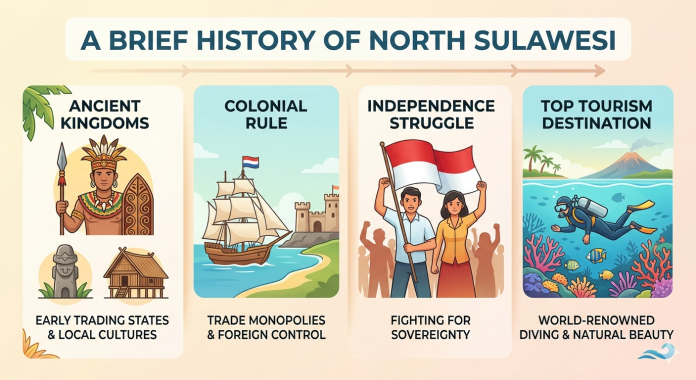

RADAR TULUNGAGUNG – The history of North Sulawesi reflects a centuries-long journey from the rise of early regional kingdoms and colonial administration to its emergence as one of Indonesia’s leading tourism destinations. Today, North Sulawesi is recognized not only for its rich historical legacy but also for its growing global tourism appeal.
The history of North Sulawesi began long before the establishment of modern Indonesia. Historical records and local traditions point to the existence of several indigenous kingdoms across the region, while later centuries saw the arrival of European colonial powers and significant political transformations that shaped the province known today.
North Sulawesi officially became a separate province on September 23, 1964, following the enactment of Law No. 13 of 1964, with Manado designated as its capital. The date remains the official anniversary of the province.
Early Kingdoms Helped Shape North Sulawesi
Several indigenous kingdoms emerged across the region long before European powers arrived in the archipelago. Historical records identify political centers in Gorontalo, Bolaang Mongondow, Minahasa, Sangihe, and Talaud, each contributing to the area’s development.
These kingdoms strengthened maritime trade networks and connected North Sulawesi with neighboring regions, including Maluku and southern Sulawesi. Merchants exchanged spices, agricultural products, and cultural influences through these routes, helping local communities prosper.
Dutch influence expanded during the nineteenth century as colonial authorities consolidated their control over the region. The Dutch East Indies administration established the Manado Residency, which covered much of present-day North Sulawesi and parts of Central Sulawesi. The residency later became a key administrative foundation for regional governance.
Colonial Rule and Independence Reshaped the Region
Political changes accelerated during the twentieth century. Japan occupied North Sulawesi from 1942 to 1945 and replaced Dutch colonial administration with military rule. Japanese authorities reorganized local government structures and tightened control over strategic areas during World War II.
After Indonesia declared independence in August 1945, Dutch forces attempted to regain influence in several regions, including North Sulawesi. Local resistance quickly emerged. One of the most significant events occurred on February 14, 1946, when nationalist groups launched the Red and White Incident in Manado. Their actions demonstrated strong support for Indonesian independence and challenged efforts to restore colonial authority.
The region later joined the State of East Indonesia, a federal entity within the Republic of the United States of Indonesia. When Indonesia returned to a unitary system, North Sulawesi became part of the Republic of Indonesia and continued its administrative development.
Lawmakers eventually established North Sulawesi as a separate province through Law No. 13 of 1964. The government designated Manado as the provincial capital, marking a major milestone in the region’s political history.
Tourism Growth Turns North Sulawesi into a National Success Story
In recent decades, North Sulawesi has become one of Indonesia’s fastest-growing tourism destinations. The province is internationally known for marine tourism, particularly the world-renowned Bunaken National Park, which attracts divers and nature enthusiasts from around the globe.
The province gained national recognition in 2019 when Indonesia’s tourism authorities described North Sulawesi as a “Rising Star” due to remarkable growth in visitor numbers and tourism performance. Government data and tourism officials reported rapid increases in both domestic and international arrivals, supported by improvements in infrastructure, accessibility, and tourism facilities.
Other popular attractions include the highlands of Tomohon, the Tangkoko Nature Reserve, Likupang, and various cultural and religious tourism destinations that showcase the region’s diversity and natural beauty. The development of the Likupang Special Economic Zone further strengthened North Sulawesi’s position as a strategic tourism hub in eastern Indonesia.
North Sulawesi’s story is ultimately one of transformation, from a region shaped by ancient kingdoms and colonial administrations into a modern Indonesian province recognized for both its historical significance and tourism achievements. The province’s rich past continues to play a vital role in shaping its identity and future development.