
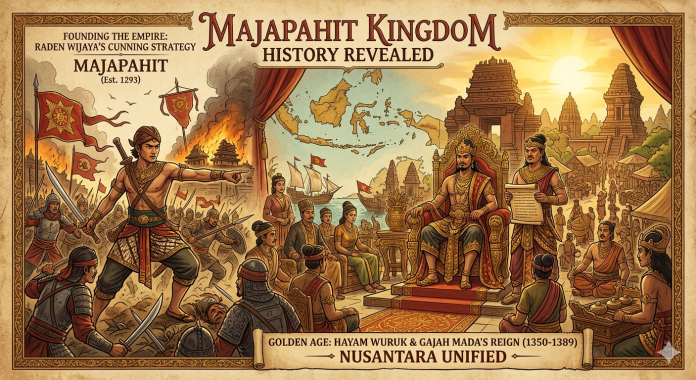

RADAR TULUNGAGUNG – The Majapahit Kingdom history remains one of the most fascinating chapters in Indonesian civilization, marked by strategic brilliance, internal conflict, and a golden era that shaped the archipelago. The story begins with a dramatic twist involving foreign forces and a calculated move by its founding king, Raden Wijaya.
In the early phase of the Majapahit Kingdom history, around 1293, an army of approximately 20,000 Mongol troops sent by Kublai Khan landed in Tuban. Their mission was to punish Kertanegara of Singhasari. However, the situation turned into an unexpected opportunity for Raden Wijaya, who sought revenge against Jayakatwang, the ruler of Kediri.
Raden Wijaya cleverly allied with the Mongol forces to defeat Kediri. After successfully overthrowing Jayakatwang, he executed another strategic move. During a celebratory feast, when the Mongol troops were off guard, his forces launched a surprise attack. Many Mongol soldiers were killed, while the survivors retreated back to their homeland. This bold maneuver secured Raden Wijaya’s path to establish Majapahit.
The Rise and Early Turmoil
After stabilizing the situation, Raden Wijaya ascended the throne as the first king of Majapahit, adopting the title Kertarajasa Jayawardhana. His reign marked the official beginning of the Majapahit Kingdom history. However, after his death in 1309, the kingdom faced significant instability under his successor, Jayanegara.
Jayanegara’s rule was plagued by multiple rebellions, including those led by Ranggalawe (1300), Sora (1311), Nambi (1316), and Kuti (1319). Among these, the Kuti rebellion posed the greatest threat. The king was forced to flee the capital and seek refuge in Bedander village.
The situation was eventually brought under control by the Bhayangkara troops led by Gajah Mada. His leadership proved decisive in crushing the rebellion and restoring order. As a reward, Gajah Mada was appointed as the Patih of Kahuripan, marking the beginning of his rise to prominence.
Gajah Mada and the Sumpah Palapa
Following Jayanegara’s death, the throne passed to Tribhuwana Tunggadewi, the first queen of Majapahit. During her reign, another rebellion emerged in 1331, led by Sadeng and Keta. Gajah Mada, who had risen through the ranks, was tasked with leading the military campaign to suppress the uprising.
After successfully defeating the rebels, Gajah Mada was appointed as Mahapatih (Prime Minister), replacing Arya Tadah. At his inauguration, he delivered the famous Sumpah Palapa, a vow declaring his determination to unite the Nusantara under Majapahit rule.
This moment became a defining milestone in the Majapahit Kingdom history, as it marked the beginning of aggressive territorial expansion. Under Gajah Mada’s leadership, Majapahit strengthened its naval power and expanded its influence across regions such as Dompu (1340) and Bali (1343).
The Golden Age of Hayam Wuruk
In 1350, Tribhuwana Tunggadewi stepped down and was succeeded by her son, Hayam Wuruk, who took the title Rajasanagara. His reign is widely regarded as the peak of the Majapahit Kingdom history.
With the continued support of Gajah Mada, Majapahit expanded its territory to include areas such as Tumasik (modern-day Singapore) and the Malay Peninsula. The kingdom also developed major ports like Ujung Galuh, Tuban, Gresik, and Pasuruan, strengthening its position as a maritime power.
Interestingly, Majapahit was not only a maritime empire but also an agrarian society. Most of its population relied on agriculture, reflecting a balanced economic structure. In addition, Gajah Mada contributed to the legal system by formulating the Kutara Manawa law, which became the foundation of governance in the kingdom.
Decline After Greatness
Despite its remarkable achievements, the decline of Majapahit began after the death of Gajah Mada in 1364. The kingdom struggled to find a capable successor who could match his leadership and vision. Gradually, internal weakness, and external pressures led to its downfall.
The Majapahit Kingdom history serves as a powerful reminder of how leadership, unity, and strategic thinking can shape the destiny of a nation. It also highlights the importance of preserving historical awareness as a foundation for national identity.