
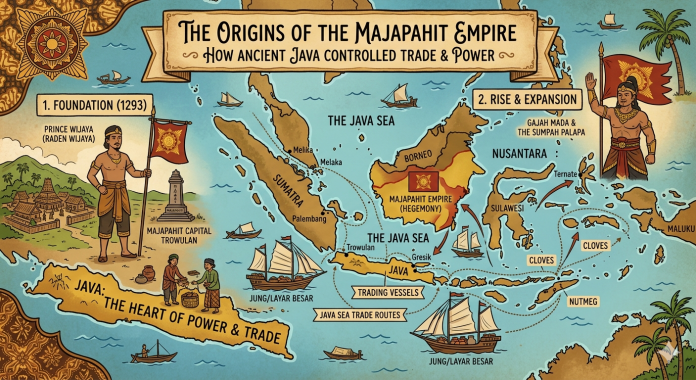

RADAR TULUNGAGUNG – The story of the Majapahit Empire origins begins long before its golden age, rooted in the extraordinary maritime culture of early Austronesian sailors. Arriving on the shores of Java, these skilled navigators mastered the winds and stars, setting the stage for what would become one of Southeast Asia’s most influential empires.
At first glance, Majapahit may not appear as one of history’s greatest empires. Its peak lasted barely a century, from around 1293 to 1389. However, its impact on the Indonesian archipelago remains profound. In fact, the Majapahit Empire origins reveal a political and cultural unification that no other local power achieved until the modern era.
More importantly, Majapahit’s legacy still shapes Indonesia today. Despite leaving behind only modest ruins and limited written records, the empire is remembered as a symbol of unity. It successfully brought together thousands of islands, over 13,000 in total, each with distinct cultures and languages.
The Maritime Roots of Power
To understand the Majapahit Empire origins, it is essential to look at two earlier kingdoms: Srivijaya and Mataram. Both laid the foundation for Majapahit’s rise, but in very different ways.
Srivijaya, based in Sumatra, was a powerful maritime kingdom that dominated trade routes between the 7th and 14th centuries. It controlled the strategic Strait of Malacca, a crucial passage for merchants traveling between China and India. Through this control, Srivijaya became the gatekeeper of the lucrative spice trade.
Its fleets transported valuable goods such as gold, sandalwood, rice, and spices across Asia. Among these commodities, nutmeg stood out as one of the most prized. In a time before refrigeration, spices were essential for preserving food, making them incredibly valuable. As a result, Srivijaya’s influence extended far beyond its territory.
Lords of Water and Trade
Srivijaya’s greatest innovation was its ability to control the seas. Instead of directly ruling vast territories, it focused on dominating trade routes. By organizing merchant fleets and even incorporating pirates into its naval system, the kingdom secured its position as a maritime superpower.
This strategy transformed coastal settlements into cosmopolitan hubs. Traders, monks, and travelers from China, India, and across Southeast Asia gathered in these ports, creating a rich blend of cultures and beliefs. Hinduism and Buddhism merged into a unique religious tradition known as Hindu-Buddhism, which would later influence Majapahit.
The Agricultural Strength of Mataram
Meanwhile, on the island of Java, the Kingdom of Mataram developed a different kind of power. Unlike Srivijaya’s maritime dominance, Mataram relied on agriculture. Its rulers controlled vast rice terraces supported by advanced irrigation systems.
Java’s volcanic soil proved exceptionally fertile, allowing Mataram to produce large quantities of rice. This agricultural surplus supported a dense population and provided the workforce needed for large-scale projects.
In addition, Mataram’s rulers used this manpower to construct monumental architecture. One of the most remarkable achievements was Borobudur, the largest Buddhist temple in the world. Built over generations, it stands as a testament to the kingdom’s organizational and cultural strength.
Monumental Ambitions and Cultural Legacy
Following Borobudur, the Hindu temple complex of Prambanan further demonstrated Java’s architectural ambition. These structures were not only religious centers but also symbols of political power.
However, such grand projects may have come at a cost. Some historians suggest that the immense resources required for construction contributed to internal instability. Nevertheless, these achievements set a new standard for what a Javanese kingdom could accomplish.
The Birth of Majapahit
Ultimately, the Majapahit Empire origins lie in the fusion of these two systems: Srivijaya’s maritime trade network and Mataram’s agricultural strength. By combining control of sea routes with a strong internal economy, Majapahit emerged as a dominant force in the region.
This unique blend allowed Majapahit to extend its influence across the archipelago. Although the exact nature of its control remains debated, there is no doubt that it reshaped the political landscape of Southeast Asia.
In conclusion, the rise of Majapahit was not a sudden event but the result of centuries of cultural exchange, economic development, and strategic innovation. Its legacy continues to inspire modern Indonesia, proving that even a short-lived empire can leave a lasting mark on history.