
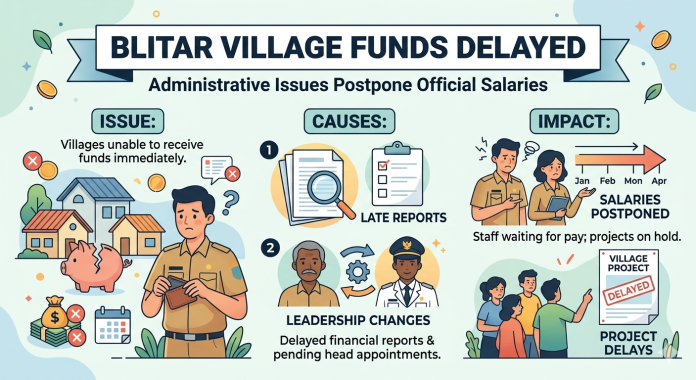

BLITAR – Blitar village fund allocation program has encountered delays in dozens of villages across Blitar Regency, forcing some village administrations to postpone salary payments for village officials. Local authorities say incomplete administrative requirements remain the main obstacle to fund disbursement.
According to the Blitar Regency Community and Village Empowerment Agency (DPMD), not all villages can receive Village Fund Allocation (ADD) payments at the same time. Each village must first submit financial accountability reports and complete administrative procedures before authorities approve the disbursement.
DPMD Head Tantowi Jauhari said the speed of fund distribution depends largely on each village’s compliance with those requirements.
“The disbursement process depends on each village. In mid-May, only 194 villages were able to receive their ADD funds. The remaining 54 villages still faced unresolved administrative issues,” Tantowi said on Wednesday.
He explained that, in general, the distribution process has run smoothly. However, several factors continue to slow down disbursement in certain areas. Administrative delays remain the most common problem, although leadership transitions in village governments have also contributed to setbacks.
One example is Umbuldamar Village in Binangun District. The village had to wait for the appointment of an acting village head before officials could process the fund disbursement. The delay followed a legal case involving the previous village head.
Authorities require the village’s chief executive official to take responsibility for the fund withdrawal process. As a result, villages experiencing leadership changes often need additional time to complete administrative procedures.
“We have repeatedly reminded villages to comply with all requirements for ADD disbursement proposals. Every week, villages continue submitting applications. Some requests cover May allocations, while others relate to March and April payments,” Tantowi said.
He acknowledged that many villages do not always submit requests according to the designated monthly schedule. Weak administrative compliance has become a recurring concern for the agency.
The delays have had a direct impact on village officials because they must wait longer to receive their income. Even so, Tantowi described the situation as a common administrative challenge rather than a major problem in the overall funding system.
He stressed that the pace of disbursement depends on how quickly villages complete and submit their required reports. According to him, the regency government has already ensured that funds remain available.
“People can only call it a problem if the regency government delays the transfer. We have distributed ADD funds smoothly since February 2026. The timing now depends on each village’s administrative compliance,” he said.
The Blitar administration expects the remaining villages to complete their paperwork soon so officials can release the delayed funds and ensure village employees receive their salaries without further disruption.