
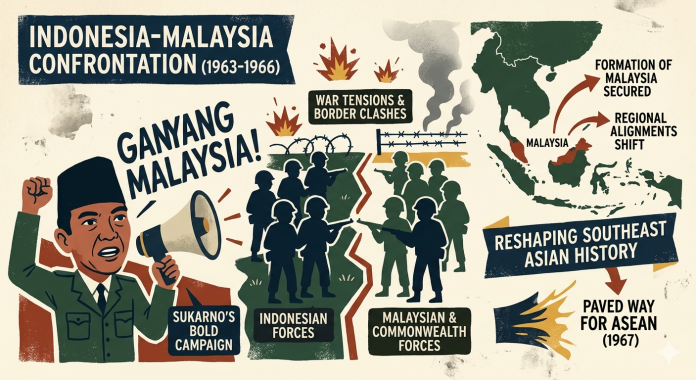

RADAR TULUNGAGUNG – Indonesia Malaysia Confrontation was a major conflict in Southeast Asia during the early 1960s, driven by political tension and Cold War rivalry. What began as a dispute over the formation of Malaysia quickly escalated into military confrontation between two neighboring nations.
Indonesia’s president, Sukarno, strongly rejected Malaysia, calling it a British-backed neocolonial project. His famous slogan “Ganyang Malaysia” ignited nationalist sentiment and pushed Indonesia toward aggressive action.
The conflict involved cross-border attacks, covert operations, and international pressure before finally ending in 1966. Despite its intensity, the confrontation remains a crucial chapter in understanding regional history.
Historical Roots of the Conflict
The roots of the Indonesia Malaysia Confrontation can be traced back to colonial times. Indonesia was under Dutch rule, while Malaysia fell under British control. Despite cultural and ethnic ties, colonial boundaries shaped distinct political paths.
In 1945, there was even a brief vision of uniting Indonesia and Malaya into a single nation. However, Japan’s surrender after World War II disrupted these plans, leading Indonesia to declare independence independently. Malaysia, on the other hand, gained independence later in 1957 under British supervision.
Tensions escalated when Malaysia proposed forming a federation that included Sabah, Sarawak, and Singapore. For Sukarno, this move represented a form of neocolonialism, as he believed Britain was using Malaysia as a proxy to maintain influence in the region.
Sukarno’s Opposition and Rising Tensions
Sukarno strongly opposed the formation of Malaysia, viewing it as a direct threat to Indonesia’s sovereignty. He accused Malaysia of being a puppet state of Western powers, particularly Britain.
Efforts to resolve the issue diplomatically, including meetings in Tokyo and Manila, failed to produce lasting agreements. When Malaysia officially declared its formation on September 16, 1963, Indonesia reacted swiftly by cutting diplomatic ties.
Public anger surged in both countries. Demonstrations erupted, embassies were attacked, and nationalist rhetoric intensified. Sukarno’s campaign slogan, “Ganyang Malaysia” (Crush Malaysia), became a rallying cry across Indonesia.
Military Escalation and Covert Operations
The Indonesia Malaysia Confrontation soon turned into armed conflict. Indonesian forces began infiltrating Malaysian territories, particularly in Sabah and Sarawak. These operations involved both regular troops and volunteer militias.
In 1964, Indonesia launched the Dwikora (Dual Command) operation, formally escalating the confrontation. Military actions included cross-border raids, guerrilla warfare, and even airborne operations targeting the Malay Peninsula.
However, Indonesia faced strong opposition. Malaysia received support from Britain, Australia, and New Zealand. British forces, experienced in jungle warfare, effectively countered Indonesian incursions.
The conflict also extended beyond the battlefield. Acts of sabotage, including bombings in Singapore, aimed to destabilize the region. One notable incident was the bombing of a building in Singapore in 1965, which caused civilian casualties and heightened tensions.
Cold War Dynamics and Internal Pressures
The Indonesia Malaysia Confrontation was deeply influenced by Cold War politics. Indonesia leaned toward communist allies such as China and the Soviet Union, while Malaysia aligned with Western powers.
This ideological divide intensified the stakes. Control over strategic trade routes like the Malacca Strait added further importance to the conflict.
Internally, Indonesia faced growing political instability. The 1965 coup attempt, known as the 30 September Movement, shifted national focus inward. Sukarno’s political power weakened significantly.
End of the Confrontation
The rise of Suharto marked a turning point. Unlike Sukarno, Suharto prioritized stability and international relations. He moved quickly to de-escalate tensions with Malaysia.
On August 11, 1966, Indonesia and Malaysia signed the Jakarta Accord, officially ending the confrontation. Diplomatic relations were restored, and Indonesia recognized Malaysia’s sovereignty.
Legacy of the Conflict
Although relatively short-lived, the Indonesia Malaysia Confrontation left lasting impacts. It strained relations between two neighboring nations with shared cultural roots and highlighted the dangers of ideological rivalry.
Today, Indonesia and Malaysia maintain diplomatic ties and cooperate in regional organizations like ASEAN. The conflict serves as a reminder of how political ambitions and global tensions can reshape regional dynamics.