
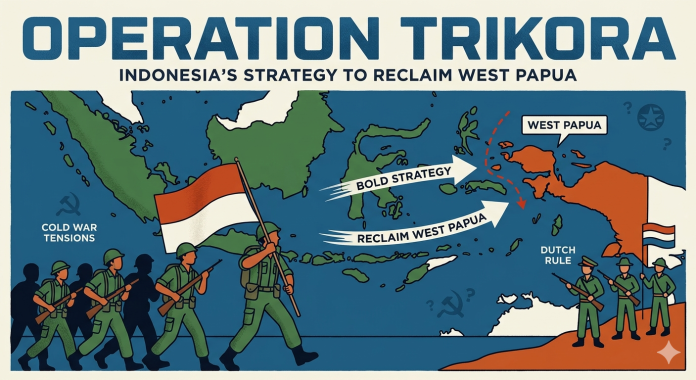

RADAR TULUNGAGUNG – Operation Trikora remains one of the most defining moments in Indonesia’s post-independence history. Launched on December 19, 1961, the operation marked a bold and strategic effort by President Soekarno to reclaim West Papua from Dutch colonial rule. The declaration, delivered in front of thousands in Yogyakarta, ignited nationalistic fervor and signaled Indonesia’s readiness for confrontation.
From the very beginning, Operation Trikora was not merely a military maneuver. It was the culmination of years of diplomatic deadlock, political tension, and international maneuvering. The roots of the conflict trace back to the aftermath of World War II, when the Dutch sought to reassert control over Indonesia, including West Papua.
Despite Indonesia’s independence in 1945, the Dutch refused to relinquish West Papua. The dispute intensified after the 1949 Round Table Conference, which recognized Indonesian sovereignty but excluded West Papua from the agreement. This unresolved issue became a persistent thorn in bilateral relations.
Rising Tensions and Political Maneuvering
The Dutch had strong motivations to retain West Papua. Beyond political control, the region held significant economic potential, particularly in natural resources such as copper and nickel. Meanwhile, Indonesia viewed West Papua as an inseparable part of its territorial integrity.
Local resistance also played a role. Figures like Frans Kaisiepo advocated for integration with Indonesia, organizing political movements despite Dutch suppression. However, the Dutch countered with their own strategies, promoting pro-independence sentiments and establishing local political structures aligned with their interests.
As diplomatic efforts repeatedly failed, President Soekarno began exploring alternative approaches. He sought support from both Western and Eastern blocs during the Cold War, positioning Indonesia as a non-aligned nation while leveraging global rivalries.
Military Build-Up and Strategic Alliances
The turning point came when Indonesia secured military support from the Soviet Union. This included aircraft, naval vessels, and other advanced weaponry, significantly strengthening Indonesia’s military capabilities. The United States, initially neutral, later shifted its stance due to geopolitical concerns about Soviet influence in Southeast Asia.
With growing confidence, Indonesia intensified pressure on the Dutch. Economic measures were implemented, including nationalizing Dutch-owned companies. However, these actions alone were insufficient to resolve the dispute.
This led to the launch of Operation Trikora, which outlined three main objectives: preventing the establishment of a Dutch-backed state in West Papua, raising the Indonesian flag in the region, and preparing for full-scale mobilization.
The Role of Komando Mandala
To execute the operation, Indonesia established Komando Mandala under Major General Soeharto. This joint command coordinated efforts across the army, navy, and air force. Thousands of troops were deployed, supported by a formidable arsenal of military equipment.
One of the most notable early clashes occurred during the Battle of the Aru Sea in January 1962. Although Indonesia suffered losses, including the death of Commodore Yos Sudarso, the confrontation demonstrated the seriousness of Indonesia’s intentions.
The operation progressed through stages, including infiltration and planned large-scale assaults. By mid-1962, both sides were on the brink of full-scale war.
Diplomatic Breakthrough and Resolution
Amid escalating tensions, the United States intervened as a mediator, fearing a broader conflict that could destabilize the region. Negotiations between Indonesia and the Netherlands eventually led to the New York Agreement in August 1962.
Under the agreement, West Papua was temporarily administered by the United Nations before being transferred to Indonesia in 1963. A referendum, known as the Act of Free Choice, was later conducted in 1969, resulting in the region’s integration into Indonesia.
The success of Operation Trikora highlighted Indonesia’s ability to combine military pressure with diplomatic strategy. While the operation avoided a prolonged war, it underscored the complexities of decolonization during the Cold War era.
Legacy and Ongoing Debate
Although Operation Trikora achieved its primary objective, debates surrounding West Papua’s integration continue to this day. Questions about the fairness of the 1969 referendum and the region’s socio-economic conditions remain topics of discussion.
Nevertheless, the operation stands as a testament to Indonesia’s determination to assert its sovereignty. It also reflects the broader struggle of post-colonial nations navigating global power dynamics.