
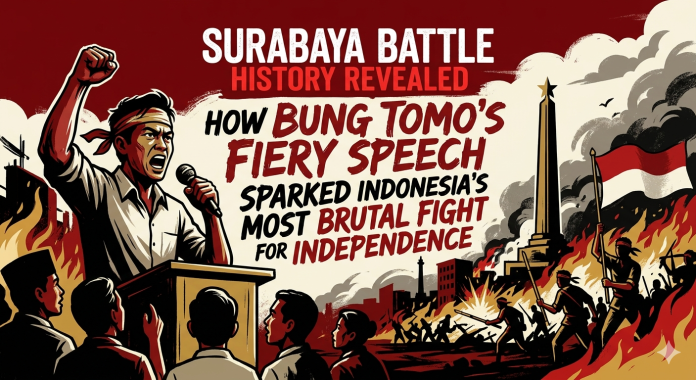

RADAR TULUNGAGUNG – The Surabaya Battle history remains one of the most defining chapters in Indonesia’s struggle for independence. The fierce resistance, driven by nationalism and unity, turned the city into a battlefield that shocked even experienced Allied forces. At the center of this struggle stood a young figure whose voice ignited courage among the people, Bung Tomo.
The Surabaya Battle history began shortly after Indonesia declared independence in August 1945. While the nation was still celebrating freedom, tension quickly escalated in East Java. In Surabaya, a city later known as the “City of Heroes,” fear and uncertainty spread as foreign troops arrived under the banner of the Allies. Although they claimed to come with neutral intentions, Indonesians suspected that colonial powers were attempting to return.
Rising Tension After Independence
The situation worsened when a foreign flag was raised at a hotel in Surabaya. This act sparked anger among local youths who had just experienced independence and refused to accept any symbol of colonial rule. In a bold move, they tore down the flag, marking the beginning of open resistance.
This moment became a turning point in the Surabaya Battle history, uniting citizens from all walks of life. Farmers, traders, students, and former soldiers began preparing themselves for the possibility of war. Their determination was fueled by a shared belief that independence must be defended at any cost.
Allied Ultimatum and Growing Conflict
As Allied forces, especially British troops, landed in Java, tensions continued to rise. Clashes broke out between Indonesian fighters and foreign soldiers. The situation escalated further when a British commander was killed during the conflict, triggering anger among Allied forces.
In response, the British issued an ultimatum demanding that Indonesian fighters surrender their weapons within a specific deadline. The warning was clear: failure to comply would result in a full-scale military attack from land, sea, and air. Surabaya faced a difficult choice, submit or resist.
Bung Tomo’s Radio Speech Ignites Resistance
At this critical moment, Bung Tomo emerged as a central figure in the Surabaya Battle history. Through radio broadcasts, he delivered powerful speeches that inspired and mobilized the people. His voice echoed across the city, calling on citizens to remain strong and united.
He famously urged Indonesians to choose between “freedom or death.” His message became a powerful rallying cry. Inspired by his words, thousands of fighters took up arms, ready to defend their homeland against a far more advanced military force.
The Battle Erupts
On November 10, 1945, the full-scale battle began. Allied forces launched heavy attacks using air strikes, naval power, and ground troops. The city was thrown into chaos as explosions and gunfire filled the streets.
Despite limited resources and weapons, many of which were seized from Japanese forces, Indonesian fighters resisted fiercely. The battle was fought from house to house and street to street. Civilians were also caught in the violence, and many lost their lives during the conflict.
Heavy Losses but Lasting Legacy
The battle lasted for nearly three weeks and caused devastating losses. Thousands of Indonesians were killed, many of them civilians. Although Indonesian forces were eventually pushed back, their resistance left a lasting impact.
Even British soldiers later admitted that the battle in Surabaya was one of the toughest they had faced after World War II. This recognition highlights the extraordinary courage and determination shown by the Indonesian people.
Why Surabaya Battle Still Matters Today
The legacy of the Surabaya Battle history continues to live on in Indonesia’s national memory. November 10 is commemorated as Heroes’ Day to honor those who sacrificed their lives for independence.
Bung Tomo’s speeches remain a symbol of unity and resistance. His ability to inspire people through words shows how powerful communication can shape history and influence collective action.
Today, Surabaya is remembered not just as a city, but as a symbol of courage and sacrifice. The battle turned it into a sea of fire, but from that destruction emerged a stronger national identity.
The story of Surabaya reminds us that independence was not simply declared, it was defended with sacrifice, courage, and unwavering determination.