
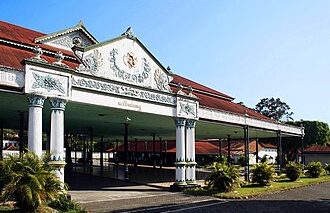

RADAR TULUNGAGUNG – The Yogyakarta Special Status remains one of the most distinctive features of Indonesia’s administrative system, with roots in a centuries-old monarchy that still plays a formal role in government. Historical decisions, royal leadership, and constitutional recognition shaped the province’s transformation from a traditional kingdom into a modern regional administration.
Unlike other provinces in Indonesia, the Special Region of Yogyakarta (DIY) maintains a governance system that recognizes the leadership of the Yogyakarta Sultanate and the Pakualaman Duchy. This arrangement reflects historical agreements dating back to the 18th century and the region’s support for the Republic of Indonesia after independence.
The legal framework for this arrangement comes from Law No. 13 of 2012 on the Special Status of Yogyakarta, which regulates the province’s unique powers and institutional structure.
From the Giyanti Agreement to a Special Region
The origins of modern Yogyakarta can be traced to the Giyanti Agreement of 1755, which divided the Mataram Sultanate into two political entities: the Yogyakarta Sultanate and the Surakarta Sunanate. Under the agreement, Prince Mangkubumi became Sultan Hamengkubuwono I and established the Yogyakarta Sultanate as a separate kingdom.
Another important institution, the Pakualaman Duchy, emerged in 1813 and later became an integral part of Yogyakarta’s political structure.
During the Dutch colonial era, the Yogyakarta Sultanate and Pakualaman retained a degree of internal autonomy through political agreements with colonial authorities. Although their powers were limited by Dutch influence, both entities continued to administer their own internal affairs and maintained recognized royal institutions.
Following Japan’s occupation during World War II, Yogyakarta continued to hold a distinct administrative position. However, the decisive moment came after Indonesia proclaimed independence in 1945.
Supporting Data and Historical Background
In September 1945, Sri Sultan Hamengkubuwono IX and Sri Paku Alam VIII declared their support for the newly established Republic of Indonesia. They affirmed that the territories of the Yogyakarta Sultanate and Pakualaman would become part of Indonesia while retaining their historical identity.
This political commitment played a significant role during Indonesia’s struggle for independence. Yogyakarta later served as the temporary capital of the Republic between 1946 and 1949 when Dutch military operations threatened Jakarta.
The province’s modern special status was formally strengthened through Law No. 13 of 2012, which grants Yogyakarta five areas of special authority. These include the procedures for filling the positions of governor and deputy governor, regional governmental institutions, cultural affairs, land management, and spatial planning.
As a result, the reigning Sultan of Yogyakarta serves as governor, while the ruler of Pakualaman serves as deputy governor, a system that differs significantly from the direct regional elections used elsewhere in Indonesia.
Impact and Why the Special Status Matters Today
The Yogyakarta Special Status continues to influence governance, cultural preservation, and regional development. Supporters argue that the arrangement protects Javanese cultural heritage while providing administrative continuity rooted in local history.
The province has also become one of Indonesia’s leading cultural and tourism destinations. Major attractions include the royal palace known as the Keraton Yogyakarta, the historic Taman Sari Water Castle, Malioboro Street, Parangtritis Beach, Baron Beach, Pindul Cave, Mangunan Pine Forest, and Breksi Cliff. These sites attract millions of domestic and international visitors each year.
At the same time, the province’s governance model continues to generate discussion among scholars and policymakers regarding the balance between democratic principles and historical traditions. Nevertheless, Indonesia’s legal framework recognizes Yogyakarta’s uniqueness as a special autonomous region.
The enduring partnership between the Yogyakarta Sultanate, Pakualaman Duchy, and the Indonesian state explains why Yogyakarta remains the country’s only province where a hereditary monarchy continues to hold a constitutionally recognized governing role.