
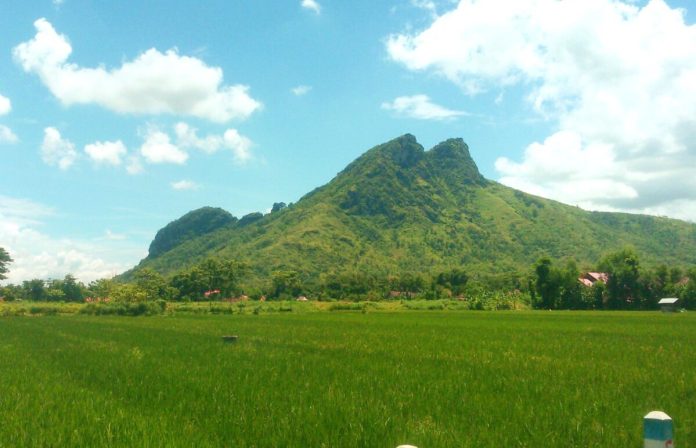

RADAR TULUNGAGUNG – Mount Budheg Tulungagung has long attracted nature lovers, hikers, and history enthusiasts who are curious about one of East Java’s most mysterious ancient volcanoes. Located only minutes from downtown Tulungagung, the hill is not just a favorite hiking destination, but also a place wrapped in folklore, spiritual stories, and historical traces dating back to the era of Ancient Mataram and Majapahit kingdoms.
The story of Mount Budheg recently resurfaced through a detailed explanation delivered by cultural preservationist Agus Utomo, a volunteer who has dedicated more than two decades to protecting the mountain and restoring its ecosystem. According to him, Mount Budheg is more than a tourist attraction because it carries geological, historical, and spiritual significance for Tulungagung society.
Agus explained that geologists believe Mount Budheg formed around 30 million years ago due to tectonic activity beneath the southern sea near the current Sanggar Beach area. Lava pathways from the ancient seabed eventually rose to the surface and created the hill now known as Mount Budheg Tulungagung.
Ancient Volcano and Megalithic Heritage
Beyond its geological origins, Mount Budheg also stores evidence of ancient civilization. Agus said megalithic communities once built menhirs on the mountain, including a stone formation now called Watu Joko Budheg. Anthropologists interpret the structure as a symbolic representation of ancestral worship practiced by early Javanese society.
During the Kediri Kingdom period, the mountain allegedly became a spiritual retreat for elderly people seeking peace before death. Agus described how ancient communities isolated themselves in the forest to meditate and prepare spiritually for the end of life.
The mountain later became associated with the legendary story of Joko Budheg and Roro Kembang Sore during the Majapahit era. Local folklore tells the story of Jokotawang, a man meditating on the mountain after falling in love with Roro Kembang Sore. His mother, Mbok Rondo Dadapan, searched for him but was not recognized during his meditation. According to the legend, her words eventually turned Joko Budheg into stone.
Mystical Stories Still Surround Mount Budheg
Even today, many hikers visiting Mount Budheg Tulungagung claim to experience unusual events. Agus admitted several visitors reported smelling flowers, incense, or mysterious fragrances while trekking through certain areas.
However, he emphasized the mountain should not be labeled as haunted. Instead, he described it as “wingit,” a sacred and spiritually respected place often associated with meditation and ancient rituals.
Agus also shared personal experiences during his years guarding the mountain. He once claimed to see elderly figures around the post area and even witnessed a strange human-like figure with a lion’s head during unusual weather conditions.
Despite the stories, Agus noted that thousands of climbers have safely reached the summit since 2011 without serious accidents. He believes the mountain still protects visitors as long as they respect nature and local traditions.
The Hidden Link Between Mount Budheg and Mataram
One of the most interesting revelations concerns the mountain’s connection to the Mataram Sultanate. Agus believes Mount Budheg has a symbolic alignment with Tulungagung’s city center similar to Yogyakarta’s famous imaginary axis linking the southern sea, royal palace, and Mount Merapi.
According to him, the mountain stands directly south of the Tulungagung regent’s office, suggesting ancient Javanese rulers intentionally positioned important structures based on spiritual and cosmological calculations.
Agus also mentioned the grave of Raden Tumenggung Surontani Kertoyudo near Mount Budheg. Historical records connect the figure to the lineage of Ki Juru Mertani, one of the founding figures of the Mataram Kingdom.
Agus Utomo’s 20-Year Mission to Save the Mountain
Aside from preserving local history, Agus has spent the last 20 years restoring Mount Budheg’s damaged forest area. He said the mountain was once nearly barren and highly vulnerable to landslides.
Starting in 2003, Agus began planting trees across the slopes using his personal funds. He admitted he initially faced suspicion from local authorities and residents who questioned his intentions.
Over time, however, the reforestation effort transformed the mountain. Vegetation coverage reportedly increased from only 10 percent to nearly 90 percent today.
Agus explained the restoration project also helped reduce erosion, flooding, and rockslide risks affecting nearby villages and agricultural land. He warned that without proper conservation, the steep slopes of Mount Budheg could become dangerous for surrounding communities.
Although he receives little financial support, Agus continues maintaining the area using most of his salary. He hopes future generations and local authorities will continue protecting Mount Budheg Tulungagung as both a natural heritage site and an important part of local history.