

RADAR TULUNGAGUNG – Ambarawa Battle 1945 stands as one of the most decisive and dramatic episodes in Indonesia’s struggle to defend its newly declared independence. Taking place just months after August 17, 1945, this battle demonstrated not only military strength but also the unity and determination of Indonesian fighters under the leadership of a young and inspiring commander, Sudirman.
The Ambarawa Battle 1945 began during a confusing period, with historical sources differing on whether the conflict started on October 20 or November 20, 1945. Regardless of the exact date, the battle unfolded during a tense time when Allied forces arrived in Central Java under the mission of disarming Japanese troops and repatriating prisoners of war.
At first, the arrival of Allied troops under the AFNEI (Allied Forces Netherlands East Indies) was welcomed by Indonesian authorities. Local leaders even provided food, shelter, and logistical support, trusting the Allies’ stated intention to assist in stabilizing post-war conditions. However, suspicion quickly arose when it became clear that Dutch colonial interests were operating alongside the Allied forces.
Rising Tension and the Spark of Conflict
Tensions escalated on October 24, 1945, when Allied forces moved into Magelang and Ambarawa to release Dutch prisoners. Instead of repatriating them, the Allies secretly rearmed these prisoners, triggering outrage among local Indonesians. This betrayal ignited clashes between Indonesian forces, known as the People’s Security Army (TKR), and the Allied troops.
The situation grew increasingly unstable, prompting Indonesian President Sukarno and British Brigadier Bethell to negotiate a ceasefire. Although an agreement was reached, the Allies soon violated it by strengthening their military position in Ambarawa, raising further suspicion among Indonesian fighters.
Strategic Importance of Ambarawa
Ambarawa was not just another town, it was a strategic gateway connecting major cities such as Yogyakarta, Surakarta, and Magelang. Control over Ambarawa meant dominance over key logistics and communication routes in Central Java.
Realizing this, Indonesian forces intensified their efforts to reclaim the area. By late November 1945, fierce battles erupted as Allied troops, supported by air power, defended their stronghold. Bombardments hit nearby villages, turning the region into a full-scale war zone.
Sudirman’s Leadership and the “Supit Urang” Strategy
The turning point in the Ambarawa Battle 1945 came after the death of Lieutenant Colonel Isdiman, a significant loss that deeply affected Colonel Sudirman. Determined to avenge his comrade and secure victory, Sudirman personally took command on the battlefield.
He introduced a brilliant military tactic known as the “supit urang” or double envelopment strategy. This maneuver aimed to encircle the enemy from both sides, cutting off their escape routes and weakening their defenses.
Under Sudirman’s leadership, Indonesian forces reorganized into four sectors, north, south, east, and west, allowing for more coordinated and effective attacks. Reinforcements from various regions, including Yogyakarta, Surakarta, and Semarang, poured into Ambarawa, strengthening the resistance.
The Final Assault and Victory
On December 12, 1945, Indonesian troops launched a coordinated offensive. Within just 30 minutes, they successfully surrounded Ambarawa. The final battle centered around Benteng Willem, the last Allied defense point.
For four days and nights, intense fighting continued. Despite heavy resistance, Indonesian forces maintained pressure. Finally, on December 15, 1945, Allied troops retreated, marking a decisive victory for Indonesia.
The triumph came at a high cost. Around 2,000 Indonesian fighters and civilians lost their lives, compared to approximately 100 Allied casualties. Nevertheless, the victory was seen as a crucial tactical success that boosted national morale.
Legacy of the Ambarawa Battle
Following the victory, Sudirman’s leadership gained nationwide recognition. Just three days later, he was promoted to Major General and appointed as the Commander-in-Chief of the Indonesian armed forces.
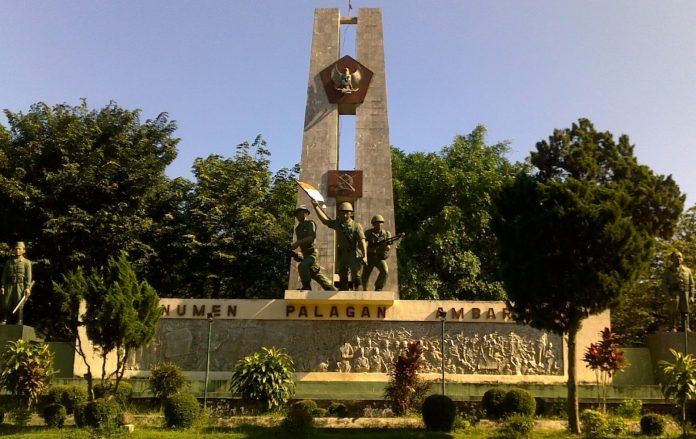
The Ambarawa Battle 1945 is now commemorated every December 15 as Indonesian Army Day (Hari Juang Kartika). A monument stands in Ambarawa as a reminder of the people’s courage and sacrifice in defending independence.
This historic battle proves that Indonesia’s independence was not merely declared, it was fiercely fought for and defended with unwavering determination.