
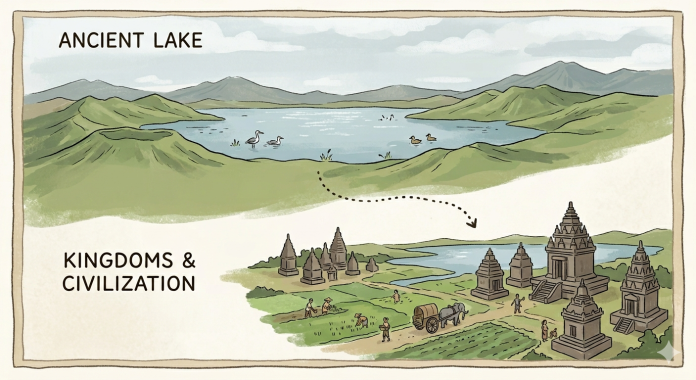

RADAR TULUNGAGUNG – The history of Malang has long fascinated historians because the region developed into one of the most influential centers of civilization in East Java despite its isolated geography. The story of the Malang ancient lake history explains how a remote highland surrounded by mountains transformed into a strategic political, cultural, and military center from the Hindu-Buddhist era until the rise of Islamic kingdoms in Java.
Historians often describe inland regions as areas that developed slowly. However, Malang broke that pattern. The fertile highland became a place where innovation, trade routes, and royal power flourished for centuries. Experts believe the people of Malang successfully adapted to geographical challenges and turned them into strategic advantages.
The Malang ancient lake history began millions of years ago during the Pleistocene era. Geological experts explained that the Malang basin was once a giant prehistoric lake formed after massive volcanic eruptions destroyed ancient stratovolcanoes. The eruptions created a gigantic caldera surrounded by mountains such as Mount Arjuno, Mount Kawi, Mount Semeru, Mount Welirang, and the Tengger range.
Malang Was Once a Giant Prehistoric Lake
At the beginning of the Pleistocene period, the area was too dangerous for human settlement because lava flows and volcanic activity dominated the landscape. Over time, volcanic activity weakened, rainwater filled the basin, and vast marshes slowly evolved into a giant ancient lake known as Danau Purba Malang.
Natural geological processes gradually changed the lake into fertile highlands. Lava deposits and cold volcanic mudflows from surrounding mountains slowly filled the basin. Meanwhile, the Brantas River carved drainage channels toward southern and western East Java, accelerating the drying process.
The result was the Malang Plateau, one of the most fertile inland regions in Java. The rich volcanic soil later supported agriculture, settlements, and major kingdoms.
Strategic Geography Made Malang Powerful
Although surrounded by mountains, Malang still had several important natural gateways connecting the region with other parts of Java. These ancient routes later became strategic transportation and military corridors.
The most important route was the Lawang corridor in northern Malang. The pathway connected Malang with Pasuruan and Surabaya, two major port regions in East Java. Historians believe this route became highly active during the Hindu-Buddhist period and remained important for centuries.
Ancient inscriptions even recorded taxes collected from travelers using the Lawang route. The strategic value of Lawang later encouraged King Wisnuwardhana to move the political center of the Tumapel Kingdom northward to Singosari.
This decision changed the political orientation of the kingdom. From Singosari, rulers could more easily access coastal trade routes and strengthen their ambitions to unify Java and the archipelago.
Malang Became the Safe Fortress of Kingdoms
The mountainous geography also turned Malang into a natural fortress. Rivers, volcanoes, and highlands protected many royal centers from outside attacks.
The Kanjuruhan Kingdom, considered the oldest kingdom in Malang and East Java, established its political center near Mount Kawi during the eighth century. The location provided natural defenses through river systems and mountain barriers.
In 929 AD, Mpu Sindok also considered the Malang area strategically important after moving the Mataram Kingdom from Central Java to East Java. Historians described Malang as a “fallback base,” a secure region for rebuilding strength during political instability.
Centuries later, several resistance leaders used the same strategy. Historical figures such as Trunojoyo, Untung Surapati, and fighters linked to Prince Diponegoro retreated to Malang to reorganize their forces after military defeats elsewhere in Java.
From Singosari to Majapahit Legacy
The glory of Malang continued during the rise of the Singosari Kingdom in the 13th century. Ken Arok, also known as Sri Ranggah Rajasa Sang Amurwabumi, established Tumapel after defeating Kediri in 1222.
The kingdom selected strategic areas protected by rivers and mountainous terrain. Historians believe this geographical advantage helped Singosari grow into one of the strongest kingdoms in Java before the rise of Majapahit.
During the golden age of the Majapahit Empire, Malang also hosted important royal territories. One of them was Kabalan, located near Bukit Buring and Kali Amprong. The area reportedly became the residence of Kusumawardhani, the crown princess and future heir connected to King Hayam Wuruk.
Even during the final years of Hindu-Buddhist power in Java, Malang remained an important defensive region. The Sengguruh kingdom in southern Malang became one of the last Hindu strongholds resisting the expansion of the Demak Sultanate.
Historical records mentioned that Demak only succeeded in conquering Sengguruh in 1545, long after many other East Javanese regions had already fallen under Islamic influence. The event marked the closing chapter of Malang’s long Hindu-Buddhist political legacy.
Today, the story of Malang ancient lake history remains one of the most remarkable examples of how geography shaped civilization in Indonesia.