
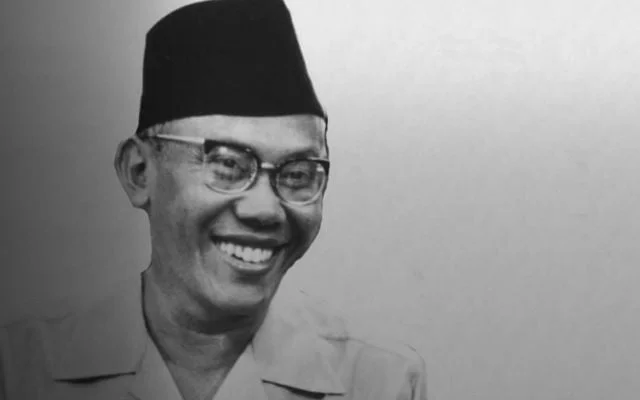

RADAR TULUNGAGUNG – The story of Indonesia’s forgotten president remains one of the most compelling yet overlooked chapters in national history. In a moment when the country nearly lost its sovereignty, Syafruddin Prawiranegara stepped forward and played a decisive role in preserving the Republic.
Born on February 28, 1911, in Banten, Syafruddin came from a noble family with roots in both Banten and Minangkabau. He showed strong intellectual curiosity from a young age, especially in literature, before eventually pursuing law at what is now the University of Indonesia. His early career as a journalist and later as a government official shaped his analytical thinking, particularly in economics.
The forgotten president narrative gained significance after Indonesia declared independence. Syafruddin quickly rose to prominence and was appointed Minister of Finance. One of his major contributions was supporting the issuance of Oeang Republik Indonesia (ORI), the country’s first official currency, which symbolized economic independence.
A Nation on the Brink
The turning point came during the Dutch Military Aggression II in December 1948. Dutch forces launched a sudden attack on Yogyakarta, the capital at that time. President Soekarno and Vice President Mohammad Hatta, along with several ministers, were captured.
This situation placed Indonesia in a dangerous position. Without a functioning central government, the country risked losing international recognition as a sovereign state. A radiogram had been sent to Syafruddin, authorizing him to form an emergency government. However, due to disrupted communications, the message never reached him.
In a remarkable coincidence, Syafruddin independently took the initiative to establish the Pemerintahan Darurat Republik Indonesia (PDRI) in West Sumatra. His decision aligned perfectly with the unseen mandate, demonstrating both instinct and leadership during crisis.
Leading Without Claiming Power
Although Syafruddin effectively held presidential authority, he refused to declare himself president. Instead, he chose to be known as chairman to avoid potential division within the nation. His decision reflected a strong commitment to unity over personal ambition.
Operating from remote areas, the PDRI functioned as a mobile government, constantly relocating to evade Dutch forces. Through international radio broadcasts, Syafruddin informed the world that Indonesia still existed and maintained its government. This directly countered Dutch claims that they had taken full control of the country.
These efforts proved crucial in maintaining global awareness and support. International pressure eventually led to negotiations, including the Roem–Van Roijen Agreement, which became a key step toward restoring Indonesian sovereignty.
Economic Recovery Efforts
After the crisis ended, Syafruddin continued to serve Indonesia in various important roles. Returning as Minister of Finance, he faced a severe economic crisis marked by high inflation and multiple currencies circulating in society.
To address this, he introduced the “Syafruddin Scissors” policy. The policy required cutting banknotes in half to reduce the money supply. While unconventional, this approach proved effective in stabilizing the economy and lowering inflation.
His contribution did not stop there. Syafruddin later became the first governor of Bank Indonesia, further strengthening the country’s financial foundation during a critical recovery period.
A Legacy of Integrity
What makes the forgotten president story even more remarkable is Syafruddin’s integrity. Despite holding high-ranking positions, he lived a modest life and never misused public funds. In fact, he and his family reportedly faced financial difficulties during his years in office.
After retiring from politics, he dedicated his life to religious activities and public service until his death in 1989. Decades later, in 2011, the Indonesian government officially recognized him as a national hero.
Syafruddin Prawiranegara’s legacy proves that true leadership is not about titles, but about responsibility. At a time when Indonesia stood on the edge of collapse, he chose to act decisively, saving the nation while refusing the highest power for the sake of unity.