
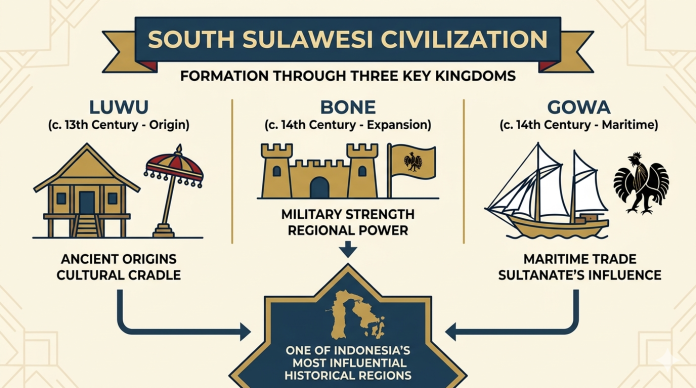

RADAR TULUNGAGUNG – Historians continue to debate the origins of South Sulawesi civilization, one of Indonesia’s most fascinating historical stories that combines mythology, archaeology, and royal chronicles. Powerful kingdoms such as Luwu, Bone, and Gowa transformed South Sulawesi into a major political and trading center between the 10th and 16th centuries.
The story of South Sulawesi civilization has long drawn connections to La Galigo, one of the world’s longest literary works. The text contains mythical narratives about divine figures descending to Earth, but scholars primarily regard it as a cultural and literary source rather than a historical record.
Despite its legendary elements, the manuscript provides valuable insight into how early communities in South Sulawesi understood leadership, social order, and the origins of their kingdoms. These traditions later helped shape regional powers that dominated eastern Indonesia for centuries.
The Rise of Early South Sulawesi Civilization
Historical traditions across South Sulawesi describe a period when fragmented communities frequently engaged in conflict. According to local chronicles, stability emerged when figures known as Tomanurung appeared and united rival groups.
Although historians consider the Tomanurung narrative a political myth that legitimized royal authority, the concept played a crucial role in state formation. Communities gradually consolidated under recognized rulers and created the foundations of organized kingdoms.
Among these kingdoms, Luwu stands out as one of the oldest and most influential. Many Bugis traditions identify Luwu as an ancestral center of Bugis culture and political development. Scholars continue to debate the kingdom’s origins, with estimates ranging from the 10th to the 14th century.
By the late medieval period, South Sulawesi hosted several major cultural groups, including the Bugis, Makassar, Toraja, and Mandar peoples. Each group developed distinct traditions and contributed to the broader evolution of South Sulawesi civilization.
Trade, Resources, and the Growth of Powerful Kingdoms
The success of the Luwu Kingdom was closely connected to its control of valuable natural resources, particularly iron ore from areas surrounding present-day Lake Matano and eastern South Sulawesi.
Historical records indicate that Luwu became an important supplier of high-quality iron used in the production of weapons and ceremonial objects. Trade networks connected the kingdom to other parts of the Indonesian archipelago, including Java, helping to expand its influence.
The kingdom’s prominence is also reflected in references found in regional literature and foreign accounts. Although historical evidence remains limited, researchers agree that Luwu played a major role in establishing long-distance commercial relationships across maritime Southeast Asia.
Another significant power was the Kingdom of Siang, located in present-day Pangkajene and Islands Regency. Portuguese sources from the 16th century describe Siang as a prosperous trading state with a substantial population and extensive commercial activity. Its strategic coastal location allowed it to thrive as a regional trade hub before being overshadowed by emerging rivals.
The Emergence of Bone and Gowa
The balance of power in South Sulawesi changed dramatically during the 15th and 16th centuries. Bone rose from a confederation of local communities into a major kingdom capable of resisting external threats.
One of the kingdom’s most celebrated rulers was La Tenrisukki, who is remembered in local chronicles for defending Bone against military campaigns involving rival powers. Bone’s political organization, including advisory councils representing different communities, contributed to its growing strength.
At the same time, Gowa emerged as an ambitious kingdom determined to expand its authority. Historical accounts suggest that Gowa gradually unified neighboring territories and strengthened its economic base through agriculture, fisheries, and maritime trade.
The eventual rise of Gowa marked a turning point in South Sulawesi history. By combining military power with strategic alliances, the kingdom became one of the most influential states in eastern Indonesia.
Underlying many aspects of South Sulawesi society was the philosophy of siri’, a concept emphasizing honor, dignity, and social responsibility. Historians note that this value system influenced both cooperation and conflict among regional kingdoms.
The history of South Sulawesi civilization ultimately reflects centuries of cultural exchange, political competition, and economic development. While legends such as La Galigo continue to shape regional identity, historical evidence highlights the enduring legacy of kingdoms like Luwu, Bone, and Gowa in shaping one of Indonesia’s most influential civilizations.