
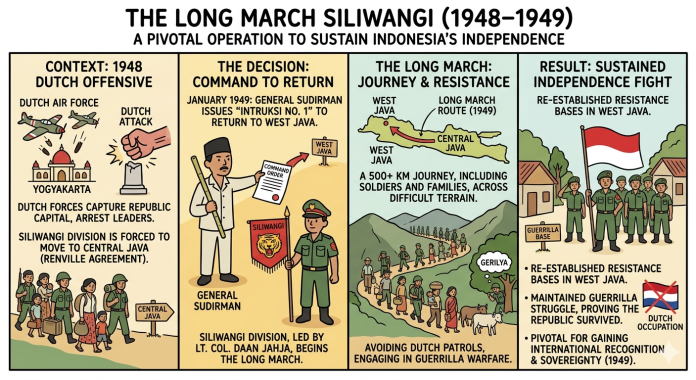

RADAR TULUNGAGUNG – The Long March Siliwangi became one of the most remarkable military operations during Indonesia’s struggle for independence. After Dutch forces launched their Second Military Aggression in December 1948, thousands of soldiers from the Siliwangi Division marched hundreds of kilometers from Central Java back to West Java to continue resisting Dutch occupation.
The Long March Siliwangi unfolded at a critical moment in the Indonesian National Revolution. Dutch troops captured Yogyakarta, the Republican capital, on December 19, 1948, and arrested key leaders including Sukarno and Mohammad Hatta. The offensive shattered the political framework created by the Renville Agreement and forced Indonesian forces to reorganize their resistance.
Acting on orders from Commander-in-Chief General Sudirman, the Siliwangi Division began a difficult journey across enemy-controlled territory. The operation later became a symbol of loyalty, endurance, and determination in defending Indonesia’s independence.
The Strategic Return to West Java
The Long March Siliwangi was not a conventional military movement. Unlike the earlier troop relocation mandated by the Renville Agreement, the return journey took place behind enemy lines during active warfare.
Approximately 12 battalions from three Siliwangi brigades participated in the operation, accompanied by divisional headquarters personnel and thousands of family members. Historical records indicate that the total number of people involved may have exceeded 30,000, including soldiers, women, children, and elderly relatives who had followed the division during its earlier relocation.
To avoid detection by Dutch forces, the columns moved primarily on foot through forests, valleys, plantations, rivers, and remote villages. Major roads and urban centers were largely avoided. Several routes were used simultaneously, stretching from the Yogyakarta and Surakarta regions through Central Java toward West Java.
Military historians often describe the operation as “Wingate Action,” referring to a deep-penetration maneuver designed to infiltrate occupied territory while avoiding large-scale engagements. The objective was straightforward: preserve combat strength, reach West Java intact, and continue long-term guerrilla warfare against Dutch occupation forces.
Harsh Conditions and Heavy Sacrifices
The journey, conducted during the rainy season of December 1948 and January 1949, exposed participants to severe hardships.
One of the most difficult obstacles was crossing the Serayu River in Central Java. Floodwaters swept away people, weapons, and supplies. Veterans later recalled witnessing family members and comrades disappear in the strong currents. Food shortages also became a recurring problem, particularly in mountainous regions around Mount Slamet.
Although the Siliwangi Division sought to avoid combat whenever possible, clashes with Dutch forces occasionally occurred. In areas such as Bantarkawung, Brebes Regency, Dutch troops reportedly deployed aircraft, including fighter and bomber units, to attack marching columns and civilian groups accompanying them.
Despite these dangers, the division succeeded in maintaining cohesion throughout the operation. Some groups spent more than three weeks walking before finally reaching West Java.
Legacy in Indonesia’s Independence Struggle
Upon returning to West Java in early 1949, Siliwangi forces re-established guerrilla bases and intensified resistance against Dutch military control. Their return also strengthened opposition to the Dutch-backed State of Pasundan, a federal entity created by the Netherlands as part of its political strategy in West Java.
The division faced additional challenges from forces associated with the Darul Islam movement led by Sekarmadji Maridjan Kartosuwiryo, but it also received substantial support from local communities. Many residents provided food, shelter, intelligence, and logistical assistance, enabling the guerrilla campaign to continue.
Today, the Long March Siliwangi is remembered as a defining chapter of the Indonesian National Revolution. Memorials across West Java commemorate the sacrifices made by the soldiers and civilians who endured the trek. Military historians regard the operation as a powerful demonstration of discipline, perseverance, and commitment to defending Indonesia’s sovereignty during one of the most critical periods of the independence war.
The march ultimately proved that despite territorial losses and the capture of national leaders, the Republic’s military resistance remained intact. For many Indonesians, the Long March Siliwangi continues to symbolize the determination to preserve national independence against overwhelming odds.