
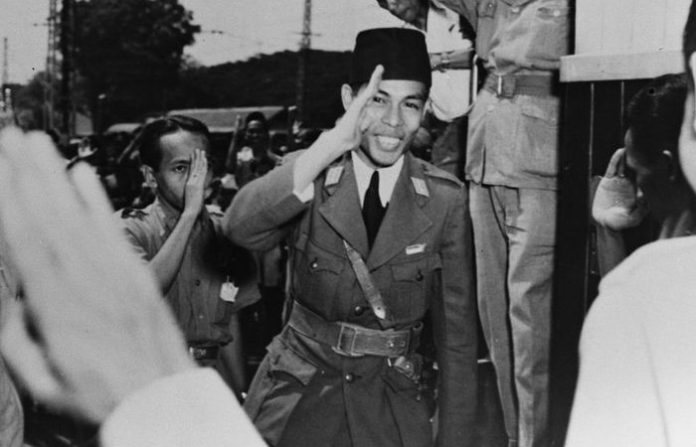

RADAR TULUNGAGUNG – The General Sudirman guerrilla war remains one of the most remarkable chapters in Indonesia’s struggle for independence. Despite suffering from severe tuberculosis and losing much of his lung function, General Sudirman led a months-long guerrilla campaign against Dutch forces during the Indonesian National Revolution, helping demonstrate that the Republic of Indonesia remained alive despite military setbacks and the capture of its political leaders.
The campaign unfolded during the Dutch Military Aggression II of 1948–1949, when Dutch troops launched a major offensive against the Republican government. As Dutch forces occupied Yogyakarta, then the capital of the Republic, many national leaders, including President Soekarno and Vice President Mohammad Hatta, were arrested and exiled. While the political leadership fell into Dutch hands, Sudirman chose to continue the fight from the countryside.
His decision transformed him into a symbol of resistance and national determination, cementing his reputation as one of Indonesia’s most respected military leaders and national heroes.
The Rise of General Sudirman and His Commitment to Independence
Born on January 24, 1916, in Purbalingga, Central Java, General Sudirman started his career as a teacher and youth leader within Muhammadiyah. He actively participated in Hizbul Wathan, the organization’s scouting movement, and earned respect for his dedication to education and public service.
During the Japanese occupation, Sudirman entered the Japanese-sponsored PETA military training program to develop his military skills. Military leaders quickly recognized his leadership abilities, and in August 1944 they appointed him as a battalion commander.
Following Indonesia’s declaration of independence on August 17, 1945, Sudirman joined the newly established military forces of the Republic. His leadership during the Battle of Ambarawa in late 1945 proved decisive. Indonesian forces successfully pushed back British-led Allied troops, a victory that significantly boosted morale during the early stages of the revolution.
The victory at Ambarawa elevated Sudirman’s standing within the military ranks. In November 1945, he was elected Commander-in-Chief of the Indonesian armed forces, becoming the first high-ranking military leader in the nation’s history.
Dutch Military Aggression II and the Guerrilla Campaign
On December 19, 1948, Dutch forces launched Operation Kraai, attacked Yogyakarta, and sought to eliminate the Republican government. The offensive resulted in the capture of Soekarno, Hatta, and several senior leaders.
Contrary to some popular narratives, the Republican leadership deliberately remained in Yogyakarta and accepted arrest to strengthen Indonesia’s diplomatic position internationally while the military continued resistance. Meanwhile, the Emergency Government of the Republic of Indonesia (PDRI), led by Sjafruddin Prawiranegara, operated from Sumatra to ensure governmental continuity.
Although seriously ill with tuberculosis, Sudirman refused to surrender. On December 22, 1948, he left Yogyakarta and began a guerrilla campaign across Central and East Java. Because of his deteriorating health, his soldiers often carried him on a stretcher while he directed military operations.
For nearly seven months, Sudirman and his troops carried out hit-and-run attacks against Dutch positions, disrupted enemy supply lines, and maintained communication with Republican forces. His determination earned widespread admiration and gave rise to the famous description that he fought with “only one functioning lung.”
International Pressure, the Yogyakarta Offensive, and Lasting Legacy
While guerrilla warfare continued, Indonesia also pursued diplomatic efforts through the United Nations. International pressure on the Netherlands increased as evidence mounted that Republican resistance remained active.
A major turning point occurred on March 1, 1949, when Indonesian forces launched the General Offensive of 1 March. Then-Lieutenant Colonel Suharto directed the operation, and Indonesian troops temporarily recaptured large parts of Yogyakarta. The operation demonstrated to the international community that the Republic had not been defeated.
Growing pressure from the United Nations and the United States eventually pushed the Netherlands toward negotiations. The Netherlands and Indonesia announced a ceasefire on August 1, 1949, paving the way for the Round Table Conference.
Although Sudirman expressed reservations about aspects of the political settlement, he consistently emphasized civilian supremacy over the military. He maintained that the armed forces existed to serve the state and the nation rather than political interests.
Just months after the Netherlands recognized Indonesian sovereignty, General Sudirman died from illness in Magelang on January 29, 1950, at the age of only 34. His sacrifice, leadership, and unwavering commitment to Indonesian independence continue to inspire generations of Indonesians and remain central to the history of the nation’s revolution.
The story of the General Sudirman guerrilla war stands as a testament to resilience under extraordinary circumstances, illustrating how military resistance, diplomatic pressure, and national unity combined to secure Indonesia’s independence.