
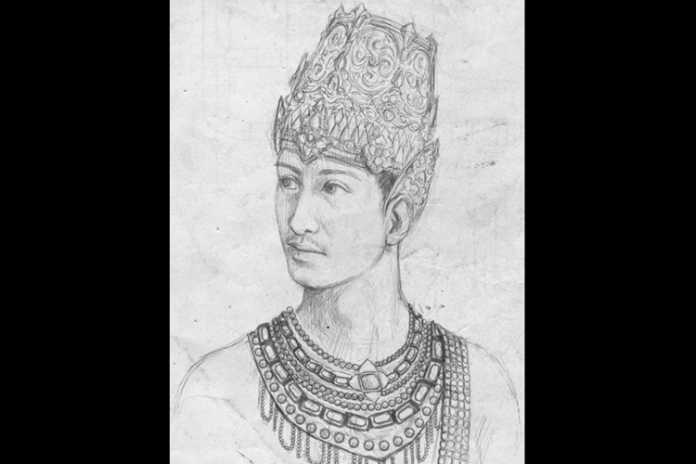

RADAR TULUNGAGUNG – The story of Hayam Wuruk continues to draw attention as historians revisit how his leadership shaped the golden age of the Majapahit Empire and inspired the philosophy behind Bhinneka Tunggal Ika. The keyword Hayam Wuruk and Bhinneka Tunggal Ika origins remains highly relevant, especially when tracing the roots of Indonesia’s unity.
Hayam Wuruk, the fourth ruler of Majapahit, ascended the throne in 1350 at just 16 years old. Despite early doubts about his leadership due to his young age, he quickly proved his capability. His reign marked a turning point in the empire’s history, transforming Majapahit into a dominant political and economic power in Southeast Asia.
The concept of Hayam Wuruk and Bhinneka Tunggal Ika origins becomes clearer when examining how he governed a vast and diverse territory. His leadership emphasized harmony among different ethnicities, cultures, and beliefs, principles that later inspired the famous motto written by Mpu Tantular in the Kakawin Sutasoma.
Early Life and Leadership Formation
Born under extraordinary natural phenomena, earthquakes, heavy rain, and a volcanic eruption, Hayam Wuruk was believed to be destined for greatness. His mother, Tribhuwana Tunggadewi, carefully prepared him for leadership by involving him in royal meetings from a young age.
He was also mentored by the legendary prime minister Gajah Mada, who instilled values of courage, justice, and diplomacy. This mentorship played a crucial role in shaping his political maturity and strategic thinking.
Overcoming Early Challenges
At the beginning of his reign, Hayam Wuruk faced skepticism and internal rebellions, particularly in Bali and Blambangan. However, with guidance from Gajah Mada, he successfully suppressed these uprisings through a combination of military strength and diplomatic negotiation.
This period proved essential in establishing his authority. His ability to manage conflict strengthened public trust and solidified his position as a capable ruler.
Economic Growth and Infrastructure Expansion
Under Hayam Wuruk’s rule, Majapahit experienced rapid economic development. Through a foreign policy known as mitreka satata, the kingdom built equal partnerships with other states. This strategy allowed Majapahit to expand trade networks, exporting commodities such as rice, spices, and textiles.
Infrastructure also advanced significantly. Roads connecting central and regional territories improved mobility and trade efficiency. Several temples, including Candi Tikus and Candi Jabung, were constructed, reflecting both religious devotion and architectural achievement.
Cultural and Literary Flourishing
The golden age of Majapahit was not limited to politics and economics. Literature thrived during this era. Besides Mpu Tantular, another prominent figure, Mpu Prapanca, wrote the Nagarakretagama, documenting the empire’s grandeur.
It was within this cultural context that Bhinneka Tunggal Ika emerged, symbolizing unity amidst diversity. The phrase encapsulated Hayam Wuruk’s inclusive governance, making it a lasting legacy that continues to define Indonesia today.
The Beginning of Decline
Despite its peak, Majapahit’s stability began to falter due to internal conflicts. One major turning point was the Bubat War in 1357, which strained relations between Hayam Wuruk and Gajah Mada.
After Gajah Mada’s departure, the empire struggled to maintain strong leadership. Following Hayam Wuruk’s death in 1389, power divisions among his heirs led to civil war, notably the Paregreg conflict. These internal disputes gradually weakened Majapahit’s dominance.
Enduring Legacy
Although the empire eventually collapsed in the early 16th century, the legacy of Hayam Wuruk remains influential. His reign represents a rare moment of unity, prosperity, and cultural brilliance in Indonesian history.
The phrase Bhinneka Tunggal Ika, rooted in the Hayam Wuruk and Bhinneka Tunggal Ika origins, stands as a timeless reminder that diversity can coexist within unity, an idea as relevant today as it was centuries ago.