
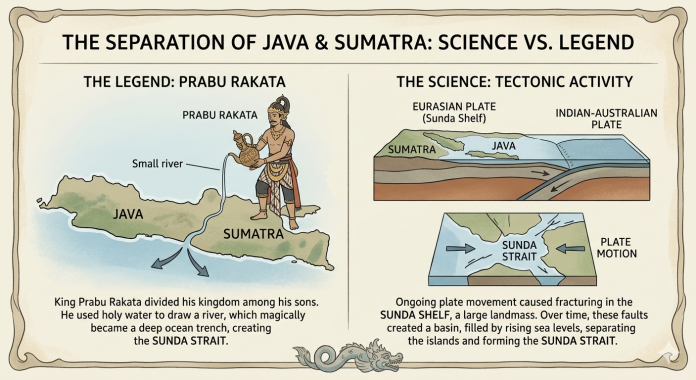

RADAR TULUNGAGUNG – The separation of Java and Sumatra has long fascinated Indonesians, inspiring both geological research and the enduring legend of Prabu Rakata. While folklore attributes the formation of the Sunda Strait to a dramatic royal conflict, modern science points to tectonic activity and ancient sea-level changes as the true drivers behind the region’s geography.
For centuries, stories about the origins of the Sunda Strait have circulated across Indonesia. Among the most popular is the tale of Prabu Rakata, a legendary king whose actions supposedly led to the division of a vast landmass into what are now Java and Sumatra. However, geological studies suggest that the reality is far more complex and spans thousands of years of Earth’s natural evolution.
The debate continues to attract attention because it combines two powerful narratives: Indonesia’s rich cultural heritage and scientific efforts to understand how one of the world’s largest archipelagic nations took shape.
Understanding How Java and Sumatra Became Separate Islands
Geologists agree that Java and Sumatra were once connected through a broader landmass known as the Sunda Shelf, a vast continental extension that also linked much of present-day western Indonesia during periods of lower sea levels.
During the last Ice Age, significant amounts of the Earth’s water were trapped in glaciers, causing sea levels to fall dramatically. This exposed large areas of land that connected regions now separated by water, including parts of Java, Sumatra, and Borneo.
As global temperatures increased and glaciers melted, sea levels rose and gradually flooded these low-lying areas. The process transformed the connected landmass into separate islands and helped shape the modern geography of Indonesia.
Scientists also point to ongoing tectonic activity along the boundary between the Indo-Australian and Eurasian plates as a major factor in the region’s geological evolution. These movements contributed to the formation of volcanic systems and marine channels, including the area now occupied by the Sunda Strait.
Krakatau, Ancient Eruptions, and Historical Theories
One theory often cited in discussions about the separation of Java and Sumatra involves an ancient eruption of Krakatau. The idea gained popularity through the writings of nineteenth-century Javanese poet and scholar Ronggowarsito, particularly in accounts that linked a catastrophic volcanic event to major geographic changes.
Some historical interpretations suggested that a massive eruption around 416 CE dramatically altered the landscape. However, modern geological research has not confirmed that such an eruption caused Java and Sumatra to split apart.
Researchers acknowledge that prehistoric eruptions in the Krakatau region may have significantly reshaped local environments. Nevertheless, experts generally view the formation of the Sunda Strait as the result of long-term geological processes rather than a single catastrophic event.
The famous 1883 eruption of Krakatau demonstrated the volcano’s destructive power, generating tsunamis and altering nearby coastlines. Yet even that historic disaster did not create the separation between Java and Sumatra.
The Legend of Prabu Rakata and Its Cultural Legacy
Beyond science, the story of Prabu Rakata remains an important part of local folklore. According to the legend, the king divided his kingdom between his sons to prevent conflict. When rivalry eventually erupted, Prabu Rakata intervened and miraculously split the land, creating the Sunda Strait.
The tale further claims that a vessel left behind by the king transformed into a mountain later associated with Krakatau. Over generations, the narrative became intertwined with local explanations for the region’s dramatic landscape.
Historians and cultural experts regard the story as a mythological tradition rather than a factual account of geological history. Nevertheless, the legend continues to hold cultural significance because it reflects how communities interpreted natural phenomena before the development of modern earth sciences.
The enduring fascination with both the Sunda Strait and Prabu Rakata illustrates how folklore and scientific inquiry can coexist, offering different perspectives on Indonesia’s remarkable natural history.
In the end, scientific evidence indicates that the separation of Java and Sumatra resulted from ancient sea-level changes and tectonic processes over thousands of years, while the legend of Prabu Rakata survives as a treasured cultural story that continues to captivate generations.