
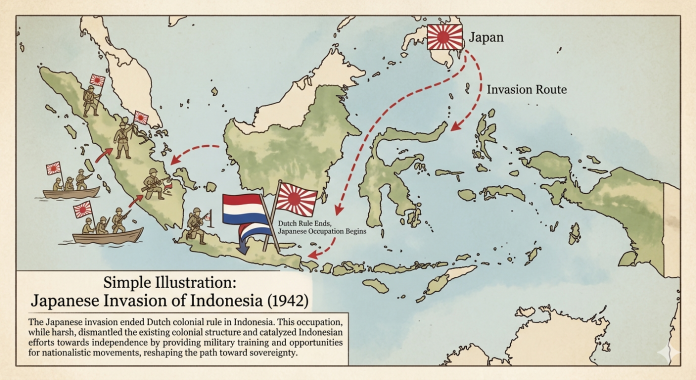

RADAR TULUNGAGUNG – Indonesia’s Japanese invasion in 1942 marked one of the fastest military collapses in colonial Southeast Asian history, ending more than three centuries of Dutch rule and dramatically reshaping the political future of the archipelago. Within a matter of months, Japanese forces swept through strategic oil-producing regions before securing Java, the administrative heart of the Dutch East Indies.
The campaign unfolded amid the broader conflict of World War II, following Japan’s attack on Pearl Harbor on December 7, 1941. As Japanese forces rapidly expanded across the Asia-Pacific region, Japanese military planners identified the resource-rich Dutch East Indies as a key target because of its vast oil reserves, strategic location, and economic importance.
Long before launching its military offensive, Japan had attempted to secure access to Indonesian natural resources through diplomatic negotiations with the Dutch colonial administration. However, talks held between late 1940 and early 1941 failed after the Netherlands rejected Japanese demands for greater access to vital commodities needed for wartime production.
Japan’s Strategic Push Into the Dutch East Indies
Tokyo viewed the Dutch East Indies as a crucial component of its vision for the Greater East Asia Co-Prosperity Sphere, an ambitious project aimed at establishing Japanese dominance across East and Southeast Asia.
After diplomatic efforts collapsed, Japan turned to military action. At the same time, Japanese authorities launched propaganda campaigns to win support among Indonesians by portraying Japan as a liberator that would free Asian nations from Western colonial rule. Radio stations broadcast messages promoting Asian solidarity across the archipelago, although many Indonesian intellectuals remained skeptical and viewed Japanese expansionism as another form of imperialism.
The military campaign accelerated in early 1942. Japanese troops captured Tarakan, one of the region’s most important oil-producing centers, on January 11, 1942. Balikpapan followed later that month, while Palembang, home to major oil facilities in Sumatra, fell in February.
These victories gave Japan control of critical energy supplies and opened the path toward Java, where the Dutch colonial government concentrated its remaining defenses.
Why Dutch Defenses Failed
Facing Japan’s rapid advance, the Netherlands joined Allied efforts through the ABDA Command, a joint military structure involving American, British, Dutch, and Australian forces. Established in January 1942, the command aimed to coordinate regional defense against Japanese expansion.
Despite these efforts, Allied forces suffered from limited resources, poor coordination, and overwhelming Japanese superiority in manpower and mobility. Dutch authorities also faced a strategic dilemma. While local participation could have strengthened resistance, colonial leaders feared arming large numbers of Indonesians because it could weaken Dutch control after the war.
As a result, Dutch military planners relied heavily on a scorched-earth strategy. Oil installations, transportation networks, bridges, railways, and industrial facilities were destroyed to prevent them from falling into Japanese hands.
However, these measures failed to stop Japan’s advance.
On March 1, 1942, Japanese troops landed at multiple locations on Java. Their forces significantly outnumbered Dutch defenders and moved rapidly toward major urban centers. Within days, Japanese units occupied key military positions and pushed Allied forces toward Bandung.
The End of Dutch Rule and the Beginning of Japanese Occupation
The decisive moment came on March 8, 1942, when Dutch colonial authorities formally surrendered to Japan at Kalijati Airfield in West Java. The capitulation effectively ended Dutch rule in the archipelago and placed Indonesia under Japanese military administration.
Japan subsequently divided the territory into separate military zones. Java and Madura fell under the Japanese Army’s 16th Army headquarters, Sumatra was administered by the 25th Army, while eastern regions including Sulawesi, Kalimantan, Maluku, and Nusa Tenggara came under Japanese naval control.
The occupation introduced sweeping political, social, and economic changes. Japanese authorities mobilized Indonesian youth through organizations such as Seinendan, Heiho, and PETA while intensifying wartime production efforts. Education systems were reorganized, Dutch influence was removed from public life, and the use of the Indonesian language expanded significantly.
Although Japan initially promoted itself as a liberator, harsh wartime policies and growing economic hardship gradually eroded public support. Yet the occupation also unintentionally strengthened Indonesian nationalism, creating political momentum that would contribute to the country’s declaration of independence in August 1945.
The Japanese invasion of Indonesia therefore represented more than a military conquest. It marked the collapse of European colonial dominance in the archipelago and set in motion the events that ultimately led to the birth of modern Indonesia.