
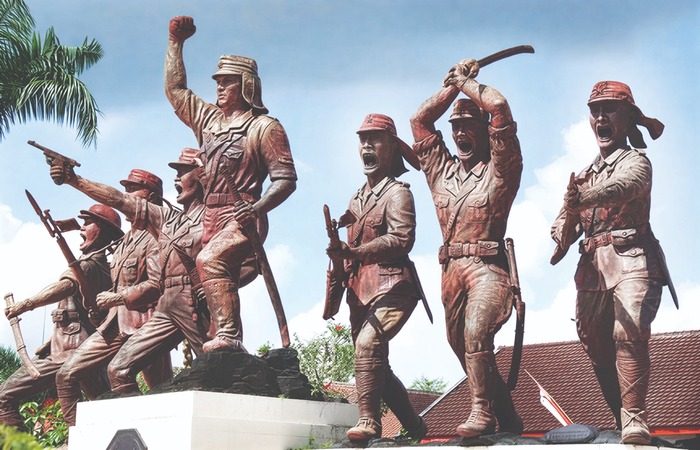

RADAR BLITAR – The Blitar PETA Rebellion is once again capturing national attention. This time, artists in East Java are reviving the historic 1945 uprising through a large-scale theatrical performance.
The rebellion broke out in the early hours of February 14, 1945. At that moment, soldiers from Pembela Tanah Air (PETA) launched an armed revolt against Japanese occupation forces. Although the uprising ultimately failed, it marked a crucial turning point in Indonesia’s struggle for independence.
Today, artists believe the story must not fade. Therefore, they are bringing it back to life on stage.
In 1992, playwright and director Bagus Putuparto transformed the PETA Monument area in Blitar into an open-air stage. Through that production, he introduced the first colossal drama centered on the Blitar PETA Rebellion.
At the time, Bagus drew inspiration from Surabaya’s iconic November 10 performances, which celebrate Bung Tomo. However, he wanted Blitar to have its own symbol of resistance. As a result, he chose Soeprijadi as the central figure.
“In Blitar, I searched for a patriotic icon,” Bagus explained. “Eventually, I found that figure in Soeprijadi.”
Soeprijadi led the rebellion before disappearing after its collapse. Nevertheless, Indonesians later honored him as a national hero. His story continues to spark debate and fascination.
From the beginning, Bagus involved young people in the production. He collaborated with Barisan Seniman Muda Blitar, an arts collective founded in 1991. In addition, he invited university and high school theater groups to participate.
Consequently, the performance became more than a historical reenactment. Instead, it turned into a space for youth engagement and cultural education.
Young performers did not merely memorize scripts. Rather, they explored the emotional weight of occupation, fear, and resistance. Through that process, they connected personally with Indonesia’s past.
To ensure accuracy, Bagus conducted direct interviews with former PETA members. He also spoke with leaders of YAPETA, an association of ex-PETA soldiers.
Among them was Shodanco Parto Hardjono, who played a role in raising Indonesia’s red-and-white flag during that turbulent era. These testimonies strengthened the script’s credibility.
Moreover, Bagus relied on literary influences. He drew from the works of Chairil Anwar and Usmar Ismail to capture the emotional climate of Japanese occupation. As a result, the performance balanced historical research with poetic expression.
Rather than pursue strict realism, he emphasized symbolism and visual impact. Thus, the drama delivered both historical depth and artistic intensity.
More than three decades later, the Blitar PETA Rebellion drama has evolved into a major annual event. Each February, organizers restage the colossal production in Blitar City.
Under director Redi Wisono and his team, the performance has expanded in scale and technical sophistication. This year’s production, titled “Alap-Alap Daidan PETA Blitar,” takes place at Plaza Park near the PETA Museum.
As attendance grows, community support also strengthens. Students, artists, and residents collaborate closely. Consequently, the event now stands as one of Blitar’s most anticipated cultural programs.
The revival of the Blitar PETA Rebellion reflects more than nostalgia. Instead, it signals a deliberate effort to preserve national memory.
History often lives quietly in textbooks. However, theater gives it movement, voice, and emotion. Through performance, audiences do not just learn about resistance — they experience it.
Ultimately, the stage becomes a bridge between generations. By transforming history into art, Blitar’s creative community ensures that the spirit of courage and sacrifice remains alive in modern Indonesia.