
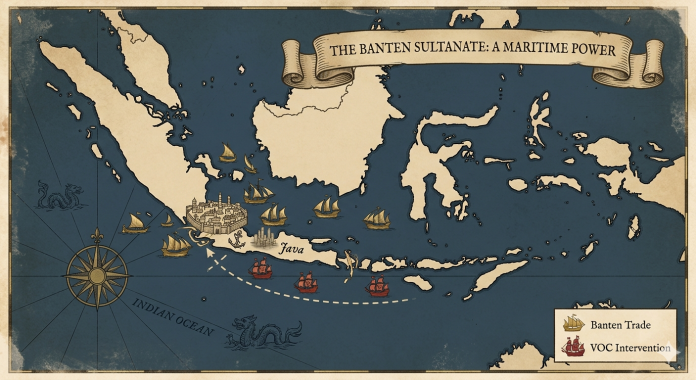

RADAR TULUNGAGUNG – Banten Sultanate once stood among Southeast Asia’s most influential maritime powers, transforming the port of Banten into a thriving international trading hub during the 16th and 17th centuries. Its strategic location near the Sunda Strait helped connect merchants from Asia, the Middle East, Africa, and Europe, making Banten a key center in the global spice trade.
In its heyday, the Banten Sultanate controlled one of the busiest ports in the Indonesian archipelago. Historical records describe ships from China, India, Persia, Arabia, and Europe arriving regularly to trade pepper and other valuable commodities. The prosperity generated by maritime commerce helped turn Banten into a cosmopolitan city known for its diversity, commercial openness, and diplomatic reach.
The rise of the Banten Sultanate also demonstrated how maritime kingdoms in the Indonesian archipelago could compete with major regional powers by embracing international trade rather than restricting it.
The Rise of Banten as a Maritime Trading Power
The origins of the Banten Sultanate date to the early 16th century, when Muslim forces led by Syarif Hidayatullah, widely known as Sunan Gunung Jati, gained control of the Banten region from the Sunda Kingdom. Banten later emerged as an independent Islamic state under Sultan Maulana Hasanuddin, who ruled from 1552 to 1570 and is recognized as the first Sultan of Banten.
One of Hasanuddin’s most significant decisions was relocating the political center closer to the coast, allowing Banten to develop as a major maritime city. The new capital, known today as Old Banten, grew around the bustling port and the royal palace of Surosowan.
Banten’s geographic position near the Sunda Strait proved crucial. The waterway served as an alternative route linking the Indian Ocean and the South China Sea, especially for merchants seeking options beyond the Strait of Malacca. This strategic location enabled Banten to become a major distribution center for pepper, one of the most sought-after commodities in global trade.
Historical accounts indicate that the sultanate adopted relatively low customs duties and encouraged merchants of different nationalities to conduct business freely. These policies attracted traders from across Asia and beyond, strengthening Banten’s reputation as an open commercial hub.
Pepper Trade, International Diplomacy, and Economic Expansion
Banten’s economy flourished largely because of the pepper trade. The kingdom established strong commercial ties with pepper-producing regions in Lampung, ensuring a steady supply of one of the world’s most valuable spices.
The sultanate also pursued diplomatic relations with foreign powers, including Portugal, England, and other Asian states. Rather than allowing a single foreign power to dominate commerce, Banten generally promoted competition among merchants.
The kingdom reached its peak under Sultan Ageng Tirtayasa, who ruled from 1651 to 1683. Historians often describe his reign as the golden age of Banten. During this period, the port expanded its trade networks across Asia, while diplomatic missions connected the sultanate with major maritime powers.
Contemporary accounts portray Banten as a prosperous and multicultural city where people of different ethnic and religious backgrounds lived and traded together. European travelers frequently praised the city’s commercial vitality and relative openness.
Conflict With VOC and the Fall of a Maritime Empire
Despite its success, Banten’s growing influence increasingly threatened the interests of the VOC, the Dutch East India Company, which sought to monopolize trade in the region.
Tensions escalated throughout the 17th century as the VOC attempted to expand its control over maritime commerce in Java. The conflict intensified when a succession dispute emerged within the royal family. Sultan Ageng Tirtayasa opposed Dutch influence, while his son, Sultan Haji, sought VOC support during a struggle for power.
The VOC exploited the internal conflict and ultimately backed Sultan Haji. Following the civil war, Banten lost much of its political independence and became increasingly dependent on Dutch power. By 1683, the once-independent trading state had effectively fallen under VOC influence.
The decline continued during the 18th century as Dutch authorities tightened control over trade and political succession. In 1808, Governor-General Herman Willem Daendels ordered military action against Banten, resulting in the destruction of the Surosowan Palace. A few years later, in 1813, the British administration under Thomas Stamford Raffles formally dissolved the Banten Sultanate, bringing nearly three centuries of history to an end.
The story of Banten remains a powerful reminder of how maritime trade, diplomatic openness, and strategic geography once enabled an Indonesian kingdom to become one of Southeast Asia’s most influential commercial centers before colonial intervention reshaped the region’s political landscape.