
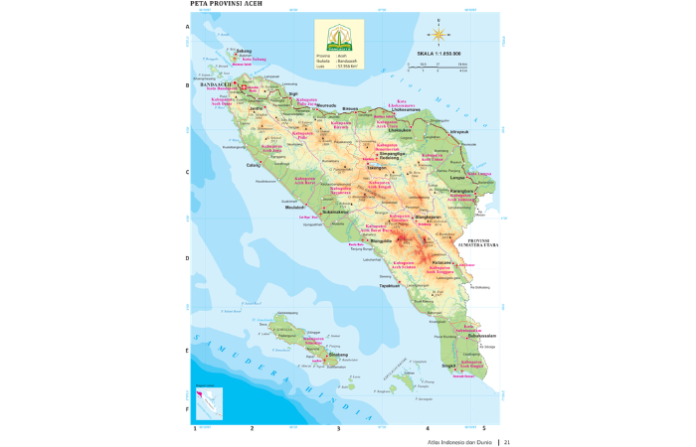

RADAR TULUNGAGUNG – Aceh history stands apart from much of Indonesia, shaped by centuries of Islamic influence, powerful sultanates, fierce resistance to colonial rule, and a modern peace process that emerged from one of the country’s deadliest conflicts. Today, Aceh remains the only Indonesian province with special autonomy allowing the implementation of Islamic law, reflecting a historical identity forged over hundreds of years.
Located at the northern tip of Sumatra, Aceh is home to diverse ethnic communities, including Acehnese, Gayo, Alas, Tamiang, Aneuk Jamee, and several others. The province recognizes more than ten local languages, while the Acehnese language serves as a major lingua franca in coastal areas.
Aceh’s distinct identity extends beyond language and culture. Local customs, known as adat, continue to play a central role in daily life, often operating alongside religious institutions and Islamic traditions that have shaped the region for centuries.
The Historical Roots of Aceh’s Islamic Identity
Much of Aceh history is closely linked to the spread of Islam in Southeast Asia. Historians generally agree that Muslim traders from Arabia, Persia, and India established commercial and religious networks in northern Sumatra between the 12th and 13th centuries.
One of the earliest confirmed Islamic states in the Indonesian archipelago was the Samudera Pasai, which emerged during the 13th century. The kingdom became an important center of trade and Islamic scholarship. Moroccan traveler Ibn Battuta visited the kingdom in the 14th century and described its ruler and population as deeply committed to Islam.
By the early 16th century, Ali Mughayat Syah unified several smaller kingdoms and established the powerful Aceh Sultanate. Under his successors, Aceh expanded its influence throughout the region and emerged as a major political and religious center.
The sultanate reached its peak during the reign of Iskandar Muda between 1607 and 1636. During this period, Aceh controlled significant portions of Sumatra’s western and eastern coasts and exerted influence across parts of the Malay Peninsula. International merchants traded pepper, gold, and spices through Acehnese ports, while renowned Islamic scholars contributed to the kingdom’s intellectual life.
Aceh War Became One of the Longest Colonial Conflicts
Following the decline of the Aceh Sultanate, Dutch colonial ambitions increasingly focused on the region. Tensions escalated into the Aceh War, which began in 1873 and became one of the longest and costliest colonial wars fought by the Netherlands.
The conflict produced legendary resistance figures such as Teuku Umar, Cut Nyak Dien, Cut Nyak Meutia, and Teungku Chik di Tiro.
Historians estimate that the war claimed tens of thousands of lives. Although Dutch forces gradually established control, armed resistance continued well into the early 20th century, making Aceh a symbol of anti-colonial determination.
From Independence Struggles to the Helsinki Peace Agreement
Aceh played a crucial role in Indonesia’s independence movement. During the late 1940s, local leaders and merchants famously donated approximately 20 kilograms of gold to help fund the purchase of the aircraft known as Seulawah RI-001, a contribution later praised by Sukarno.
However, tensions between Aceh and Jakarta resurfaced in the decades after independence. Disputes over regional autonomy, Islamic governance, natural resource management, and political representation fueled dissatisfaction.
In 1976, Hasan di Tiro established the Gerakan Aceh Merdeka (GAM), launching an insurgency that would continue for nearly three decades. The conflict intensified during the military operations period of the late 1980s and 1990s, leaving deep social and humanitarian scars.
A turning point came after the devastating 2004 Indian Ocean tsunami on December 26, 2004, which killed more than 170,000 people in Aceh alone. The tragedy created momentum for negotiations between GAM and the Indonesian government.
On August 15, 2005, both sides signed the Helsinki Memorandum of Understanding in Finland. The agreement granted Aceh expanded autonomy, allowed local political parties, strengthened self-governance, and formally ended decades of armed conflict.
Today, Aceh remains one of Indonesia’s most unique provinces. Its identity reflects a blend of Islamic tradition, local customs, historical resilience, and a hard-won peace that continues to shape the region’s future.