
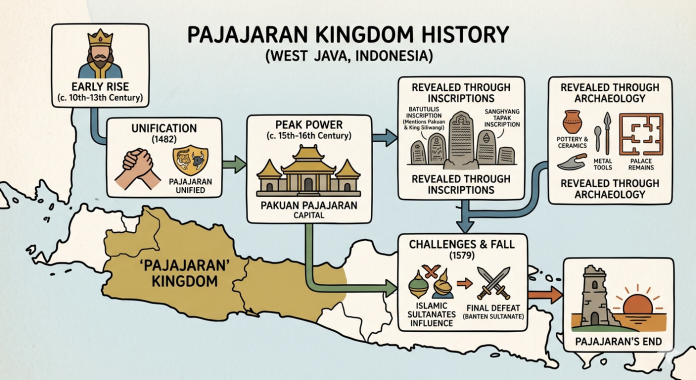

RADAR TULUNGAGUNG – The Pajajaran Kingdom, one of the most influential Hindu-Buddhist states in the history of western Java, emerged from centuries of political transformation that began after the decline of Tarumanagara and eventually unified the Sunda and Galuh kingdoms. Archaeological discoveries, ancient inscriptions, and historical manuscripts continue to reveal how the kingdom rose to prominence before collapsing in the late 16th century.
Historians closely connect the story of the Pajajaran Kingdom to the broader development of civilization in Tatar Sunda, the cultural region that today encompasses most of West Java and Banten. Although scholars still debate several aspects of its history, inscriptions and literary sources provide important clues about its political structure, territorial reach, and eventual downfall.
Long before Pajajaran became the dominant power in western Java, earlier kingdoms shaped the region’s political landscape. Among them, Tarumanagara flourished around the fifth century CE under King Purnawarman. Several inscriptions, including the Ciaruteun Inscription in Bogor, preserve evidence of the kingdom and commemorate the king’s authority and influence.
The Long Transition from Tarumanagara to the Pajajaran Kingdom
Archaeological evidence indicates that Tarumanagara was a major political force in western Java during the fifth and sixth centuries. Its influence extended across areas that now include Jakarta, Bogor, Pandeglang, and parts of eastern West Java.
However, historical records become scarce after the seventh century. Chinese sources mention diplomatic missions from Tarumanagara, but references disappear afterward, leaving historians uncertain about the kingdom’s fate. Some later manuscripts suggest internal fragmentation and the emergence of smaller regional polities, though archaeological evidence remains limited.
The next major milestone appears in the Sanghyang Tapak Inscription, dated 952 Saka (1030 CE), discovered in present-day Sukabumi. The inscription refers to Maharaja Sri Jayabupati of the Sunda Kingdom and provides one of the earliest confirmed references to political authority in the region after Tarumanagara’s decline.
For nearly three centuries afterward, archaeological evidence remains sparse. New clues emerge only in fourteenth-century inscriptions found in Bandung, Ciamis, and Tasikmalaya, indicating the existence of powerful regional kingdoms, particularly Sunda and Galuh.
Archaeological Evidence Reveals the Growth of Sunda and Galuh
Among the most important discoveries is the Astana Gede archaeological complex in Kawali, Ciamis. The site contains six inscriptions written in Old Sundanese, including references to Prabu Niskala Wastu Kancana, one of the region’s notable rulers.
Historical studies suggest that two major kingdoms developed in Tatar Sunda after the disappearance of Tarumanagara. The Sunda Kingdom was centered around Pakuan, near modern-day Bogor, while the Galuh Kingdom flourished in eastern West Java around present-day Ciamis.
According to the ancient manuscript Carita Parahyangan, the two kingdoms eventually became united through a dynastic marriage involving Sanjaya of Galuh and a daughter of Tarusbawa, ruler of Sunda. The political center subsequently shifted to Pakuan, strengthening the foundation of what would later be known as the Pajajaran Kingdom.
Evidence for the kingdom’s administration and governance also comes from the Kebantenan copperplate inscriptions and the famous Batu Tulis Inscription in Bogor. These sources highlight the importance of Sri Baduga Maharaja, often regarded as Pajajaran’s greatest ruler.
Decline, Foreign Alliances, and the Fall of Pajajaran
The Batu Tulis Inscription, believed to have been commissioned after Sri Baduga Maharaja’s death, records several achievements attributed to the king. These included constructing defensive earthworks around the royal capital, improving roads, and establishing protected forest areas.
By the early sixteenth century, however, the kingdom faced increasing pressure from expanding Islamic powers along Java’s northern coast. In 1522, King Surawisesa concluded an agreement with the Portuguese, granting trading privileges and permission to build a fortress at Sunda Kelapa in exchange for military support.
The alliance failed to alter the regional balance of power. In 1527, Sunda Kelapa fell to forces associated with Demak, depriving Pajajaran of a vital maritime gateway. Cut off from major trade routes and increasingly isolated, the kingdom weakened significantly.
The final blow came in 1579 when forces from the Banten Sultanate captured the Pajajaran capital, bringing an end to the last major Hindu-Buddhist kingdom in Tatar Sunda.
Although the kingdom disappeared more than four centuries ago, inscriptions, archaeological sites, and ancient manuscripts continue to shape modern understanding of the Pajajaran Kingdom, whose legacy remains deeply embedded in the cultural identity of West Java.