

RADAR TULUNGAGUNG – Indonesian national heroes on banknotes are more than decorative images on currency. Every rupiah denomination circulating across the country features a historical figure whose contributions helped shape Indonesia’s independence, territorial integrity, political development, and national identity.
From founding fathers Sukarno and Mohammad Hatta on the Rp100,000 note to Acehnese resistance heroine Cut Nyak Meutia on the Rp1,000 bill, each portrait represents a chapter in Indonesia’s journey as a nation. These figures include presidents, freedom fighters, religious leaders, educators, and regional pioneers whose influence extends far beyond their own eras.
While millions of Indonesians use these banknotes every day, many may not fully understand the stories behind the faces printed on them. The heroes featured on Indonesia’s currency played crucial roles in securing independence, defending sovereignty, advancing education, and promoting national unity, making their presence on the rupiah a lasting reminder of the country’s historical legacy.
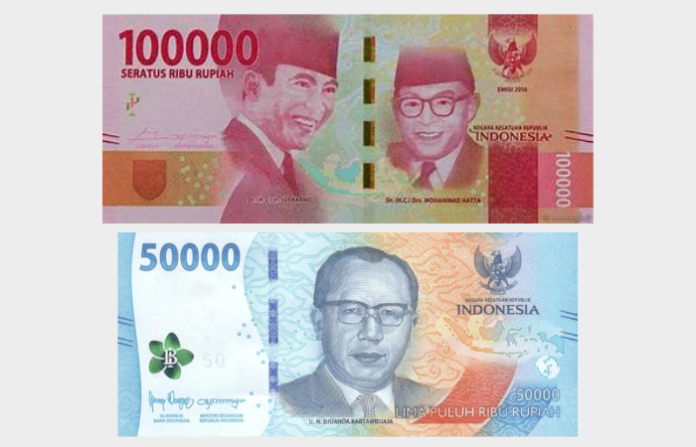
Sukarno and Mohammad Hatta on the Rp100,000 Note
Indonesia’s highest circulating banknote, the Rp100,000 denomination, features Sukarno and Mohammad Hatta, the nation’s founding fathers and Proclamation Heroes.
On August 17, 1945, Sukarno read Indonesia’s declaration of independence while Hatta stood beside him, marking the birth of the Republic of Indonesia. The two leaders later became Indonesia’s first president and vice president.
Their portraits have appeared on various Indonesian banknote designs for decades. They are also featured on the commemorative Rp75,000 banknote released in 2020 to celebrate the 75th anniversary of Indonesian independence. That special issue included advanced security features, including color-shifting and dynamic visual effects.
Juanda Kartawidjaja and the Djuanda Declaration
The blue Rp50,000 banknote displays Ir. Djuanda Kartawidjaja, Indonesia’s last prime minister, who served from 1957 to 1959 before the parliamentary system ended.
Djuanda is best remembered for the Djuanda Declaration of 1957, a landmark policy that asserted Indonesia’s sovereignty over the waters connecting its islands. The declaration became a cornerstone of Indonesia’s archipelagic-state concept and significantly strengthened the country’s maritime claims under international law.
His role in shaping Indonesia’s territorial integrity remains one of the most important achievements recognized by the government.
Sam Ratulangi and Frans Kaisiepo’s Contributions to National Unity
The Rp20,000 banknote features Dr. Sam Ratulangi, a politician, educator, journalist, and independence advocate from North Sulawesi.
Ratulangi earned a doctorate from the University of Zurich in Switzerland in 1919. He became known for his philosophy, “Si Tou Timou Tumou Tou,” often interpreted as the belief that people become truly human by helping others grow and develop. He also served on preparatory bodies involved in Indonesia’s independence process and later became the first governor of Sulawesi.
Meanwhile, the Rp10,000 banknote honors Frans Kaisiepo, a key figure in integrating Papua into Indonesia. He actively promoted Indonesian nationalism in Papua during Dutch colonial rule and became one of the region’s most prominent pro-independence leaders.
Kaisiepo later served as Governor of Irian Barat and was posthumously awarded the title of National Hero in 1993 for his lifelong efforts to support national unity.
Idham Chalid and Mohammad Husni Thamrin
The Rp5,000 banknote depicts K.H. Idham Chalid, one of Indonesia’s most influential political and religious leaders. He led Nahdlatul Ulama (NU) for more than three decades and held several senior government positions, including deputy prime minister, chairman of the DPR, and chairman of the MPR.
Beyond politics, Idham Chalid made significant contributions to education and social welfare through various initiatives aimed at expanding access to learning opportunities.
The Rp2,000 denomination features Mohammad Husni Thamrin, a prominent Betawi leader who advocated for indigenous Indonesians during the Dutch colonial era. As a member of the Volksraad, or People’s Council of the Dutch East Indies, Thamrin consistently pushed for greater rights and representation for local communities.
He also supported the development of Indonesian football by helping fund facilities for indigenous players during the colonial period.
Cut Nyak Meutia: The Heroine on the Rp1,000 Note
The Rp1,000 banknote honors Cut Nyak Meutia, one of Indonesia’s most respected female resistance fighters from Aceh.
She joined armed resistance against Dutch colonial forces and continued the struggle after the death of her husband, Teuku Cik Tunong. Leading troops in Aceh, she became a symbol of courage and determination during one of the most intense periods of anti-colonial resistance.
Cut Nyak Meutia was killed in battle on October 24, 1910, at the age of 40. Indonesia later recognized her contributions by granting her National Hero status.
The portrait used on the Rp1,000 banknote is not based on an authentic photograph. Historians note that no verified photograph of Cut Nyak Meutia exists, and the image on the currency is an artistic illustration representing Acehnese women of her era.
Indonesia’s banknotes therefore serve as more than a medium of exchange. They function as a living gallery of national heroes, reminding millions of citizens every day of the individuals whose sacrifices and leadership helped shape the nation’s history.