
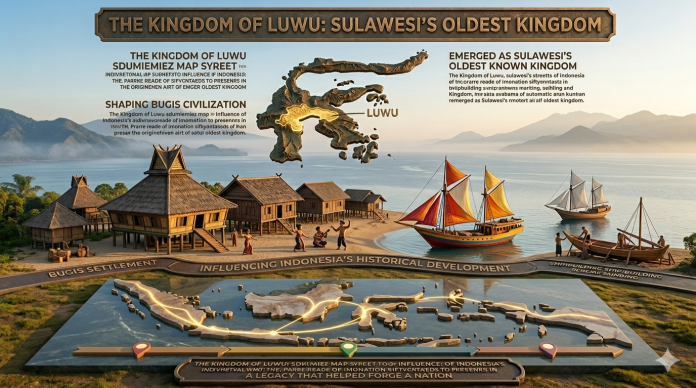

RADAR TULUNGAGUNG – The Kingdom of Luwu, widely regarded as the oldest known Bugis polity in Sulawesi, played a pivotal role in shaping the island’s early civilization and the cultural foundations that continue to influence modern Indonesia. Its emergence followed thousands of years of human settlement in Sulawesi, a region now recognized as one of the world’s most significant centers of prehistoric culture.
Archaeological discoveries indicate that humans inhabited Sulawesi tens of thousands of years ago. The Maros-Pangkep karst region contains prehistoric cave art, including hand stencils and animal depictions, dated to at least 40,000 years ago by an international research team led by archaeologist Maxime Aubert of Griffith University. The findings, published in Nature in 2014, challenged long-held assumptions that Europe was the exclusive birthplace of the world’s earliest cave art.
Long before kingdoms emerged, Sulawesi’s inhabitants lived as hunter-gatherers and later developed settled communities based on agriculture and local customs. These societies gradually established leadership structures, customary laws, and belief systems that laid the groundwork for organized political authority.
From Prehistoric Settlements to Organized Societies in Sulawesi
Historians identify the Kingdom of Luwu, or Kedatuan Luwu, as one of the earliest major Bugis states to emerge in South Sulawesi. While traditional Bugis literature associates Luwu with very ancient origins, modern archaeological research suggests the kingdom rose to prominence around the 13th to 14th centuries, becoming a major regional power through control of iron resources and strategic trade routes.
Located around the Gulf of Bone, Luwu benefited from access to rich iron deposits that supported the production of tools and weapons. Control of these resources strengthened its political influence and helped establish extensive trade networks across the Indonesian archipelago.
The kingdom was governed by a ruler known as a Datu, whose authority combined political leadership with spiritual legitimacy. Bugis traditions emphasized that rulers were responsible for maintaining harmony between society, customary law, and the natural world.
The cultural significance of Luwu is also reflected in La Galigo, the monumental Bugis epic that recounts the stories of legendary figures such as Sawerigading. Although historians regard many elements of the epic as mythological, it remains an invaluable source for understanding early Bugis social structures and cultural values.
Kingdom of Luwu Emerges as the Cradle of Bugis Civilization
The influence of the Kingdom of Luwu extended far beyond its own territory. Through migration, trade, and cultural exchange, Bugis traditions spread throughout South Sulawesi and contributed to the development of later kingdoms such as Bone, Wajo, and Soppeng.
By the 16th century, Sulawesi entered a new era marked by the rise of powerful maritime states. The Kingdom of Gowa-Tallo transformed Makassar into one of Southeast Asia’s most important trading centers. Historian Anthony Reid described Makassar as a leading commercial hub that attracted merchants from across Asia and Europe during the age of maritime trade.
A major turning point came in 1605 when the ruler of Gowa embraced Islam and adopted the title Sultan Alauddin. The spread of Islam across South Sulawesi occurred largely through political alliances and trade networks, blending with existing customs rather than replacing them.
Maritime Expansion, Islamization, and Colonial Pressures
The prosperity of Sulawesi’s kingdoms eventually drew the attention of European powers, particularly the Dutch VOC. Competition over trade routes led to escalating conflicts that culminated in the Makassar War between 1666 and 1669.
One of the most celebrated figures of this period was Sultan Hasanuddin, ruler of Gowa, who became renowned for resisting Dutch expansion. Despite fierce resistance, the conflict ended with the Treaty of Bongaya, which significantly weakened the sovereignty of South Sulawesi’s kingdoms and expanded VOC influence.
During the colonial era, traditional kingdoms gradually lost political authority. However, their cultural influence remained intact. Following Indonesia’s independence on August 17, 1945, many royal and customary leaders pledged support to the newly established Republic of Indonesia.
The Enduring Legacy of Sulawesi’s Historic Kingdoms
Today, institutions linked to Luwu, Bone, and other historical kingdoms continue to preserve genealogies, ceremonies, and customary laws. Values deeply rooted in Bugis and Makassar society, including honor, solidarity, deliberation, and resilience, remain influential in contemporary social life.
The story of the Kingdom of Luwu therefore represents more than the history of a single state. It reflects the evolution of Sulawesi from prehistoric settlements and maritime kingdoms into an integral part of modern Indonesia, while preserving traditions that continue to shape regional identity.
Although the political power of Sulawesi’s kingdoms has long since faded, their cultural legacy endures. From the ancient cave art of Maros-Pangkep to the rise of the Kingdom of Luwu and the maritime achievements of later Bugis and Makassar states, the island’s history remains a testament to the resilience, adaptability, and enduring identity of its people.