
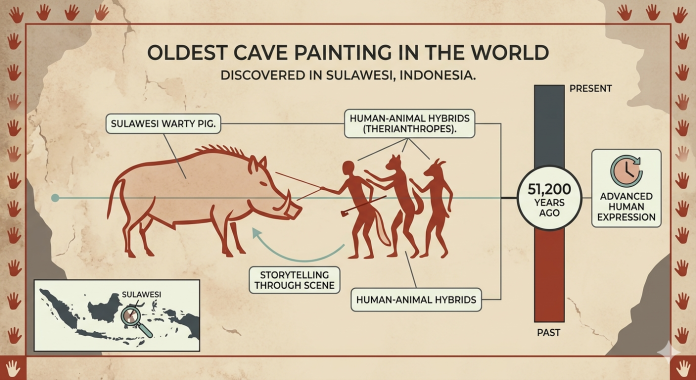

RADAR TULUNGAGUNG – The discovery of the oldest cave painting in the world in Sulawesi, Indonesia, is reshaping scientific understanding of human creativity and symbolic communication. Recent research shows that a cave painting in South Sulawesi dates back at least 51,200 years, making it the oldest known figurative artwork created by Homo sapiens.
The discovery has attracted global attention because it suggests that humans developed complex storytelling and symbolic thinking much earlier in Southeast Asia than scholars previously believed. For decades, researchers focused heavily on Europe when discussing prehistoric cave art. New evidence from Indonesia now challenges that long-standing perspective.
Within the limestone karst landscape of Maros-Pangkep in South Sulawesi, hundreds of prehistoric caves preserve hand stencils, animal depictions, and human-like figures that offer rare insights into ancient societies and their beliefs.
The Discovery That Rewrote Prehistoric Art History
The most significant recent discovery comes from Leang Karampuang cave, where researchers identified a painting depicting a human-like figure interacting with a wild pig. Scientific analysis published in 2024 concluded that the artwork is at least 51,200 years old, surpassing previous records for figurative cave art created by modern humans.
The finding follows a series of remarkable discoveries in the same archaeological region. In Leang Tedongnge, researchers documented a life-sized painting of a Sulawesi warty pig (Sus celebensis), dated to approximately 45,500 years ago. When it was announced in 2021, the artwork was recognized as the world’s oldest known figurative animal painting.
Another important site, Leang Bulu’ Sipong 4, contains a hunting scene estimated to be around 44,000 years old. The artwork depicts human-like figures pursuing animals with spears and ropes, making it one of the earliest known examples of narrative storytelling in visual form.
“These discoveries suggest that prehistoric people in Sulawesi were not merely creating isolated images but were also producing scenes that conveyed stories and interactions,” researchers have noted in studies examining the region’s cave art.
Evidence Challenges Europe-Centered Theories
For much of the twentieth century, scholars viewed Europe as the primary center of Paleolithic artistic innovation. Famous cave sites in France and Spain, including the Chauvet and Lascaux caves, shaped theories about the development of symbolic behavior among early humans.
However, discoveries in Sulawesi have challenged two major assumptions. The first was that human-like figures were relatively rare in early cave art. The second was that clear narrative compositions appeared only later in human history.
The Indonesian paintings demonstrate that both anthropomorphic imagery and storytelling scenes existed tens of thousands of years ago. This suggests that early Homo sapiens possessed sophisticated cognitive abilities and creative expression far earlier than many researchers once believed.
Indonesia’s prehistoric art heritage extends beyond Sulawesi. In East Kalimantan, researchers discovered cave paintings and hand stencils in more than 30 caves. Studies indicate that some of these artworks were created between roughly 52,000 and 40,000 years ago, placing them among the oldest examples of cave art anywhere in the world.
How Scientists Determine the Age of Cave Paintings
Dating ancient cave art remains one of archaeology’s greatest challenges. Traditional radiocarbon dating sometimes produces unreliable results because contamination from younger materials can distort measurements.
To overcome these limitations, scientists now rely on more advanced techniques. For the Sulawesi discoveries, researchers applied uranium-series dating to thin calcite layers that formed naturally above the paintings. By measuring radioactive decay within those mineral deposits, they established minimum ages for the artworks.
Ancient artists created the paintings with pigments derived from natural minerals and organic materials. Iron-rich ochre produced red and purple tones, while charcoal and manganese compounds generated black pigments. To make hand stencils, artists pressed their hands against cave walls and blew pigment around them, leaving distinctive negative impressions.
The discoveries contribute far more than artistic knowledge. The paintings help researchers understand human cognition, communication, and the relationship between ancient communities and their environment.
As scientists continue exploring Indonesia’s cave systems, they may uncover new evidence that further transforms our understanding of humanity’s earliest creative achievements. For now, the oldest cave painting in the world highlights Indonesia’s central role in the story of human artistic development more than 50,000 years ago.