
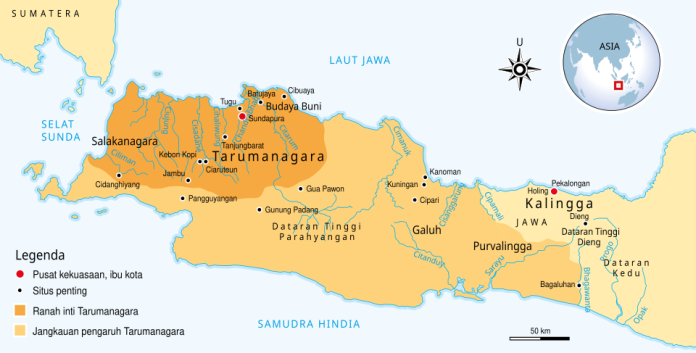

RADAR TULUNGAGUNG – The ancient kingdom of Tarumanagara in West Java emerged as one of Southeast Asia’s earliest centers of hydraulic engineering after King Purnawarman launched massive river dredging projects in the 5th century AD to combat destructive flooding. Historians and archaeologists now regard the effort as one of the earliest recorded public infrastructure projects in Indonesian history, helping save thousands of lives and strengthen Tarumanagara’s political power.
While the Western Roman Empire collapsed under waves of invasions across Europe, communities on Java faced a different threat. Seasonal floods repeatedly struck the heart of Tarumanagara, an early Hindu kingdom centered in present-day West Java. According to the famous Tugu Inscription, King Purnawarman answered the crisis with ambitious river engineering projects that transformed the kingdom’s landscape.
The king ordered workers to dredge the Candrabhaga River, which researchers widely identify as the modern Bekasi River. The project redirected floodwaters toward the sea and reduced disasters that threatened settlements and farmland.
Evidence Behind the Tarumanagara Kingdom
Tarumanagara remains the oldest historically verified kingdom on Java Island. Unlike the debated existence of Salakanagara, historians support Tarumanagara’s existence with inscriptions, archaeological discoveries, and Chinese historical records.
Researchers have identified several inscriptions linked to the kingdom, including the Ciaruteun Inscription, Pasir Koleangkak Inscription, Kebon Kopi Inscription, and Tugu Inscription. Ancient scribes wrote most of them in Sanskrit using Pallava script, which places the kingdom around the 5th century AD.
The inscriptions portray Purnawarman as a powerful and intelligent ruler who expanded his authority across western Java. The Lebak Cidanghiang Inscription describes him as brave and noble, while the Pasir Koleangkak Inscription praises the king’s military strength and impenetrable armor.
Chinese dynastic records also confirm Tarumanagara’s international connections. Records from the Liu-Song Dynasty mention a kingdom in Java that sent envoys to China in 435 AD. The New History of the Tang Dynasty later recorded a kingdom called “To-lo-mo,” which French archaeologist George Coedès associated with Taruma.
Archaeologists have also connected several ancient sites to Tarumanagara, including the Batujaya temple complex in Karawang and the Cibuaya archaeological site, where researchers discovered statues of Vishnu. Many scholars believe Batujaya dates to the same period as Tarumanagara, although experts still debate the exact relationship between the sites and the kingdom.
Purnawarman’s River Engineering and Political Expansion
The most remarkable achievement associated with Purnawarman remains the kingdom’s large-scale canal and river dredging projects. The Tugu Inscription records that during the 22nd year of his reign, the king ordered the excavation of the Gomati River, believed by some historians to correspond to the modern Cakung Lama River.
According to the inscription, workers completed a 12-kilometer waterway in just 21 days — a staggering feat for the 5th century, long before the existence of modern excavation equipment.
Historians believe the river projects served multiple purposes. Besides controlling floods, the canals likely improved irrigation, transportation, and agricultural productivity throughout western Java.
Purnawarman’s rule also reflected the growing influence of Indian political concepts in the archipelago. The king adopted the idea of the “Dewaraja,” or divine king, presenting himself as a sacred ruler associated with the Hindu gods Vishnu and Indra. The Ciaruteun Inscription compares the king’s footprints to those of Vishnu, while the Kebon Kopi Inscription links the royal elephant to Airavata, the mythical mount of Indra.
At the same time, historians note that Tarumanagara likely preserved many local Austronesian traditions. Scholars such as M.C. Ricklefs argued that pre-Indian societies in the archipelago were organized around tribal and regional alliances before evolving into mandala-style kingdoms influenced by Indian statecraft.
The Mystery Behind Tarumanagara’s Collapse
Despite its apparent prosperity, Tarumanagara eventually vanished from historical records. No inscription clearly identifies Purnawarman’s successor, and after the 7th century, references to the kingdom became increasingly scarce.
Some historians suspect that Srivijaya, the rising maritime empire from Sumatra, may have contributed to Tarumanagara’s decline. The Kota Kapur Inscription from 686 AD records a Srivijaya military expedition to Java, suggesting regional power struggles were already underway.
Modern historians also reject popular claims about the “12 Kings of Tarumanagara,” noting that the narrative largely originates from the controversial Wangsakerta Manuscripts, which many scholars consider a modern fabrication rather than an authentic ancient source.
Even with many unanswered questions surrounding his origins and death, Purnawarman remains one of the most influential rulers in early Indonesian history. His ambitious river engineering projects demonstrated how ancient kingdoms in the archipelago developed sophisticated solutions to environmental disasters centuries before modern technology existed.
Today, the legacy of Tarumanagara survives not only through inscriptions and ruins, but also through the enduring story of a ruler who transformed flood management into one of the earliest known infrastructure achievements in Indonesian civilization.