
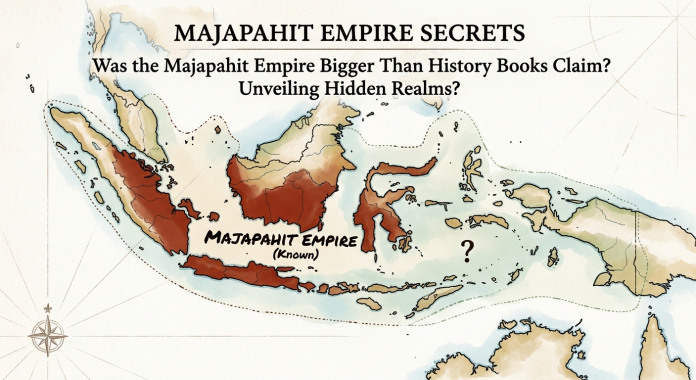

RADAR TULUNGAGUNG – A growing wave of alternative historical theories is challenging what we know about the Majapahit Empire, suggesting its influence may have extended far beyond conventional records. Could it be that what students learn in school represents only a fraction of the truth?
This question has sparked renewed interest among researchers and history enthusiasts, especially as discussions emerge about the possibility that Majapahit was not merely a regional kingdom, but a vast maritime empire with global connections.
Official historical accounts state that Majapahit was a Hindu-Buddhist kingdom founded in 1293 by Raden Wijaya. It reached its golden age under King Hayam Wuruk and his powerful prime minister Gajah Mada. During this era, Majapahit’s influence reportedly extended across much of Southeast Asia, including present-day Indonesia, Malaysia, Brunei, and parts of the Philippines.
However, some historians question the completeness and accuracy of these records.
Questioning Historical Sources
Much of what is known about Majapahit comes from ancient texts such as Nagarakretagama by Mpu Prapanca and Pararaton. While valuable, these sources are not without limitations.
Nagarakretagama is often seen as a royal glorification text, written to praise the ruling king. Meanwhile, Pararaton, compiled after Majapahit’s peak, blends history with mythology and legend. This raises an important question: were these narratives shaped by political motives?
Some scholars suggest that historical accounts may have been selectively edited by later powers to reshape the past and legitimize new regimes. If so, the true scale of Majapahit’s influence might have been intentionally minimized.
A Global Maritime Power?
Alternative theories propose that Majapahit was not just a regional force but a dominant maritime empire. According to these views, it possessed a powerful naval fleet and controlled extensive trade networks reaching India, China, the Middle East, and even East Africa.
References from Chinese and Indian travelers mention a powerful southern kingdom with advanced ports and formidable ships. These descriptions have led some modern researchers to compare Majapahit with global maritime powers like Venice or Carthage.
Archaeological evidence also adds weight to this theory. Artifacts such as Chinese and Persian ceramics dating back to the 14th century have been discovered in inland areas of Java and Kalimantan. These findings suggest the existence of complex trade routes and logistics systems.
Evidence Across Southeast Asia
Beyond Java, traces of Majapahit-style architecture have been found in Bali, Sumatra, and even southern Thailand. These similarities hint at cultural and political influence that may have extended further than officially documented.
The concept of Nusantara, famously declared in the Sumpah Palapa by Gajah Mada, is also central to this discussion. Some academics believe this vision of a unified archipelago reflects Majapahit’s broader geopolitical ambition, one that aligns with the idea of a large-scale empire.
Why Is the Record Limited?
If Majapahit was indeed as vast as these theories suggest, why is there so little concrete documentation?
One explanation points to the political transitions that followed Majapahit’s decline. Emerging powers in the archipelago may have deliberately downplayed its legacy to strengthen their own authority.
Colonial influence is another factor. European narratives often portrayed Southeast Asia as lacking advanced civilizations prior to Western arrival. This perspective may have contributed to the narrowing of Majapahit’s historical significance.
Between Fact and Theory
It is important to note that these ideas remain speculative and are not universally accepted in academic circles. However, they open up valuable discussions about how history is written and who gets to shape its narrative.
The story of the Majapahit Empire serves as a reminder that history is not always absolute. It evolves with new findings, interpretations, and perspectives.
As interest in Indonesia’s past continues to grow, so does the need for critical thinking and open dialogue. Whether Majapahit was truly a global empire or not, the exploration itself brings us closer to understanding the complexities of history.