
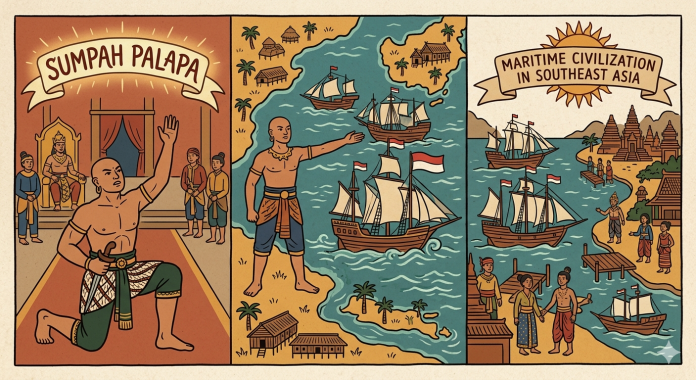

RADAR TULUNGAGUNG – The fall of a king often signals uncertainty, but in the case of the Majapahit Empire, it marked the beginning of one of the most ambitious visions in Southeast Asian history. Internal conflict among nobles and the fragile state of succession created a tense political climate. The throne, as portrayed in historical narratives, was never a symbol of comfort, it was a burden, “a fire” that could either destroy or forge greatness.
In this moment of instability, a defining figure emerged: Gajah Mada. His rise was not merely about power but about destiny. When asked if he could safeguard the kingdom, his response went beyond loyalty. He envisioned something far greater, the unification of Nusantara under one banner.
The bold declaration, later known as the Palapa Oath, became a turning point. Gajah Mada swore he would not indulge in worldly pleasures before conquering regions such as Bali and Sunda, along with the rest of Nusantara. This vow symbolized more than military ambition; it was a commitment to unity and political integration.
The Rise of a Visionary Leader
Gajah Mada’s leadership style stood out in a time when kingdoms often relied solely on brute force. He emphasized that Majapahit’s expansion was not about destruction but unification. His philosophy reframed conquest as a pathway to stability and shared identity across diverse regions.
Under his command, military campaigns were executed with precision. Yet, he also recognized that sustaining a vast empire required more than victories on the battlefield. Governance, trade systems, and loyalty among regions became equally critical. This dual approach allowed Majapahit to grow into a formidable maritime power.
Expansion Beyond Warfare
As Majapahit’s territory expanded, new challenges emerged. Managing a vast and culturally diverse region required strategic thinking. Gajah Mada understood that swords alone could not maintain order. He promoted the development of laws, trade networks, and administrative systems to ensure long-term stability.
This vision transformed Majapahit into more than a kingdom, it became a center of civilization. Maritime trade flourished, connecting various parts of Southeast Asia. The empire’s influence extended beyond politics into culture, economy, and social structures.
Unity as the Core Mission
The idea of unity remained central throughout Majapahit’s expansion. Rather than ruling through fear, the leadership aimed to foster allegiance. Regions were integrated into a broader system where loyalty and cooperation were key.
The narrative of inheritance also played a significant role. The ruler was not only seen as a successor of bloodline but also as a bearer of a grand vision, to preserve unity and ensure prosperity across Nusantara. This sense of purpose helped maintain cohesion despite the empire’s vast reach.
Legacy That Still Resonates
The story of Gajah Mada and the Majapahit Empire continues to resonate in modern Indonesia. The concept of Nusantara as a unified entity reflects a historical aspiration that predates the nation-state. His oath symbolizes determination, sacrifice, and the belief that unity can overcome division.
While debates about the extent and methods of Majapahit’s expansion persist, there is little doubt about its lasting impact. The empire set a precedent for governance, trade, and cultural integration in the region.
In the end, what began as a moment of crisis turned into a defining chapter of history. Through bold leadership and a vision that extended beyond immediate power, Majapahit rose to prominence, leaving behind a legacy that continues to inspire generations.